Data Sheet - Cessna 172
CESSNA 172M SKYHAWK · V Speeds Reference
Overview
This document is a data sheet for the Cessna 172, detailing essential specifications, weights, powerplant information, fuel system, landing gear, electrical system, and critical flight speeds. It serves as a quick reference for pilots and aviation enthusiasts, providing key operational data necessary for safe flight operations. The data sheet includes weight limits, engine specifications, fuel requirements, and V-speed references, which are crucial for flight planning and performance calculations.
- Empty Weight: 1481.1 lbs
- Maximum Takeoff Weight: 2400 lbs
- Engine: Lycoming O-320, 160 BHP
- Total Fuel Capacity: 43.0 gallons
- Best Glide Speed: 65 KIAS
- Stall Speed (Landing Configuration): 33 KIAS
- Never Exceed Speed: 158 KIAS
Document
Source
Originally published by www.purdueaviationllc.com. Sprinkle hosts a reference copy with an added summary, specifications and searchable full text.
Document details
- Type
- V Speeds Reference
- Year
- 2011
- Pages
- 2
- File size
- 91 KB
- Publisher
- www.purdueaviationllc.com
Specifications & performance
Extracted from this document.
Specifications
- Engine (hp)
- 160
- Engine model
- Lycoming O-320
- Empty weight (lb)
- 1,481.1
- Fuel capacity (gal)
- 43
- Max takeoff weight (lb)
- 2,400
Performance
- Max crosswind (kt)
- 15
- Best glide speed (kt)
- 65
- Stall speed clean (kt)
- 44
- Stall speed landing (kt)
- 33
V-speeds
- VA
- 82
- VR
- 55
- VX
- 60
- VY
- 76
- VFE
- 110
- VNE
- 158
- VNO
- 127
- VS1
- 44
- VSO
- 33
Weight & balance
- Useful load (lb)
- 918.9
- Max ramp weight (lb)
- 2,407
- Baggage allowance (lb)
- 120
- Max landing weight (lb)
- 2,400
- Max takeoff weight (lb)
- 2,400
Common. Rarer than 1% of the aircraft models we track.
Most owners only have the POH. Here's the essential set for the CESSNA 172M SKYHAWK.
- Pilot's Operating Handbook / AFM
- Checklist
- Maintenance Manual
- Parts Catalog (IPC)
- Systems & Wiring
- Service Bulletins
- Type Certificate (TCDS)
CESSNA 172M SKYHAWK for sale now

Free — save the 172M Skyhawk to your watchlist and track it in one place.
More CESSNA 172M SKYHAWKmanuals & documents
See all 31 →- Airborne Wave Relay® System (AWRS)Supplemental Type Certificate
- Supplemental Type CertificateSupplemental Type Certificate
- Cessna 172M N80168 Weight and BalanceWeight And Balance
- Cessna 172 M/N ChecklistChecklist
- 16-020-MT2901, Rev. 3 Instructions for Continued Airworthiness Tail ...Parts Catalog
- C172M MANUALAvionics Manual
- AAIB Bulletin: 4/2019Maintenance Manual
- Request for Legal Interpretation Regarding the Operation of an Aircraft Equipped with an Inoperative Rotating BeaconAirworthiness Directives
- CESSNA 172 TRAINING MANUALTraining Manual
- AVIATION INVESTIGATION REPORT A06Q0157 ENGINE FAILURE CESSNA 172M C-FFRVService Bulletins
- Airworthiness Directives; Hartzell Propeller Inc. ( )HC-( )(2,3)(X,V)( )-( ) Series and HA-A2V20-1B Series Propellers with Aluminum BladesAirworthiness Directives
- PILOT'S OPERATING HANDBOOK Cessna 1976 Skyhawk CESSNA MODEL 172MPilot's Operating Handbook
If you fly the CESSNA 172M SKYHAWK, you may also be researching these.


In this document
Weights
The document lists the empty weights for various aircraft numbers, with the primary example being 1481.1 lbs for aircraft number 63366. The maximum ramp weight is 2407 lbs for normal operations and 2107 lbs for utility operations. The maximum takeoff and landing weights are both 2400 lbs for normal and 2100 lbs for utility. Baggage weight limits are specified as 120 lbs for normal operations, with no baggage allowed in utility operations.
Powerplant
The Cessna 172 is equipped with a Lycoming O-320 engine, producing 160 BHP at 2700 RPM. It has four cylinders, is direct drive, horizontally opposed, air-cooled, and carburetor-equipped. The oil capacity is 7 quarts, with a minimum of 6 quarts for local flights and 7 quarts for cross-country flights. The recommended oil grades are 100W50 for summer and 65W30 for winter.
Fuel System
The aircraft has a total fuel capacity of 43.0 gallons, with 40.0 gallons usable. It uses approved fuel grades of 100LL (blue) and 100 (green). The fuel system consists of two vented tanks, a selector valve, a strainer, and a carburetor. For takeoff and landing, the fuel selector should be in the BOTH position.
Speeds
The document provides critical V-speeds for the Cessna 172: Best Glide Speed (65 KIAS), Stall in Landing Configuration (Vso 33 KIAS), Stall in Cruise Configuration (Vs1 44 KIAS), Rotate Speed (Vr 55 KIAS), Best Angle of Climb (Vx 60 KIAS), Best Rate of Climb (Vy 76 KIAS), and more. The Never Exceed speed (Vne) is 158 KIAS, and the demonstrated crosswind component is 15 knots.
Full document text
Lafayette Aviation Inc. Cessna 172 Data Sheet 3/23/11 Data Sheet - Cessna 172 Weights Aircraft Number Empty Weight Empty Moment Useful Load 63366 1481.1 lbs 57777.7 918.9 lbs 51204 62085 1482.9 1489.7 57760.2 57133.0 917.1 lbs 917.2 lbs *All Basic Empty Weights include wheel pants, subtract 15.4 pounds during winter months when wheel pants are removed. Maximum Weights Normal Utility Ramp Weight 2407 lbs. 2107 lbs. Takeoff Weight 2400 lbs. 2100 lbs. Landing Weight 2400 lbs. 2100 lbs. Baggage Weight 120 lbs. none Area 1 120 lbs. none Area 2 50 lbs. none Powerplant Engine: Lycoming O-320, 160BHP @ 2700 RPM. Four cylinders, direct drive, horizontally opposed, air cooled, carburetor-equipped. Oil: Full 7 qt. Min. for Local Flight 6 qt. Min. for X-Country 7 qt. Grade and Type Summer - 100W50 wt. Winter - 65W30 wt. Fuel System Fuel: Approved Grades 100LL (blue), 100 (green) Total Fuel 43.0 Gal. Total Usable 40.0 Gal. System Description: The airplane is equipped with a standard fuel system consisting of two vented fuel tanks, a fuel tank selector valve, fuel strainer, manual primer, and carburetor. Fuel flows by gravity from one or both tanks to the fuel selector, through a fuel strainer to the carburetor. From the carburetor, the fuel/air mixture flows to the cylinders. The fuel selector should be in the BOTH position for takeoff, climb, descent, landing, and maneuvers that involve prolonged slips or skids. Operation from either the LEFT or RIGHT position is reserved for level cruising flight only. Lafayette Aviation Inc. Cessna 172 Data Sheet 3/23/11 Landing Gear and Brakes System Description: Landing gear is fixed in the tricycle configuration with a steerable nosewheel. Nosewheel is steerable through a 10 degree arc each side of center. Differential braking increases the turning arc to 30 degrees each side of center. Nose strut is an air-oil type shock. Each main gear is equipped with a hydraulically activated single disk brake on the inboard side of each wheel. Tire Inflation: Mains 28 psi. Nose 34 psi. Electrical System Alternator - 28 volt, 60 ampere Battery - 24 volt System Description: Power is supplied to most general electrical items through the primary bus. All avionics are powered by the avionics bus. The two busses are tied together through the avionics power switch, which also functions as a circuit breaker for the avionics bus. The avionics power switch should be turned off prior to starting the engine to prevent harmful transient voltages from damaging the avionics equipment. The ammeter shows a charge or discharge on the battery and should remain at or near the zero indication after a brief charging period. Pitot-Static System System Description: The system is standard with a heated pitot head under the left wing and a static port on the left nose cowling. The alternate static source is located on the panel below the throttle and supplies static pressure from inside the cockpit. Speeds BEST GLIDE SPEED 65 KIAS Stall in landing configuration Vso 33 KIAS Stall in cruise configuration Vs1 44 KIAS Rotate Speed Vr 55 KIAS Best angle of climb Vx 60 KIAS Best rate of climb Vy 76 KIAS Maneuvering Speed Va 1600 lbs. 82 KIAS 2400 lbs. 99 KIAS Flaps extended Vfe 0-10° 110 KIAS 10-30° 85 KIAS Max. Structural Cruising Speed Vno 127 KIAS Enroute Climb Speed 75-85 KIAS Approach Speed 60-70 KIAS Never Exceed Vne 158 KIAS Demonstrated Crosswind Component 15 knots
227 CESSNA 172M SKYHAWK parts for sale
See all →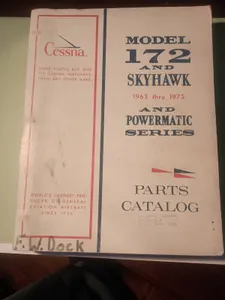
Parts listed for sale by vetted eBay sellers — confirmed on eBay at checkout.