
Cessna 404 Titan Pilot's Operating Handbook
Pilot's Operating Handbook for the Cessna 404 Titan
PDF, 80 pages, 7.3 MB, from Sprinkle’s own files.
What it covers
This Pilot's Operating Handbook (POH) is specifically designed for the Cessna 404 Titan, providing essential information for pilots operating this aircraft. It includes details on aircraft specifications, operating procedures, performance data, and safety information. The POH serves as a comprehensive guide for both new and experienced pilots, ensuring they have the necessary knowledge to operate the Cessna 404 Titan safely and efficiently. Key sections cover preflight checks, emergency procedures, and performance charts, all tailored to the unique characteristics of the Titan.
Key points
- Maximum takeoff weight: 5,500 lbs
- Wingspan: 50 ft 0 in
- Cruise speed: 200 knots
- Stall speed: 65 knots
- Service ceiling: 25,000 feet
Figures in this document
As the document states them. Check them against the PDF before you rely on one.
Specifications
- Engine model
- GTSIO-520
- Max takeoff weight (lb)
- 8,400
Performance
- Takeoff distance (ft)
- 2,658
Weight and balance
- Max takeoff weight (lb)
- 8,400
Main sections
Aircraft Specifications
The Cessna 404 Titan features a maximum takeoff weight of 5,500 lbs, a wingspan of 50 ft 0 in, and a length of 40 ft 6 in. The aircraft is powered by two Continental TSIO-520-U engines, each producing 300 horsepower.
Operating Procedures
Standard operating procedures for the Cessna 404 Titan include detailed checklists for preflight, takeoff, landing, and emergency situations. Pilots are advised to follow these procedures closely to ensure safe operation.
Performance Data
The Cessna 404 Titan has a maximum cruise speed of 200 knots and a stall speed of 65 knots. The service ceiling is approximately 25,000 feet, with a range of about 1,200 nautical miles.
Emergency Procedures
Emergency procedures include engine failure, electrical failure, and cabin depressurization. Each procedure is outlined step-by-step to assist pilots in managing in-flight emergencies effectively.
Weight and Balance
Weight and balance calculations are critical for safe flight operations. The POH provides charts and formulas to determine the center of gravity and ensure the aircraft is within weight limits.
Safety notes
- Always perform a thorough preflight inspection before each flight.
- Ensure weight and balance calculations are completed prior to departure.
- Follow emergency procedures as outlined in the POH.
The document’s text
Show the text read from the PDF
AIRCRAFT ACCIDENT REPORT 2/2001 Air Accidents Investigation Branch Department for Transport, Local Government and the Regions Report on the accident to Cessna 404 Titan, G-ILGW, Near Glasgow Airport on 3 September 1999 This investigation was carried out in accordance with The Civil Aviation (Investigation of Air Accidents and Incidents) Regulations 1996 London: The Stationery Office © Crown Copyright 2001 Published with the permission of the Department for Transport, Local Government and the Regions (Air Accidents Investigation Branch) on behalf of the controller of Her Majesty's Stationery Office. This report contains facts which have been determined up to the time of publication. This information is published to inform the aviation industry and the public of the general circumstances of accidents and serious incidents. Extracts can be published without specific permission providing that the source is duly acknowledged. ISBN 0 11 5523456 Standing Order Service Are you making full use of The Stationery Office's Standing Order Service? The Standing Order Service is a free monitoring of the publications of your choice from over 4,000 classifications in 30 major subject areas. We send you your books as they are published along with an invoice. With a standing order for class 03.01.029 (or 66.03.005 for Aircraft Accidents in Scotland only) you can be supplied automatically with further titles in this series as they are published. The benefits to you are: . • automatic supply of your choice of classification on publication • no need for time-consuming and costly research, telephone calls and scanning of daily publication lists saving on the need and the costs of placing individual orders We can supply a wide range of publications on standing order, from individual annual publications to all publications on a selected subject. If you do not already use this free service, or think you are not using it to its full capability, why not contact us and discuss your requirements? You can contact us at: The Stationery Office Standing Order Department PO Box 29 St Crispins Duke Street Norwich NR3 1GN Tel 0870 600 5522; fax 0870 600 5533 We look forward to hearing from you. LIST OF RECENT AIRCRAFT ACCIDENT AND INCIDENT REPORTS ISSUED BY THE AIR ACCIDENTS INVESTIGATION BRANCH 1/99 2/99 3/99 4/99 HS748 SERIES 2A, G-ATM at Liverpool Airport on 16 August 1996 Piper PA-31-350, CN-TFP 3 nm north-west of Jersey, Channel Islands on 12 June 1998 Report by the Dominican Republic Authorities Boeing 757-200, G-WJAN at Puerto Plata Airfield, Dominican Republic on 1 January 1998 Fokker F27-500, G-BNCY at Guernsey Airport, Channel Islands on 7 December 1997 1/2000 HS 748-2A, G-BIUV and G-BGMO 2/2000 on approach to Isle of Man (Ronaldsway) Airport on 6 June 1998 Fokker F27-600 Friendship, G-CHNL near Guernsey Airport, Channel Islands on 12 January 1999 3/2000 RAF Tornado GR1, ZA 330, and Cessna 152, G-BPZX at Mattersey, Nottinghamshire on 21 January 1999 Airbus A340-311, G-VSKY February 1999 February 1999 April 1999 July 1999 February 2000 April 2000 April 2000 4/2000 5/2000 1/2001 at London Heathrow Airport on 5 November 1997 Boeing 767-322ER, N653UA, at London Heathrow Airport on 9 January 1998 Boeing 747-436, G-BNLY, and Airbus A321, G-MIDF at London Heathrow Airport on 28 April 2000 August 2000 November 2000 June 2001 (iii) Department for Transport Local Government and the Regions Air Accidents Investigation Branch Berkshire Copse Road Aldershot Hampshire GU11 2HH The Right Honourable Stephen Byers Secretary of State for Transport and the Regions Sir, I have the honour to submit the report by Mr R StJ Whidborne, an Inspector of Air Accidents, on the circumstances of the accident to Cessna 404 Titan, G-ILGW, which occurred near Glasgow Airport on 3 September 1999. I have the honour to be Sir Your obedient servant KPR Smart Chief Inspector of Air Accidents (iv) Contents Glossary of abbreviations Synopsis Factual information Page (xi) 1 3 1 1.1 1.1.1 History of the flight Background 1.1.2 1.1.3 1.1.4 Early morning activity Accident flight preparations. Ground manoeuvres 3 3 4 33 1.1.5 The take-off 1.1.6 RT Messages 1.1.7 Eyewitness evidence 4 4 5 6 1.2 1.3 1.4 1.5 1.5.1 Injuries to persons Damage to the aircraft Other damage Personnel information Commander 7 7 7 1.5.2 2nd pilot. 1.6 Aircraft information 1.6.1 General information 1.6.2 Aircraft description 7 7 8 9 9 9 1.6.3 Flight Controls 1.6.4 Engines 1.6.4.1 Engine reliability 1000 1.6.4.2 Accessory gears and idler pin. 10 1.6.4.3 Starter adapter. 11 1.6.4.4 Engine and propeller controls. 12 1.6.5 Aircraft fuel system 12 1.6.6 Weight and Balance 12 1.6.6.1 Limitations 1.6.6.2 Weighing Report 1.6.6.3 Loadsheet 12 13 14 (v) 1.6.6.4.1 Aircraft weight 1.6.6.4.2 Payload weight 1.6.6.4.3 Take-off weight 1.6.6.4.4 Centre of Gravity 1.6.6.5 Operating speeds 14 15666 1.6.7 Service history of the GTSIO-520 engine 17 1.6.8 1.6.8.1 Maintenance history of G-ILGW Maintenance history of the left engine. 18 18 1.6.8.2 The right engine 19 1.6.9 Passenger and crew seating 19 1.7 Meteorological information 1.8 Aids to navigation 1.9 Communications. 20 222 20 20 1.10 Aerodrome and approved facilities 21 1.11 Flight recorders 21 1.12 Aircraft Examination 21 1.12.1 The accident site 21 1.12.2 Examination of the aircraft on site 21 1.12.3 Examination of the propellers . 23 1.12.3.1 The right propeller 1.12.3.2 The left propeller 1.12.4 Examination of the engines 1.12.4.1 The right engine 1.12.4.2 The left engine. 1.12.5 The left engine torsional viscous damper 1.12.6 Damper security 1.12.7 Detailed examination of the accessory gear train 2222222222229 23 24 24 24 24 25 27 28 (vi) 1.12.8 Fuel Selection . 28 1.12.9 Damage to seats and cabin floor 29 22 1.13 Medical and pathological information 29 1.14 Fire 1.15 Survival aspects 31 1.15.1 First aid 31 1.15.2 Scottish Ambulance Service response. 31 1.15.3 Rescue helicopter response 1.15.4 Injury assessments 32 32 ते ल ल ल ल लै लै 30 1.16 Tests and research 1.16.1 Flight tests 1.16.2 Airworthiness Flight Test Report 1.16.3 Survey of engines returned from service 1.16.4 Changes in seat and structural requirements 1.16.5 Simulation of impact dynamics 333333 34 35 35 37 1.17 Organisational and management information 1.17.1 The operating company. 38 38 1.18 Additional information 1.18.1 Performance Category. 1.18.2 Emergency Procedures 1.18.3 Safety actions. 39 39 39 39 1.19 Useful or effective investigation techniques 39 2 Analysis 39 2.1 Overview 2.1.1 Flight reconstruction 2.1.2 Wreckage analysis (vii) 39 39 40 2.1.3 The initiating event 41 2.2 Other factors 41 2.2.1 Aircraft loading 41 2.2.2 Pre take-off events 41 2.2.3 Flap position. 42 2.3 Event timing 43 2.4 Before the initiating event. 2.4.1 The take-off 2.4.2 The initial climb 43 43 45 2.5 The initiating event .45 2.5.1 2.5.2 The position of the aircraft when the bang was heard The source of the bang 45 2.5.3 The aircraft height when the initiating event occurred. 46 44 44 45 2.6 Practical engine failure identification 47 2.6.1 The commander's RT transmission 47 2.7 Events between the initiating event and the right turn Deviation to the left 47 2.7.1 2.7.2 The yaw to the left 48 2.7.3 Control of bank angle. 48 2.7.4 Misfiring noises 48 2.7.5 Climb performance 49 2.7.6 The relevance of propeller condition to climb performance 49 7 4 4 4 9 ↑ 47 2.8 Condition of the engines in flight 49 49 2.8.1 The left engine. 49 2.8.2 The right engine 50 2.8.3 Operating the wrong propeller RPM lever 51 2.8.4 Spluttering noises 51 (viii) 2.8.5 2.8.6 The commander's reaction to the spluttering Engine instrument indications. 51 2.8.7 The time of feathering the right propeller 52 53 2.9 Events during the turn 53 53 2.9.1 Total power loss 2.9.2 Loss of control 2.9.3 Explanation of the right propeller blade angle at impact SSS 53 54 54 2.10 The loss of power from the left engine 55 2.10.1 Summary of left engine damage 57 2.11 Progressive power loss in the left engine 2.12 Training and testing for pilots of light piston engine aircraft 58 59 2.12.1 The forced landing option 59 2.12.2 The commander's decision to return 60 2.12.3 2.12.4 Engine failure training and testing in light twin-engine aircraft Simulator training 60 61 2.13 The implications of Performance Category C 2.14 Survivability 3 3(a) 3(b) 4. 2.14.1 Aircraft seating Conclusions Findings. Casual Factors Recommendations (ix) 61 62 62 64 64 67 67 Appendices Appendix A: Glasgow Airport Chart and most probable flight path. Appendix B: Photographs of damaged accessory Gears, Crankshaft Gear, and Torsional viscous Damper from left engine. Appendix C: Detailed examination of the left engine accessory gears. Appendix D: Analysis of the rupture of the idler pin support. Appendix E: Investigations into torsional viscous dampers and accessory gears. (x) GLOSSARY OF ABBREVIATIONS USED IN THIS REPORT AAD AAIB Additional Airworthiness Directive nm Air Accidents Investigation Branch QAR agl above ground level QNH nautical miles(s) Quick Access Recorder corrected mean sea level pressure amsl above mean sea level RAF - Royal Air Force AFS Airfield Fire Serice RPM Revolutions per minute AOP Air Operator's Certificate RT radiotelephony APS Aircraft prepared for service SFB Strathclyde Fire Brigade ARCC Air Rescue Co-ordination Centre TCM ATC Air Traffic Control Temp AVGAS Aviation gasoline ΤΟ Teledyne Continental Motors Temperature Take-off BCAR British Civil Airworthiness Requirement UK United Kingdom USA United States of America CAA Civil Aviation Authority UTC Co-ordinated Universal Time CAP Civil Aviation publication CSB Continental Service Bulletin CICL CSB - Deg Cranfield Impact Centre Limited Critical Service Bulletin Degrees DERA - Defence Evaluation and Research Agency FAA - Federal Aviation Administration FAR Federal Aviation Regulations g hrs JAA JAR - IFR KIAS Lb gravity at standard sea level hours Joint Aviation Authorities Joint Aviation Requirement Instrument Flight Rules Knots indicated airspeed pounds Lg kilograms kt knot(s) MAUW - Maximum all-up weight Mb MTOW Millibar Maximum take-off weight (xi) Air Accidents Investigation Branch Aircraft Accident Report Registered Owner Operator Aircraft Type Nationality Registration Place of Accident Date and Time No: 2/2001 (EW/C99/9/01) Fraggle Leasing Limited Edinburgh Air Charter Limited Cessna Model 404 Titan Ambassador III British G-ILGW Blackstoun Farm approximately 1nm west of Glasgow Airport, Paisley, Strathclyde Latitude: 55° 51' North Longitude: 004° 29' West Altitude: 25 feet amsl 3 September 1999 at 1136 hrs All times in this report are UTC unless otherwise stated Synopsis The accident was notified to the Air Accidents Investigation Branch (AAIB) at 1250 hrs on 3rd September 1999 and an investigation began the same day. The investigation was conducted by Mr R StJ Whidborne (Investigator-in-Charge), Mr J J Barnett (Operations), Mr R D G Carter (Engineering), Mr C I Coghill (Engineering), Mr P Hannant (Operations) and Mr D S Miller (Operations). The aircraft had been chartered to transport an airline crew of nine persons from Glasgow to Aberdeen. The aircraft was crewed by two pilots and, so far as could be determined, its take-off weight was between 8,320 and 8,600 lb. The maximum permitted take-off weight was 8,400 lb. ATC clearance for an IFR departure was obtained before the aircraft taxied from the business aviation apron for take-off from Runway 23, with a take-off run available of 2,658 metres. According to survivors, the take-off proceeded normally until shortly after the aircraft became airborne when they heard a thud or bang. The aircraft was then seen by external witnesses at low height, to the left of the extended runway centreline, in a wings level attitude that later developed into a right bank and a gentle descent. Witnesses reported hearing an engine 1 spluttering and saw at least one propeller rotating slowly. There was a brief ‘emergency' radio transmission from the commander and the aircraft was seen entering a steep right turn. It then entered a dive. A witness saw the wings levelled just before the aircraft struck the ground on a northerly track. Three survivors were helped from the wreckage by a nearby farm worker before flames from a severe post-impact fire engulfed the cabin. The investigation identified the following causal factors: The left engine suffered a catastrophic failure of its accessory gear train leading to a progressive but complete loss of power from that engine. The propeller of the failed engine was not feathered and therefore the aircraft was incapable of climbing on the power of one engine alone. A total loss of thrust occurred once the left engine had failed and the right propeller had been feathered. The commander attempted to return to the departure airfield but lost control of the aircraft during a turn to the right. Three safety recommendations were made during the course of the investigation. 2 1 Factual Information 1.1 1.1.1 1.1.2 History of Flight Background The commander had been off duty for four days and not flown commercially for the operator since Sunday 29 August 1999. On that day he underwent a non- revenue proficiency check flight in G-ILGW with an authorised type-rating examiner. Later that Sunday he operated return revenue flights to and from Newcastle in the same aircraft. The commander was working at home on the day before the accident. That evening, on the instructions of the deputy chief pilot who had been instructed by the commander, G-ILGW was refuelled with 190 litres (292 lb.) of aviation gasoline resulting in a total fuel weight of 900 lb. The aircraft remained in the open air on the business aviation ramp at Glasgow where it was normally parked. Although the aircraft was certified for single-pilot operation, the airline charter contracts required the operator to crew the aircraft with two pilots. The commander operated a significant proportion of these flights himself and the same co-pilot often accompanied him. This person was qualified to fly the generic group of aircraft to which G-ILGW belonged but he was not qualified to operate revenue flights in a Cessna 404 as single pilot because he had not undergone the requisite type-specific checks and tests. His duties were chiefly to assist the commander with radio telephony and administration; consequently, a more appropriate description for his role was 'second pilot'. Early morning activity Some time after 0500 hrs UTC (0600 hrs local time) on the day of the accident the commander left his home to drive to the airstrip nearby where a company Cessna 402 aircraft had been parked for two days. He departed the private airstrip and flew to Glasgow Airport where he landed at 0632 hrs UTC. He then transferred to one of the company's Cessna 310 aircraft to operate a traffic survey flight. That flight took off from Glasgow Airport at 0710 hrs and returned at 0800 hrs. Shortly afterwards the commander drove from Glasgow Airport to the operator's headquarters at Edinburgh Airport. He left the company offices at about 0935 hrs to drive back to the business aviation centre at Glasgow Airport. He had arrived there by 1035 hrs and subsequently he met the second pilot who had driven from Edinburgh where he was based. 3 1.1.3 1.1.4 1.1.5 Accident flight preparations The two pilots briefed for the flight in the business aviation centre and walked to their aircraft. They were content to prepare it for flight without assistance and no one paid much attention to the aircraft or the pre-flight activities of the crew. The passengers were collected in a minibus from their offices near the airport's main terminal and were driven to the aircraft where they met the crew and handed over their bags. The crew loaded the bags into the nose lockers and the passengers boarded the aircraft. The commander was the last person to board; he gave a safety briefing to the passengers before taking his seat. With 11 persons on board the aircraft's take-off weight was usually close to the maximum permitted. In recent weeks the commander had initiated a programme of determining each passenger's weight, principally because he considered the alternative method of using the nominal weights prescribed by regulation was inaccurate and operationally restrictive. A weighing device was carried on the aircraft but none of the survivors recalled anyone being weighed or asked to give their weight to the handling agent or the crew before the flight. The crew did not leave a copy of the weight and balance sheet with the handling agents. Ground manoeuvres At 1126 hrs the second pilot requested ATC clearance to start engines for the flight to Aberdeen. Clearance was granted, the engines were started, and clearance to taxi was sought at 1128 hrs. None of the three surviving passengers recalled any engine starting difficulties. The aircraft was cleared to taxi and to hold before reaching the main taxiway. Whilst it was moving, but before the aircraft entered the taxiway, a witness near the aircraft heard the speed of the engines increase and decrease accompanied by what he considered misfiring sounds from the engines as their speed changed. However, the witness saw nothing untoward and none of the survivors recalled hearing any engine misfiring whilst the aircraft was taxiing. An aviation enthusiast near the holding point for Runway 23 took a colour photograph of G-ILGW just before it reached the Runway. The photograph showed the right side of the aircraft. The wing flaps were retracted and there were no visible signs of any abnormality. The take-off The aircraft was cleared to line-up on the runway behind a departing light aircraft and it taxied into position abeam Hold A near the runway threshold (see Appendix A) where it stopped. Clearance to take-off was given and the second pilot acknowledged the clearance at 11:33:43 hrs. According to a survivor the commander was handling the controls and he increased engine power before 4
Read from the PDF by machine, so tables and diagrams come out rough. The PDF is the document.
More Cessna 404 Titan documents
All 21 →- Cessna 404 Titan Model Guide
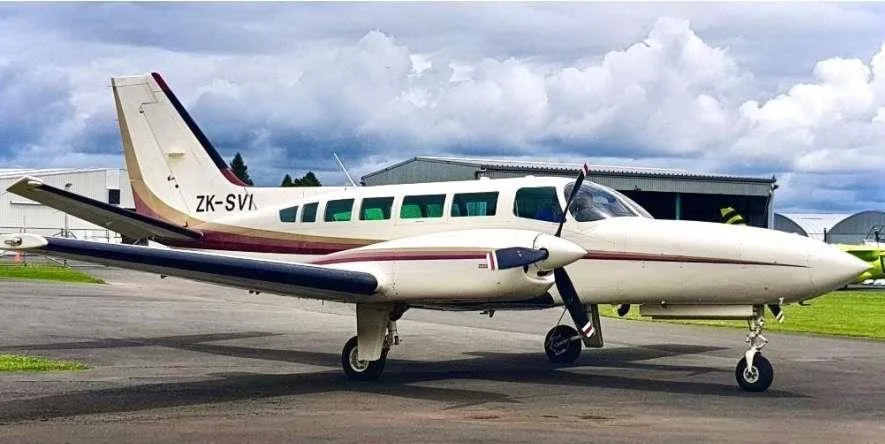
The Cessna 404 Titan is an unpressurised, low-wing light twin piston aircraft, built from 1976 to 1982. It has two crew and nine passengers (8 to 10 seats in the library entry; the type certificate allows a maximum of 11). It grew out of the 402B, with a larger wing, a 35-inch fuselage stretch and large fowler flaps. Two Continental GTSIO-520-M engines power it. Maximum takeoff weight is 8,400 lb (3,810 kg).
- Fumes event involving Cessna 404, VH-LAD
This document is an investigation report by the Australian Transport Safety Bureau (ATSB) regarding a serious incident involving a Cessna 404 Titan aircraft on April 11, 2024. The aircraft was conducting an aerial survey flight when the crew experienced cabin fumes, leading to a return to Emerald Airport. The report outlines the events leading up to the incident, the crew's response, and the findings of the investigation. It emphasizes the importance of using supplemental oxygen and being aware of potential hazards posed by fumes in the cabin. The report serves to enhance safety awareness and inform operators about the risks associated with airborne contaminants.
- Controlled flight into terrain involving Cessna 404, VH-OZO
This document is an accident investigation report by the Australian Transport Safety Bureau (ATSB) concerning a Cessna 404 aircraft, registered VH-OZO, which was involved in a controlled flight into terrain (CFIT) incident on March 11, 2020. The report details the circumstances leading to the accident, including the flight's approach to Lockhart River Airport under instrument flight rules (IFR) in adverse weather conditions. It examines the pilot's actions, the aircraft's performance, and the regulatory environment surrounding the operation. The report aims to identify contributing factors to the accident and provide safety recommendations to prevent similar occurrences in the future.
- AHAC-INCID-01-2019, Cessna 404 Titan Matricula HR-AYD
This document is an investigation report concerning an aviation incident involving a Cessna 404 Titan aircraft, registration HR-AYD. The report is structured to comply with international aviation regulations and aims to prevent future accidents by analyzing the incident's circumstances. It includes factual information about the flight, injuries, damages, and the aircraft's condition. The investigation was conducted by the Honduran Civil Aviation Authority (AHAC) and includes recommendations for safety improvements based on the findings. The document serves as a critical resource for aviation safety and compliance, particularly for operators of the Cessna 404 Titan.
- Type Acceptance Report TAR 8/21B/8 – Cessna 404
This Type Acceptance Report provides detailed information on the Cessna Model 404, which has been granted type acceptance in New Zealand based on validation of FAA Type Certificate number A25CE. The report outlines the aircraft's certification details, operational requirements, and compliance with New Zealand regulations. It serves as a reference for operators and regulatory bodies, ensuring that the Cessna 404 meets the necessary standards for airworthiness and operational safety. The document includes specifications for the aircraft, including its maximum takeoff weight, seating capacity, and engine details, as well as information on the certification process and any applicable requirements for operation in New Zealand.
- Cessna 404 Systems Description
This document is a parts catalog for the Cessna 404 Titan, detailing various components and assemblies related to the aircraft's exhaust system. It includes part numbers, descriptions, and maintenance recommendations for specific parts. The catalog serves as a reference for maintenance personnel and technicians responsible for the upkeep of the Cessna 404, ensuring that they have the necessary information to perform inspections and replacements as required. The document emphasizes the importance of regular inspections and the use of specific materials, such as Inconel, which require careful handling and inspection due to their unique properties.
- Engine-driven fuel pump – material substitution
This document is an investigation report by the Australian Transport Safety Bureau (ATSB) concerning the crash of a Cessna 404 Titan aircraft (VH-ANV) on August 11, 2003. The report details the circumstances surrounding the engine failure that led to the crash, specifically focusing on the failure of the engine-driven fuel pump (EDFP) due to the use of inappropriate materials in its repair. The investigation revealed that the pump had been overhauled using a non-original material for the bearing, which ultimately led to its failure. The report also discusses the implications of material selection in aviation maintenance and the oversight responsibilities of the Civil Aviation Safety Authority (CASA).
- Airworthiness Directive Schedule Aeroplanes Cessna 404 Series
This document is an Airworthiness Directive (AD) schedule specifically for the Cessna 404 series aircraft, issued by the CAA of New Zealand on November 29, 2007. It outlines mandatory modifications, inspections, and replacements required to maintain the airworthiness of the Cessna 404 aircraft. The directives are applicable to various serial numbers within the Cessna 404 range and address critical components such as the nose landing gear actuator, engine beam, fuel systems, and passenger seats. Compliance with these directives is essential for ensuring safety and operational integrity, and the document provides specific timelines for compliance based on flight hours or calendar dates.
Cessna 404 for sale now
View all 2 for sale →Aircraft that this pilot's operating handbook covers, listed on the sites Sprinkle reads. Asking prices, not sales. Cessna 404 asking prices by year built.
Also useful for the Cessna 404 Titan
From Sprinkle’s library of aircraft documents. PDFs open from Sprinkle’s own files. Read Aug 7, 2026.
Want this document taken down? Request removal