BOEING BBJ Model Guide
BOEING BBJ · Model Guide
Overview
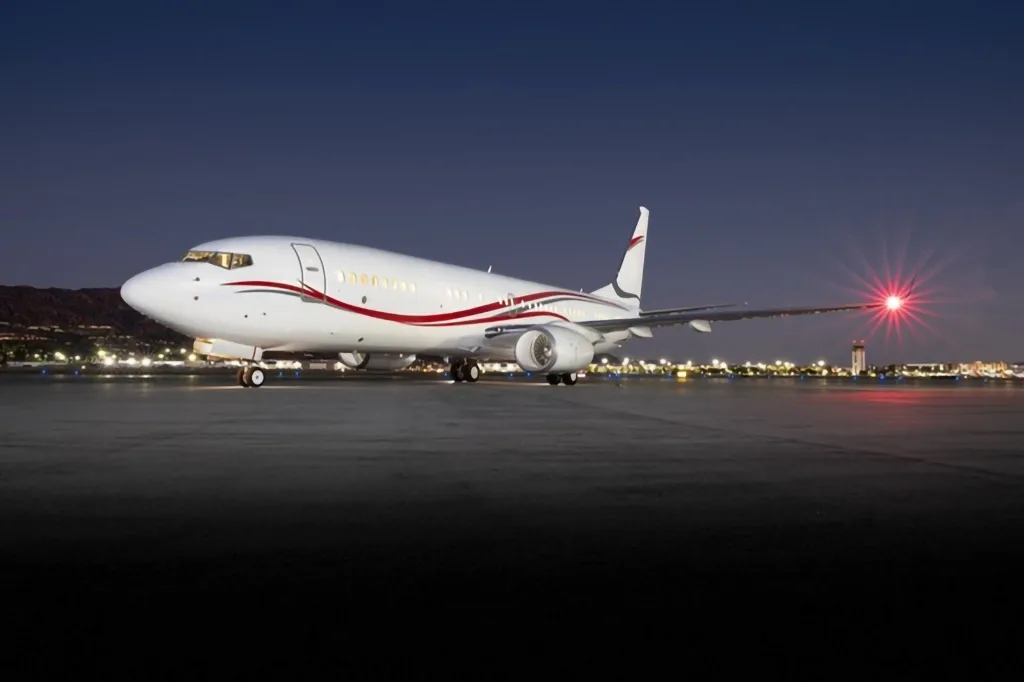
BOEING BBJ is the business-jet version of the Boeing 737, a turbofan jet. The registry has no BBJ-specific seat, range or year data. The 737 family figures here (up to 230 passengers, 3800 nm range, 460 kt cruise, 41000 ft ceiling) are context only. The documents are service bulletins, which show what to check before buying.
- The registry gives no BBJ-specific specs. The 737 family reaches up to 230 passengers and 3800 nm, so confirm your airframe's own figures.
- APB bulletin AP737-27-002 lists 737-700IGW (BBJ) line numbers 101 through 684 as Group 3 for a stabilizer trim limit correction.
- Boeing bulletin 737-28A1206 covers a center fuel tank boost pump shutoff change on 737-700 airplanes. Ask for proof of compliance.
Summary written by AI from the source document. Check the original before relying on it. See which parts of Sprinkle are written by AI.
Reference only, not for flight. Use the current approved manual for your aircraft. See terms, section 5.
Document
Source
Copy found at sprinkle.com. Sprinkle hosts a reference copy with an added summary, specifications and searchable full text.
Document details
- Type ·
- Model Guide
- Year ·
- 2026
- File size ·
- 44 KB
- Copy found at ·
- sprinkle.com
Does the registry give specs for BOEING BBJ?
No. The BOEING BBJ record has no seats, years, range or weights. Only 737 family maxima exist: up to 230 passengers, 3800 nm and 460 kt. Verify your airframe's own data.
Which BOEING BBJ airplanes does the trim bulletin name?
AP737-27-002 names 737-700IGW (BBJ) line numbers 101 through 684 as Group 3. These are airplanes whose original light plates were not replaced under APB737-27-001.
What should I ask a BOEING BBJ seller to show?
Ask for records showing AP737-27-002 and 737-28A1206 were done, including AD 2008-24-51 and the center tank boost pump shutoff functional test.
What is the BOEING BBJ Model Guide?
The BOEING BBJ Model Guide is a model guide for the BOEING BBJ, dated 2026.
What year was the BOEING BBJ Model Guide published?
The BOEING BBJ Model Guide — the BOEING BBJ model guide on file — is dated 2026.
Common. One of the most common aircraft types we track.
Most owners only have the POH. Here's the essential set for the BOEING BBJ.
- Pilot's Operating Handbook / AFM
- Checklist
- Maintenance Manual
- Parts Catalog (IPC)
- Systems & Wiring
- Service Bulletins on file
- Type Certificate (TCDS)
BOEING BBJ for sale now
Free — save the 737 to your watchlist and track it in one place.
More BOEING BBJmanuals & documents
Related documents
- BOEING 767-300ER Model GuideBOEING 767-300ER · Model Guide
- BOEING 757-200 Model GuideBOEING 757-200 · Model Guide
- Aviation Partners Boeing Service Bulletin AP737-27-002BOEING BBJ · Service Bulletins
- BEECHCRAFT B200GT Model GuideBEECHCRAFT B200GT · Model Guide
- AIRBUS A330 Model GuideAIRBUS A330 · Model Guide
If you fly the BOEING BBJ, you may also be researching these.


In this document
Family-level context
The registry covers the whole 737 family, from the 737-100 Series to the 737-9 and 737-8200. Family maxima: range up to 3800 nm, cruise up to 460 kt, service ceiling up to 41000 ft, MTOW up to 89700 kg. These are not BBJ figures. Get the airframe's own performance data.
Trim limit service bulletin
AP737-27-002 (Revision 4, April 24, 2017) applies to 737-700 airplanes with APB Blended Winglets installed under STC. Group 3 is 737-700IGW (BBJ) line numbers 101 through 684 whose original light plates were not replaced under APB737-27-001. Work: relocate one stabilizer warning switch, replace the control stand light plates, update FMC software. Part 1 is estimated at 2.5 man-hours.
Fuel boost pump bulletin
Bulletin 737-28A1206 Revision 2 (May 21, 2009) followed a report that a 737-700's left center tank boost pump did not shut off in flight. Boeing found wire W0040-6402-14 terminated at the wrong terminal block. It must go on TB5060F, position 5. FAA mandated AD 2008-24-51 on November 18, 2008.
Summary written by AI from the source document. Check the original before relying on it. See which parts of Sprinkle are written by AI.
Safety notes
- Uncorrected, the nose-up trim limit sits too far aft. The airplane could become uncontrollable at takeoff if the crew mistrims full nose-up in an aft-light loading.
- A miswired center tank boost pump may keep running after OFF is selected. A dry-running, overheated pump could be an ignition source in a fuel tank.
Summary written by AI from the source document. Check the original before relying on it. See which parts of Sprinkle are written by AI.
Full document text
BOEING BBJ Model Guide BOEING BBJ is the business-jet version of the Boeing 737, a turbofan jet. The registry has no BBJ-specific seat, range or year data. The 737 family figures here (up to 230 passengers, 3800 nm range, 460 kt cruise, 41000 ft ceiling) are context only. The documents are service bulletins, which show what to check before buying. • The registry gives no BBJ-specific specs. The 737 family reaches up to 230 passengers and 3800 nm, so confirm your airframe's own figures. • APB bulletin AP737-27-002 lists 737-700IGW (BBJ) line numbers 101 through 684 as Group 3 for a stabilizer trim limit correction. • Boeing bulletin 737-28A1206 covers a center fuel tank boost pump shutoff change on 737-700 airplanes. Ask for proof of compliance. Family-level context The registry covers the whole 737 family, from the 737-100 Series to the 737-9 and 737-8200. Family maxima: range up to 3800 nm, cruise up to 460 kt, service ceiling up to 41000 ft, MTOW up to 89700 kg. These are not BBJ figures. Get the airframe's own performance data. Trim limit service bulletin AP737-27-002 (Revision 4, April 24, 2017) applies to 737-700 airplanes with APB Blended Winglets installed under STC. Group 3 is 737-700IGW (BBJ) line numbers 101 through 684 whose original light plates were not replaced under APB737-27-001. Work: relocate one stabilizer warning switch, replace the control stand light plates, update FMC software. Part 1 is estimated at 2.5 man-hours. Fuel boost pump bulletin Bulletin 737-28A1206 Revision 2 (May 21, 2009) followed a report that a 737-700's left center tank boost pump did not shut off in flight. Boeing found wire W0040-6402-14 terminated at the wrong terminal block. It must go on TB5060F, position 5. FAA mandated AD 2008-24-51 on November 18, 2008. Safety notes: • Uncorrected, the nose-up trim limit sits too far aft. The airplane could become uncontrollable at takeoff if the crew mistrims full nose-up in an aft-light loading. • A miswired center tank boost pump may keep running after OFF is selected. A dry-running, overheated pump could be an ignition source in a fuel tank.