
AD/CESSNA 180/89 - Crew Seat Back Cylinder Lock Modification
Service Bulletins for the Cessna 180
PDF, 2 pages, 24 KB, from Sprinkle’s own files.
What it covers
This document is an Airworthiness Directive (AD) issued by the Civil Aviation Safety Authority of Australia, specifically addressing safety modifications required for the Cessna 180 and related models. The directive mandates the installation of modification kits for the crew seat back cylinder lock assembly to prevent potential failures that could lead to unsafe conditions during flight. It outlines specific compliance timelines based on the aircraft's time-in-service and provides detailed instructions for both installation and inspection procedures. The AD aims to enhance safety by addressing reported issues with the seat lock assembly that could result in uncontrolled seat movement during flight.
Key points
- Modification Kit MK172-25-10C must be installed for applicable aircraft without prior modifications.
- Inspection is required for aircraft with Modification Kit MK172-25-10A or MK172-25-10B installed.
- Compliance timelines vary: 4 months for >1,000 hours TIS, 8 months for 501-1,000 hours TIS, and 12 months for 0-500 hours TIS.
- The AD aims to prevent seat back assembly failures that could lead to safety issues during flight.
- Effective date of the AD is April 11, 2007.
Main sections
Applicability
The AD applies to Cessna 180, 182S (Serial Numbers 18280001 through 18280944), Cessna 182T (Serial Numbers 18280945 through 18281701), and Cessna T182T (Serial Numbers T18208001 through T18208453).
Requirement
The directive requires the installation of Modification Kit MK172-25-10C for aircraft without previous modifications. For those with Modification Kit MK172-25-10A or MK172-25-10B, an inspection is mandated to ensure compliance with the AD.
Compliance
Compliance timelines are specified based on the aircraft's time-in-service (TIS). For aircraft over 1,000 hours TIS, actions must be completed within 4 months; for 501 to 1,000 hours TIS, within 8 months; and for 0 to 500 hours TIS, within 12 months.
Background
The AD was prompted by reports of failures in the crew seat back cylinder lock assembly, which could lead to uncontrolled seat movement and potential safety hazards during flight.
Safety notes
- Failure of the crew seat cylinder lock assembly could cause uncontrolled movement of the seat back, leading to potential accidents.
- Backward collapse of the crew seat could result in abrupt pitch-up during flight.
The document’s text
Show the text read from the PDF
COMMONWEALTH OF AUSTRALIA (Civil Aviation Safety Regulations 1998), PART 39 - 105 CIVIL AVIATION SAFETY AUTHORITY SCHEDULE OF AIRWORTHINESS DIRECTIVES Page 1 of 2 AIRWORTHINESS DIRECTIVE For the reasons set out in the background section, the CASA delegate whose signature appears below issues the following Airworthiness Directive (AD) under subregulation 39.001(1) of CASR 1998. The AD requires that the action set out in the requirement section (being action that the delegate considers necessary to correct the unsafe condition) be taken in relation to the aircraft or aeronautical product mentioned in the applicability section: (a) in the circumstances mentioned in the requirement section; and (b) in accordance with the instructions set out in the requirement section; and (c) at the time mentioned in the compliance section. Cessna 180, 182 and Wren 460 Series Aeroplanes AD/CESSNA 180/89 Crew Seat Back Cylinder Lock Modification 5/2007 DM Applicability: Cessna 182S (Serial Numbers 18280001 through 18280944), Cessna 182T (Serial Numbers 18280945 through 18281701) and Cessna T182T (Serial Numbers T18208001 through T18208453). Requirement: 1) Aeroplanes that do not have Modification Kit MK172-25-10A or Modification Kit MK172-25-10B installed, for each crew seat (pilot and copilot), install Modification Kit MK172-25-10C or fabricate and install a steel lock rod/bar. Follow Cessna Single Engine Service Bulletin SB04-25-01, Revision 4, dated December 26, 2006, for installing Modification Kit MK172-25-l0C, or, follow Cessna Single Engine Service Bulletin SB04-25-02, Revision 1, dated October 17, 2005, or Revision 2, dated June 5, 2006, for fabricating and installing a steel lock rod/bar. 2) Aeroplanes that have Modification Kit MK172-25-10A or Modification Kit MK172-25-10B installed: (i) For each crew seat (pilot and co-pilot), perform an installation inspection in accordance with Cessna Single Engine Service Bulletin SB04-25-01, Revision 4, dated 26 December 2006. (ii) If you do not find any discrepancies during the inspection required in paragraph (2)(i) of this AD, make a log book entry showing compliance with this AD and no further action is required. (iii) If you find discrepancies during the inspection required in paragraph (2)(i) of this AD, make all necessary corrective actions in accordance with Cessna Single Engine Service Bulletin SB04-25-01, Revision 4, dated 26 December 2006. Note: FAA AD 2007-05-10 Amdt 39-14971 and Cessna Service Bulletins SB04-25-01 and SB04-25-02 refer. Compliance: 1) For aeroplanes over 1,000 hours time-in-service (TIS) on the effective date of this AD, perform the action within the next 4 months after the effective date of this AD; or For aeroplanes from 501 to 1,000 hours TIS on the effective date of this AD, perform the action within the next 8 months after the effective date of this AD; or -- 1 of 2 -- COMMONWEALTH OF AUSTRALIA (Civil Aviation Safety Regulations 1998), PART 39 - 105 CIVIL AVIATION SAFETY AUTHORITY SCHEDULE OF AIRWORTHINESS DIRECTIVES Cessna 180, 182 and Wren 460 Series Aeroplanes AD/CESSNA 180/89 (continued) Page 2 of 2 For aeroplanes from 0 to 500 hours TIS on the effective date of this AD, perform the action within the next 12 months after the effective date of this AD. 2) For aeroplanes meeting Requirement 2: (i) Within the next 30 days after the effective date of this AD. (ii) Before further flight after the inspection required in paragraph 2(i) of this AD. (iii) Before further flight after the inspection required in paragraph 2(i) of this AD. This Airworthiness Directive becomes effective on 11 April 2007. Background: This AD results from reports of the crew seat back cylinder lock assembly failing at the aft end area and other cylinder lock assemblies found cracked. The actions specified in this AD are intended to prevent the crew seat cylinder lock assembly from bending, cracking, or failing. This failure could cause uncontrolled movement of the seat back, resulting in possible backward collapse during flight. Backward collapse of either crew seat back could result in an abrupt pitch-up if the affected crew member continues to hold on to the control yoke during this failure and could cause difficulty in exiting the airplane from an aft passenger seat after landing. David Villiers Delegate of the Civil Aviation Safety Authority 9 March 2007 -- 2 of 2 --
Read from the PDF by machine, so tables and diagrams come out rough. The PDF is the document.
More Cessna 180 documents
All 32 →- Cessna 180 Service Bulletins
This Airworthiness Bulletin (AWB 28-013) addresses the over-wing fuel tank vent systems in early Cessna 180 models manufactured between 1953 and 1955. It highlights the potential dangers associated with the single point dynamic air pressure fuel tank venting systems and flexible rubber bladder fuel tanks. The bulletin aims to inform operators about the risks of fuel siphoning and erroneous fuel gauge readings due to vent blockage, particularly in icing conditions. It also outlines recommendations for operators to assess their aircraft's fuel tank installations and implement necessary modifications to enhance safety.
- ALERT SERVICE BULLETIN - Hartzell Propeller
This document is an Alert Service Bulletin issued by Hartzell Propeller Inc. regarding the replacement of propellers on Cessna 180 aircraft equipped with floats. Specifically, it addresses the Hartzell PHC-(C,G)3YF-1RF/F7691( ) propeller, which has been reported to not provide adequate thrust for climb performance when installed on Cessna 180 aircraft with floats. The bulletin outlines the compliance requirements for replacing this propeller with the PHC-(C,G)3YF-1RF/F8468A-6R model. The document includes detailed instructions for compliance, including warnings about the consequences of non-compliance, and provides information on the necessary materials and estimated labor hours for the replacement process. It also discusses the weight and balance implications of the new propeller and lists recommended repair facilities for installation.
- AIRWORTHINESS DIRECTIVE AD/CESSNA 180/84 KAP 140 Autopilot System
This document is an Airworthiness Directive (AD) issued by the Civil Aviation Safety Authority (CASA) concerning the Cessna 180 and related models. It addresses the Honeywell KAP 140 autopilot system, which has been reported to engage inadvertently, potentially leading to unsafe flight conditions. The directive outlines necessary actions for compliance, including software updates and restrictions on replacement parts. It is crucial for operators of the affected aircraft models to adhere to these requirements to ensure safety and airworthiness. The directive is effective from September 30, 2004, and includes specific compliance timelines for the required actions.
- SEB95-3 R1 - McFarlane Aviation
This document is a service bulletin issued by Cessna Aircraft Company, specifically addressing the inspection of flap supports and the installation of roller washers for various Cessna models, including the Cessna 172. The bulletin emphasizes the importance of these inspections to prevent potential wear and damage to flap supports, which could lead to loss of flap control. The compliance with the inspection is mandatory, with specific timelines provided for initial and repeat inspections. The document includes detailed instructions, required parts, and compliance guidelines to ensure ongoing airworthiness of the aircraft.
- SERVICE BULLETIN - Wing X Stol
This Service Bulletin (SB-1-96) addresses the lower main spar cap at Wing Station 100.00 for Cessna 180, 182, and 185 series aircraft equipped with specific wing extensions. It outlines mandatory inspection and reinforcement procedures to ensure structural integrity due to the absence of an angle stiffener in early model wings. The bulletin is crucial for maintaining safety and compliance with design requirements, as static testing has indicated that modified wings without the stiffener do not meet necessary standards. Compliance is mandatory, and the bulletin provides detailed instructions for inspection and installation of a reinforcing strap if needed.
- AD/CESSNA 180/67 Aileron Balance Weight 1/84 - CASA
This document is an Airworthiness Directive issued by the Civil Aviation Safety Authority of Australia, specifically addressing modifications and inspections required for Cessna 180 and 182 series aircraft. It focuses on the aileron balance weights for models 180 through 180K and 182 through 182R. The directive outlines the necessary steps to determine if the aircraft has been modified according to specific Supplemental Type Certificates (STCs) and provides guidance on measuring and replacing aileron balance weights to ensure safe operation. Compliance with these directives is critical to prevent potential aileron flutter, which could lead to catastrophic failure during flight.
- CESSNA 180 Model Guide
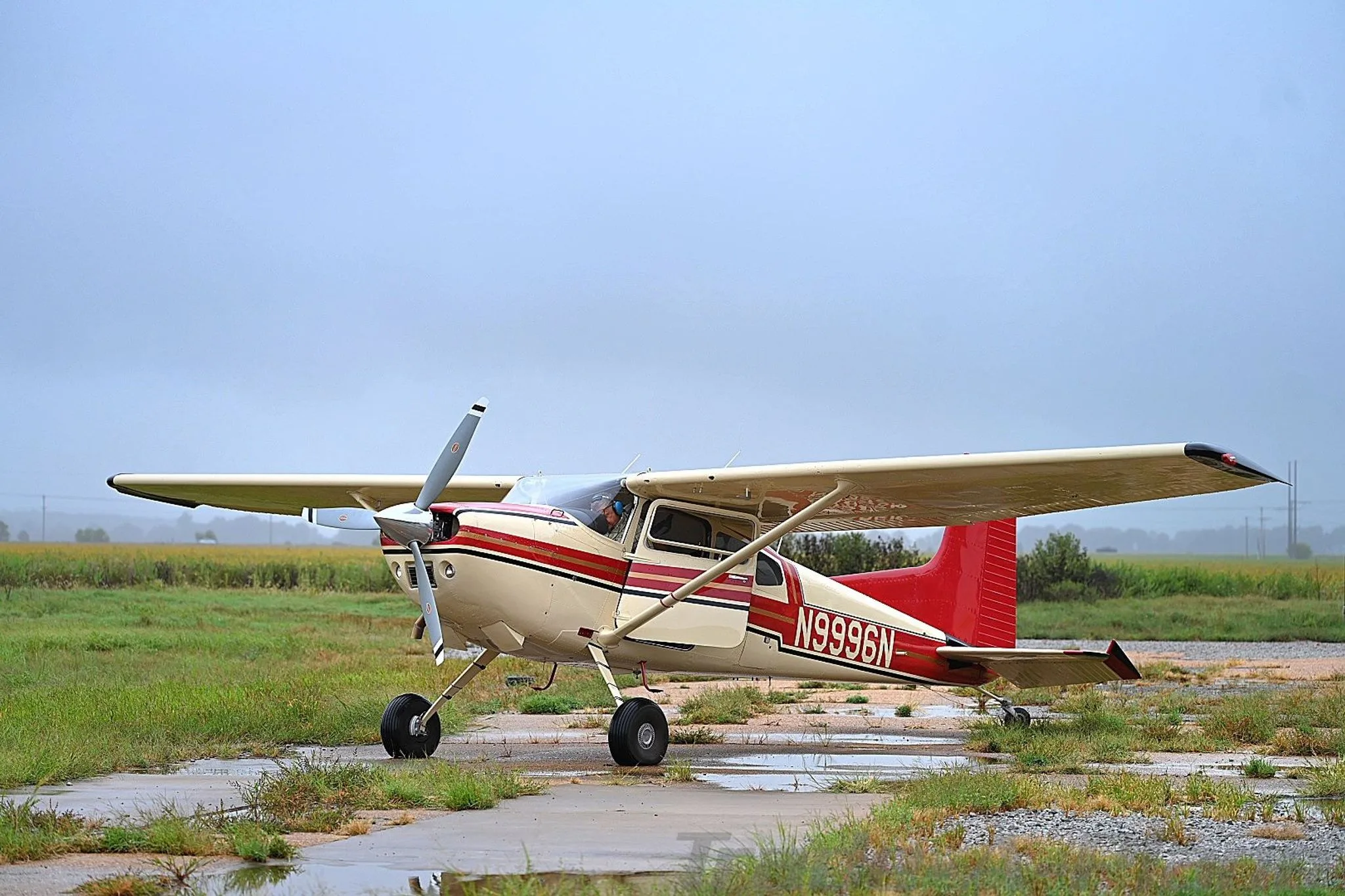
The CESSNA 180 (Skywagon) is a single-engine piston, tailwheel utility airplane. The figures below come mainly from the 1979 Model 180K handbook: a Continental O-470-U of 230 BHP, a constant-speed McCauley propeller, 84 gallons usable fuel and an 2800 lb takeoff weight. The type spans Models 180 through 180K. Early models seat 4 and the 180G through 180K seat 6. Weights, engines and equipment differ a lot between years. The library record for this model lists a 300 hp IO-520 and a 3525 lb maximum takeoff weight. That does not match the 180K handbook or the type data, so check any airplane against its own papers.
- Instructions For Continued Airworthiness - Hartzell Propeller
This document provides Instructions for Continued Airworthiness (ICA) for Cessna 180 and 180K aircraft, as well as Cessna 182 and F182 models, equipped with Continental O-470 engines and utilizing a Hartzell DHC-G2YF-1BFP/F8068+2 propeller. It outlines the maintenance requirements, airworthiness limitations, and propeller specifications necessary for compliance with FAA regulations. The ICA serves as a supplement to the existing Cessna service manuals, detailing specific procedures and time limits for maintenance checks. This document is essential for aircraft owners, maintenance personnel, and operators to ensure the continued safety and airworthiness of their aircraft.
Cessna 180 for sale now
View all 23 for sale →Aircraft that this service bulletins covers, listed on the sites Sprinkle reads. Asking prices, not sales. Cessna 180 asking prices by year built.

Also useful for the Cessna 180
From Sprinkle’s library of aircraft documents. PDFs open from Sprinkle’s own files. Read Jun 26, 2026.
Want this document taken down? Request removal