
Normal Procedures for Cessna 210
Normal Procedures for the Cessna 210
PDF, 10 pages, 6.7 MB, from Sprinkle’s own files.
What it covers
This document serves as a comprehensive guide for the Normal Procedures associated with the Cessna 210 aircraft. It is intended for pilots and aviation enthusiasts who operate or are interested in this specific model. The manual outlines standard operating procedures, checklists, and critical information necessary for safe and efficient flight operations. It emphasizes the importance of following established protocols to ensure safety and compliance with aviation regulations.
Key points
- Always perform a thorough preflight inspection before each flight.
- Follow the engine start checklist to ensure proper startup procedures.
- Adhere to V-speeds during takeoff and landing for optimal performance.
- Maintain communication with air traffic control during all phases of flight.
- Review emergency procedures regularly to ensure readiness.
Figures in this document
As the document states them. Check them against the PDF before you rely on one.
Specifications
- Range (nm)
- 800
- Engine (hp)
- 285
- Height (ft)
- 8.8
- Length (ft)
- 28.8
- Propeller
- Hartzell 3-blade
- Wingspan (ft)
- 36.1
- Engine model
- Continental IO-520
- Empty weight (lb)
- 1,800
- Fuel capacity (gal)
- 65
- Rate of climb (fpm)
- 1,000
- Service ceiling (ft)
- 20,000
- Max takeoff weight (lb)
- 3,600
Performance
- Fuel burn (gph)
- 12
- Landing over 50ft
- 1,200
- Takeoff over 50ft
- 1,500
- Landing distance (ft)
- 1,000
- Takeoff distance (ft)
- 1,200
Weight and balance
- Useful load (lb)
- 1,800
- Max ramp weight (lb)
- 3,620
- Baggage allowance (lb)
- 200
- Basic empty weight (lb)
- 1,800
- Max landing weight (lb)
- 3,600
- Max takeoff weight (lb)
- 3,600
Main sections
Preflight Procedures
This section details the necessary steps before flight, including aircraft inspections, fuel checks, and weight and balance calculations. Pilots are advised to verify that all systems are operational and that the aircraft is within weight limits.
Engine Start Procedures
The engine start procedures outline the correct sequence for starting the Cessna 210's engine, including pre-start checks and monitoring engine parameters during startup.
Takeoff Procedures
This section covers the takeoff checklist, including flap settings, engine performance checks, and runway alignment. It emphasizes the importance of adhering to V-speeds during takeoff.
In-Flight Operations
In-flight operations include guidelines for maintaining altitude, navigation, and communication protocols. It also discusses handling in-flight emergencies.
Landing Procedures
Landing procedures provide a checklist for approach and landing, including speed management, flap deployment, and final approach checks.
Safety notes
- Ensure all safety equipment is functional before flight.
- Monitor engine instruments closely during startup and flight operations.
The document’s text
Show the text read from the PDF
ATLANTIC AERO Serving the World through Aviation DAS 7 SO Atlantic Aero, Inc. POST OFFICE BOX 35408 GREENSBORO, NC 27425-5408 FAA APPROVED "PILOTS OPERATING HANDBOOK AND FAA APPROVED AIRPLANE FLIGHT MANUAL" SUPPLEMENT FOR CESSNA 210N SERIAL NUMBER 21062955 THROUGH 21064897 Serial No.: Registration No.: 210-63828 N-2306D This Supplement must be attached to the "Pilot's Operating Handbook and FAA Approved Airplane Flight Manual" when the Teledyne Continental Motors 10-550-P engine and Hartzell propeller Model PHC-J3YF- RF/F7691() are installed in accordance with Supplemental Type Certificate ST02029AT-D dated May 26, 2000. The information contained herein supplements or supersedes the information in the basic handbook only in those areas listed herein. For limitations, procedures and performance information not contained in this Supplement, consult the basic "Pilot's Operating Handbook and FAA Approved Flight Manual". FAA Approved: Original signed by Richard J. Gritter DAS Coordinator Atlantic Aero, Inc. DAS 7 SO FAA Approved: DAS Coordinator Atlantic Aero, Inc. DAS 7 SO FAA APPROVED Date: April 28, 2000 Revised: June 01, 2001 Page 1 of 10 15393101, Rev. A ATLANTIC AERO Serving the World through Aviation DAS 7 SO Pilot's Operating Handbook and FAA Approved Airplane Flight Manual Supplement For Cessna 210N Log of Revisions GENERAL Revision Number Description Pages FAA Approval Affected and Date Basic Initial Release All Bilal atte DAS Coordinator April 28, 2000 PF/F7391 A Corrected low Pitch Blade Angle 4,5 Batte DAS Coordinator Corrected Wording. 7 June 1, 2001 Removed description of 10 landing gear warning. System unchanged Motor from original. Revised wording on rated, direct drive fuel pump switch. FAA APPROVED ous Power rated at 2700 RPM Page 2 of 10 Date: April 28, 2000 15393101, Rev. A evised: June 01, 2001 ATLANTIC AERO Serving the World through Aviation DAS 7 SO Pilot's Operating Handbook and FAA Approved Airplane Flight Manual Supplement For Cessna 210N SECTION 1 GENERAL ud) INTRODUCTION The installation consists of replacement of the standard 10-520-L engine and propeller with a TCM IO-550-P engine and Hartzell PHC-J3YF-1RF/F7691() propeller. DESCRIPTIVE DATA ENGINE Number of Engines:. Engine Manufacturer:.......... Engine Type:........ 1 Teledyne Continental Motors. .Normally aspirated, direct drive, .air cooled, horizontally opposed, fuel injected, six cylinder engine with 550 cu. in. displacement. Horsepower Rating and Engine Speed: Maximum Continuous Power: .310 rated BHP at 2700 RPM. PROPELLER Propeller Manufacturer:. Propeller Model Number: ....Number of Blades: .Hartzell Propeller, Inc. PHC-J3YF-1RF/F7691() 3 Page 3 of 10 FAA APPROVED 15393101, Rev. A Date: April 28, 2000 Revised: June 01, 2001 A ATLANTIC AERO Serving the World through Aviation DAS 7 SO Pilot's Operating Handbook and FAA Approved Airplane Flight Manual Supplement SECTION 1 GENERAL (Continued) DESCRIPTIVE DATA (Continued) Propeller Diameter: Maximum:....... Minimum:...... Propeller Type:...... For Cessna 210N 78 inches 77 inches Constant speed and hydraulically actuated, with a low pitch setting .........of 14.0° and a high pitch setting | of 31.0 measured at the 30 inch station. SECTION 2 LIMITATIONS POWERPLANT LIMITATIONS Engine Manufacturer: .......... .... Teledyne Continental Motors Engine Model Number:.... Engine Operating Limits for Continuous Operations: Maximum Power, Continuous:......... Maximum Engine Speed, Continuous:........ IO-550-P 310 BHP .2700 RPM Fuel Pressure: nimum:....... viaximum:.... .3.5 PSI 22.3 PSI FAA APPROVED Page 4 of 10 15393101, Rev. A Date: April 28, 2000 Revised: June 01, 2001 A AILANTIC AERO Serving the World through Aviation DAS 7 SO Pilot's Operating Handbook and FAA Approved Airplane Flight Manual Supplement SECTION 2 LIMITATIONS (CONTINUED) POWERPLANT LIMITATIONS (CONTINUED) For Cessna 210N Propeller Manufacturer: Hartzell Propeller Inc. Propeller Model Number: ..... PHC-J3YF-1RF/F7691() Propeller Diameter: Maximum:.. Minimum:...... 78 inches 77 inches Propeller Blade Angle at 30 inch Station: Low: ....... h:.. 14.0° +/-0.1° I .31.0° +/- 1.0° POWERPLANT INSTRUMENT MARKINGS Tachometer: Green Arc:.. 2200 thru 2550 RPM (Normal Operating Range) Red Line:..... 2700 RPM (Maximum) Fuel Flow (Pressure): Red Line:........ .... 3.5 PSI (Minimum) Green Arc:... 42-102 LBS/HR (Normal Operating Range) Red Line:... 170 LBS/HR (22.3 PSI) (Maximum) FAA APPROVED Page 5 of 10 Date: April 28, 2000 15393101, Rev. A Revised: June 01, 2001 ATLANTIC AERO Serving the World through Aviation DAS 7 SO Pilot's Operating Handbook and FAA Approved Airplane Flight Manual Supplement For Cessna 210N SECTION 2 LIMITATIONS (CONTINUED) S PLACARDS Near Tachometer: Do not exceed 20 inches manifold pressure uste below 2200 RPM Near fuel flow/manifold pressure gauge: Mary Fuel ng may be on throttle MIN. FUEL FLOW AT FULL THROTTLE S.L. 2700 R.P.M. 150 LBS/HR 4000 FT. 127 LBS/HR 8000 FT. 112 LBS/HR in the position may indicate card. Around the auxiliary fuel pump switch: ON ON HIGH LOW FAA APPROVED Date: April 28, 2000 Page 6 of 10 15393101, Rev. A Revised: June 01, 2001 ATLANTIC AERO Serving the World through Aviation DAS 7 SO Pilot's Operating Handbook and FAA Approved Airplane Flight Manual Supplement For Cessna 210N SECTION 3 EMERGENCY PROCEDURES ENGINE-DRIVEN FUEL PUMP FAILURE Failure of the engine-driven fuel pump will be evidenced by a sudden reduction in the fuel flow indication prior to a loss of power while operating from a fuel tank containing adequate fuel. In the event of an engine-driven fuel pump failure, immediately move the HIGH portion of the Auxiliary Fuel Pump switch to the ON position. Manual leaning may be required for engine smoothness depending on throttle position. Land as soon as practical. WARNING If normal fuel flow and engine operation are not established within 3-5 seconds after activating the RPM HIGH position the Auxiliary Fuel Pump, turn the Auxiliary Fuel Pump OFF. Lack of a flow indication with the HIGH portion in the ON position may indicate a broken fuel line that can lead to a fire hazard. Page 7 of 10 Date: April 28, 2000 15393101, Rev. A Revised: June 01, 2001 FAA APPROVED r Έ 63 a ATLANTIC AERO Serving the World through Aviation DAS 7 SO Pilot's Operating Handbook and FAA Approved Airplane Flight Manual Supplement For Cessna 210N SECTION 4 NORMAL PROCEDURES STARTING ENGINE SECTION Use the Auxiliary Fuel Pump Switch HI portion for priming the engine. Turn Switch OFF after priming. NORMAL AND SHORT FIELD TAKEOFF Power:...... NORMAL CLIMB Power:. ture: FULL THROTTLE AND 2700 RPM 25 inches Hg. and 2550 RPM Lean to 120 LBS/HR BALKED LANDING Power:... FULL THROTTLE and 2700 RPM FAA APPROVED Date: April 28, 2000 Revised: June 01, 2001 Page 8 of 10 15393101, Rev. A == ΓΕ 16 ≈ (V a FR A ATLANTIC AERO Serving the World through Aviation DAS 7 SO Pilot's Operating Handbook and FAA Approved Airplane Flight Manual Supplement For Cessna 210N SECTION 5 DESC PERFORMANCE MS Performance is either unchanged or improved with installation of the IO-550-P engine and PHC-J3YF-1RF/F7691() propeller. SECTION 6 WEIGHT AND BALANCE The weight and moment of added items is as follows: ITEM WEIGHT (LBS) ARM (IN) MOMENT (IN-LB) IO-550-P ENGINE 465 -17.5 7945 PHC-J3YF-1RF/F7691() 77.3 -44 -3401 PROPELLER NOTE: The weight and moment of the removed engine and propeller must be accounted for when changing the overall aircraft weight and balance. FAA APPROVED Date: April 28, 2000 Revised: June 01, 2001 1000. 0 Page 9 of 10 15393101, Rev. A ATLANTIC AERO Serving the World through Aviation DAS 7 SO Pilot's Operating Handbook and FAA Approved Airplane Flight Manual Supplement SECTION 7 For Cessna 210N DESCRIPTION OF SYSTEMS FUEL SYSTEM AUXILIARY FUEL PUMP OPERATION The auxiliary fuel pump is a dual speed, dual pressure pump activated by a yellow and red split-rocker type switch located on the left side of the instrument panel. The yellow right half of the switch is labeled LOW, and its ON position is used for increasing fuel flow and minor vapor purging. The red left half of the switch is labeled HIGH, and its ON position is used in the event of an engine-driven fuel pump failure. The HIGH pump position is also used for priming during normal starting and for extreme vapor purging. Maximum fuel flow is produced when the HIGH side of the switch is placed in the ON position. In this position, an interlock within the switch also trips the LOW side of the switch to the ON position. When the HIGH side of the switch is turned OFF, the LOW side will remain in the ON position until manually returned to the OFF position. WARNING Continued used of the HIGH side will cause an overly rich mixture if the engine-driven fuel pump is so operating. Manual leaning will be required to prevent engine roughness and possible engine stoppage due to excessive richness. FAA APPROVED Date: April 28, 2000 Revised: June 01 2001 =7 ar th ua Page 10 of 10 15393101, Rev. A 17 v. IF
Read from the PDF by machine, so tables and diagrams come out rough. The PDF is the document.
More Cessna 210 documents
All 23 →- CESSNA 210 Model Guide
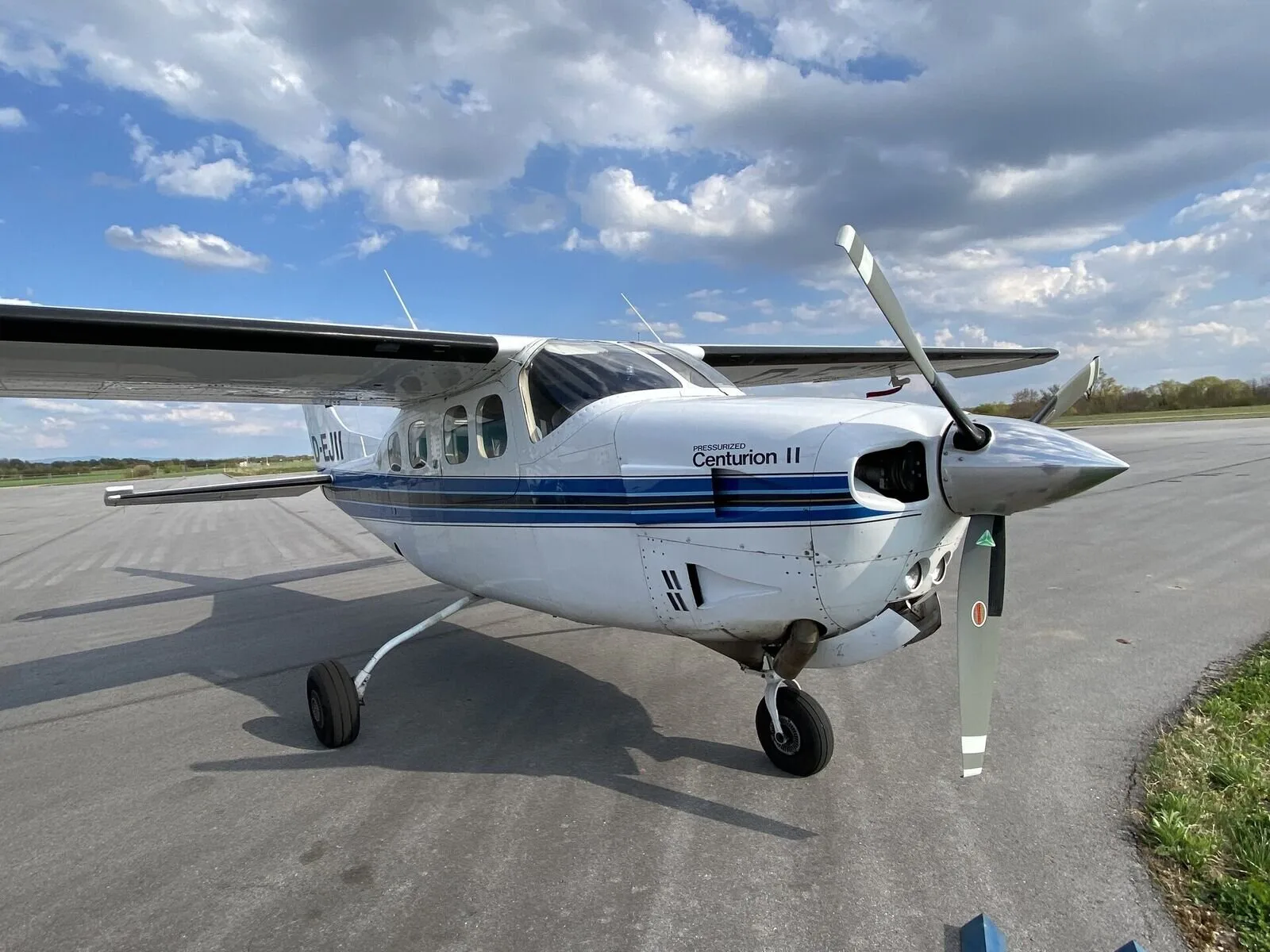
The CESSNA 210 is a single-engine piston aircraft. Library data lists a 285 hp Teledyne Continental IO-520-L46B with a 3-blade Hartzell variable-pitch propeller, 65 gal of fuel, 1800 lb useful load and 3600 lb max takeoff weight. Cruise is 130 kt with a stated range of 800 nm. Figures vary by variant, so check them against the specific serial number.
- Service Bulletin SB-14 - McFarlane Aviation
This Service Bulletin SB-14, issued by McFarlane Aviation on December 8, 2025, addresses a critical issue regarding the MC0743624-2 Shimmy Dampener Assembly used in various Cessna 210 model aircraft. The bulletin highlights an interference problem between the shimmy dampener and the nose gear door and linkage, which necessitates the removal of the affected dampener from all installations on the specified aircraft models. The document outlines compliance requirements, identification methods for affected parts, and detailed instructions for removal and return of the shimmy dampener assembly. It is essential for aircraft operators to adhere to this bulletin to ensure safety and compliance with maintenance regulations.
- AIRWORTHINESS BULLETIN Cessna Single Engine Electro-Hydraulic Undercarriage Retraction Systems
This Airworthiness Bulletin (AWB) addresses safety concerns related to the electro-hydraulic undercarriage retraction systems in Cessna single-engine aircraft, specifically focusing on the Cessna 210. It alerts pilots, operators, and maintainers to the risks of fire and smoke in the cockpit due to potential malfunctions of the hydraulic power pack. The bulletin highlights incidents of overheating and electrical failures that have led to in-flight cabin fires, urging compliance with recommended safety measures. The document serves as a critical reference for ensuring the safe operation of the undercarriage system and preventing incidents related to hydraulic power pack failures.
- Request for Legal Interpretation of 14 C.F.R. §§ 91.403(c) and 43.16 Concerning Whether Requirements in an Airworthiness Limitations Section (ALS) Developed By a Design Approval Holder (DAH) and Approved by the Federal Aviation Administration (FAA) as a Change to Type Design
This document is a legal interpretation from the FAA regarding the applicability of Airworthiness Limitations Sections (ALS) added to the maintenance manuals of Cessna Model 210 aircraft. It addresses whether these newly added ALS requirements are mandatory for operators and maintainers of older Cessna 210 models that were type-certificated before the new ALS was approved. The document clarifies that unless an Airworthiness Directive (AD) is issued, the new ALS is not retroactively mandatory for older aircraft. It emphasizes the importance of understanding the type design of the aircraft in relation to compliance with maintenance requirements. The interpretation is significant for owners, operators, and maintenance providers of Cessna 210 aircraft, as it outlines the legal framework governing the enforcement of maintenance procedures and the implications of changes in type design.
Maintenance Manual · 2015PDF · 5 pages · 6.5 MB of Request for Legal Interpretation of 14 C.F.R. §§ 91.403(c) and 43.16 Concerning Whether Requirements in an Airworthiness Limitations Section (ALS) Developed By a Design Approval Holder (DAH) and Approved by the Federal Aviation Administration (FAA) as a Change to Type Design, opens in a new tabRequest removal of Request for Legal Interpretation of 14 C.F.R. §§ 91.403(c) and 43.16 Concerning Whether Requirements in an Airworthiness Limitations Section (ALS) Developed By a Design Approval Holder (DAH) and Approved by the Federal Aviation Administration (FAA) as a Change to Type Design - Backdoor Rulemaking? | Savvy Aviation
This document is a maintenance manual revision for the Cessna 210 series aircraft, published by Cessna Aircraft Co. on February 10, 2014. It introduces a new section titled 'Airworthiness Limitations' (ALS), which outlines mandatory inspection intervals and replacement times for critical components of the aircraft. The document emphasizes the regulatory implications of the ALS, particularly in relation to FAA regulations that govern aircraft maintenance. It is intended for aircraft owners, maintenance personnel, and aviation enthusiasts who need to understand the compliance requirements associated with the Cessna 210. The manual highlights the importance of adhering to the ALS to ensure airworthiness and safety in operations.
- SERVICE LETTER SEL-29-01 Revision 1: Hydraulic Power Pack Inspection
This document is a service letter from Cessna detailing the inspection procedures for the hydraulic power pack in various single-engine aircraft, including the Cessna 210. It addresses potential issues related to electrical arcing at the positive terminal connection of the hydraulic power pack motor used for landing gear operation. The letter mandates compliance during the next scheduled 100-hour or annual inspection, providing detailed steps for inspecting and ensuring the correct installation of the hydraulic power pack wiring. The document is intended for Cessna distributors, authorized service facilities, and aircraft owners, ensuring safety and operational integrity of the aircraft's hydraulic system.
- Airplane Upset Recovery Training Aid Revision 2
This document is the "Airplane Upset Recovery Training Aid Revision 2", developed in response to FAA requests for guidance on operations and recovery from unintentional slowdowns in high altitude environments. It is designed for flight crews operating jet airplanes, particularly those with 100 seats or more. The training aid aims to enhance pilot knowledge and skills to prevent and recover from upsets, emphasizing the importance of understanding airplane performance capabilities and limitations at high altitudes. The document includes insights from an industry working group and is intended to be integrated into training programs to improve aviation safety.
- Airworthiness Directive AD/CESSNA 210/69 Amdt 2
This document is an Airworthiness Directive (AD) issued by the Civil Aviation Safety Authority (CASA) for the Cessna 210 series aeroplanes. It outlines mandatory inspection requirements for the horizontal stabilizer front spar assembly due to reported cracking issues. The directive applies to all models of Cessna 210 aircraft, with specific compliance timelines based on the aircraft's total time in service. The document emphasizes the importance of these inspections to ensure the structural integrity of the aircraft and prevent potential catastrophic failures. It also provides guidance on how to conduct the inspections, especially for later models with a three-layer spar design.
Cessna 210 for sale now
View all 94 for sale →Aircraft that this normal procedures covers, listed on the sites Sprinkle reads. Asking prices, not sales. Cessna 210 asking prices by year built.


Also useful for the Cessna 210
From Sprinkle’s library of aircraft documents. PDFs open from Sprinkle’s own files. Read Jul 1, 2026.
Want this document taken down? Request removal