AAIB Bulletin: G-RGSK AAIB-29925
Cirrus SR22T G7 · Other Documents
Overview
This document is an accident report concerning the Cirrus SR22T aircraft registered as G-RGSK, which was involved in a fatal incident during a touch-and-go landing at Duxford Airfield on March 26, 2024. The report provides a detailed analysis of the flight history, the circumstances leading to the accident, and the subsequent investigation findings. It highlights the pilot's experience, the aircraft's performance, and the operational environment at the time of the accident. The report aims to inform and educate about the risks associated with the aircraft's ballistic parachute system and the handling considerations during go-arounds, particularly the left-turning tendencies that can occur when power is applied during low-speed flight.
- The Cirrus SR22T G-RGSK was destroyed in a crash during a touch-and-go landing.
- The pilot had 115 total flight hours, with 16 hours on the SR22T.
- The aircraft's ballistic parachute system deployed during the impact sequence.
- The accident occurred on March 26, 2024, at Duxford Airfield.
- The pilot's last flight prior to the accident was 54 days earlier.
Document
Source
Originally published by assets.publishing.service.gov.uk. Sprinkle hosts a reference copy with an added summary, specifications and searchable full text.
Document details
- Type
- Other Documents
- Year
- 2025
- Pages
- 28
- File size
- 2.6 MB
- Publisher
- assets.publishing.service.gov.uk
Common. One of the most common aircraft types we track.
Most owners only have the POH. Here's the essential set for the Cirrus SR22T G7.
- Pilot's Operating Handbook / AFM
- Checklist
- Maintenance Manual
- Parts Catalog (IPC)
- Systems & Wiring
- Service Bulletins
- Type Certificate (TCDS)
Cirrus SR22T G7 for sale now
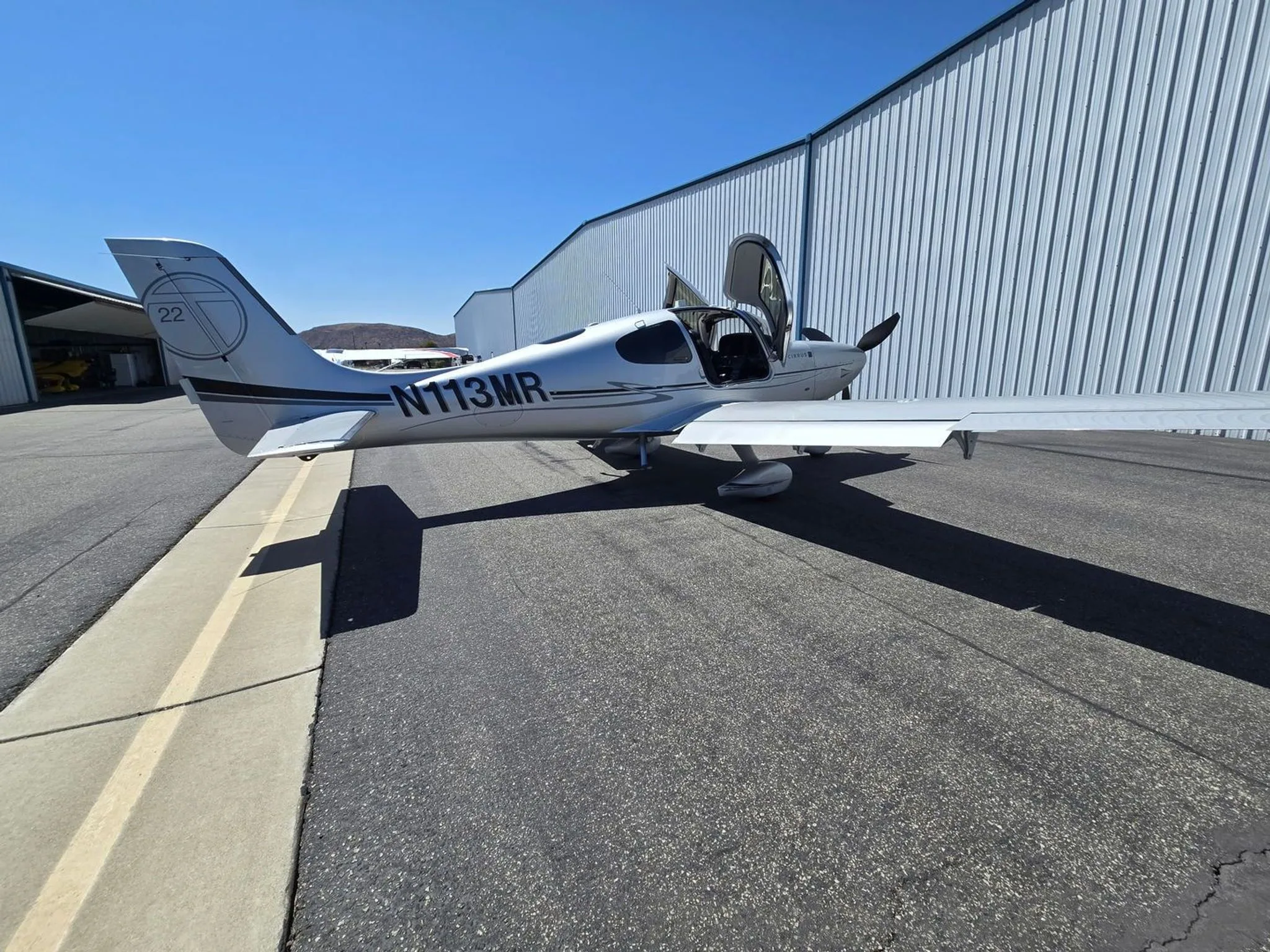


Free — save the SR22T to your watchlist and track it in one place.
More Cirrus SR22T G7manuals & documents
See all 21 →- AIRPLANE FLIGHT MANUAL for the CIRRUS SR22TPilot's Operating Handbook
- 2025 SR22T GTS G7Pilot's Operating Handbook
- Specifications for the Cirrus SR22T G7Specifications
- 2024 SR SERIES G7 / SR22Weight And Balance
- 2024 SR SERIES G7 / SR22TChecklist
- 2024 Cirrus SR22T G7 GTS (N229AT)Checklist
- Cirrus SR22T G7 ChecklistChecklist
- COPA Pilot - September 2024Parts Catalog
- 2024 SR SERIES G7 / SR22TWeight And Balance
- AIRPLANE FLIGHT MANUAL for the CIRRUS SR22 with Cirrus Perspective Touch+ Avionics SystemFlight Manual
- PILOT’S INFORMATION MANUAL for the CIRRUS SR22T with Cirrus Perspective Touch+ Avionics SystemPilot's Operating Handbook
- Pilot’s Guide for the Cirrus SR2x with Cirrus Perspective Touch+ by GarminFlight Manual
If you fly the Cirrus SR22T G7, you may also be researching these.



In this document
Accident Summary
The accident involved the Cirrus SR22T G-RGSK, which crashed during a touch-and-go landing after bouncing on touchdown. The pilot attempted a go-around but lost control, resulting in a left turn and stall before impact. The pilot sustained fatal injuries, and the aircraft was destroyed.
Flight History
On the day of the accident, the pilot completed two successful circuits before the incident. Weather conditions were generally favorable, with visibility greater than 10 km and winds from the southeast at about 7-8 knots. The final approach for the touch-and-go was made with 100% flaps and a descent rate of 500 ft/min.
Pilot Experience
The pilot had a total of 115 flight hours, with 16 hours on the Cirrus SR22T. He had recently completed transition training for the SR22T and had flown 12 hours in the aircraft prior to the accident.
Aircraft Information
The Cirrus SR22T is a five-seat low-wing monoplane powered by a Teledyne Continental TSIO-550-K piston engine producing 315 hp. It features a ballistic parachute recovery system (BPRS) and advanced avionics, including a Garmin GFC700 autopilot system.
Handling Considerations
The report discusses the aerodynamic effects of engine power on the aircraft's pitch and yaw during go-arounds. It emphasizes the importance of compensating for left-turning tendencies with right rudder and maintaining appropriate pitch attitudes to avoid stalling.
Safety notes
- Pilots should be aware of the left-turning tendencies when applying power during a go-around.
- Proper handling techniques must be followed to avoid stalling during low-speed maneuvers.
Full document text
1 ©Crown copyright 2025 All times are U TC AAIB Bulletin: G-RGSK AAIB-29925 Accident Aircraft Type and Registration: Cirrus SR22T, G-RGSK No & Type of Engines: 1 Teledyne Continental TSIO-550-K piston engine Year of Manufacture: 2023 (Serial no: 9368) Date & Time (UTC): 26 March 2024 at 1339 hrs Location: Duxford Airfield, Cambridgeshire Type of Flight: Private Persons on Board: Crew - 1 Passengers - None Injuries: Crew - 1 (Fatal) Passengers - N/A Nature of Damage: Aircraft destroyed Commander’s Licence: Private Commander’s Age: 58 years Commander’s Flying Experience: 115 hours (of which 16 were on type) Last 90 days - 9 hours Last 28 days - 0 hours Information Source: AAIB Field Investigation Synopsis At the end of a third circuit, which was intended to be a touch-and-go, G-RGSK bounced on touchdown. The pilot applied full power to go around but lost control of the aircraft, which turned left through approximately 90° before striking the ground. The aircraft’s ballistic parachute system deployed during the impact sequence. It was found that the aircraft had approached the stall as the nose attitude was increased for the go-around, triggering the stall warning. The tendency for the aircraft to yaw and roll left was not controlled, causing the aircraft to turn left, and the aircraft then stalled during the turn. The pilot sustained fatal injuries. To warn and protect people who may be unfamiliar with aircraft ballistic parachute systems, such as the emergency rescue services and others, from the potential danger, two Safety Recommendations are made concerning the provision of clear, conspicuous and unambiguous markings. The UK Civil Aviation Authority has published a Safety Notice on the same topic. Introduction The accident involving G-RGSK highlighted a number of issues concerning the risk of injury to third parties following an accident involving an aircraft fitted with a Ballistic Parachute Recovery System (BPRS). In order to address these issues, this accident report has been written in two sections. The first will address the accident and the second the BPRS. 2 ©Crown copyright 2025 All times are U TC AAIB Bulletin: G-RGSK AAIB-29925 Section one – Aircraft accident History of the flight On the day of the accident, the weather reports from local airfields1 indicated that there was a small amount of cloud cover at 4,000 ft with visibility greater than 10 km. The winds were from the south-east to south-southeast at about 7 to 8 kt. At 1310 hrs, the pilot of G-RGSK contacted Duxford Information to request a radio check and airfield information for a circuits flight. He subsequently departed from the asphalt Runway 06R into the southerly right-hand circuit and completed three circuits, which, up until the third landing, were flown without incident. The amount of other circuit traffic was not unusual for the location and all expected radio calls were made and responded to as normal. The final circuit immediately prior to the accident was less busy than the first two circuits and there were no potentially conflicting aircraft movements during the approaches. While G-RGSK was on final approach for a touch-and-go, the Flight Information Service Officer (FISO) at Duxford transmitted that the wind was from 150° at 8 kt with a maximum windspeed of 14 kt. On touchdown after the third circuit, G-RGSK was observed to bounce and full power was applied. A video taken by a witness showed the aircraft remaining low but with the nose slightly high and with a left angle of bank. The aircraft was pointing about 45° left of the runway and it continued to turn left until it was about 90° left of runway heading as the angle of bank increased to about 90° left wing low. At that point, the nose began to drop and the aircraft overbanked slightly. The left wing struck the ground first followed by the nose of the aircraft. The aircraft was severely disrupted on impact and the aircraft’s ballistic parachute system was seen to deploy during the impact sequence. The pilot sustained fatal injuries. Witness evidence Two pilots in a Harvard T6 lined up on the parallel grass runway witnessed G-RGSK touch down. One stated that he saw the aircraft bounce about 2 ft on touchdown and that the flaps were down. The other commented that the aircraft attitude appeared higher than would be expected and that during the go-around he could “hear the propeller bite”, suggesting full power had been applied. G-RGSK passed in front of the Harvard T6 and struck the ground ahead and to the left of it. Figure 1 shows the recorded final track of the aircraft. Footnote 1 Duxford Airfield does not issue TAFs and METARs. The weather reports from Cambridge and Stansted airports were reviewed and complemented by the winds reported by ATC to pilots in the circuit. 3 ©Crown copyright 2025 All times are U TC AAIB Bulletin: G-RGSK AAIB-29925 Impact point Wreckage location Runway 06R Witness video location Recorded aircraft position 1338:50 - Final recorded position Harvard location Figure 1 G-RGSK approximate accident track A witness standing towards the south-western end of the public western apron captured on video the aircraft shortly after it had gone around, its subsequent flight path and the impact sequence. The witness video matched the aircraft attitude in the recorded data. The video did not show the aircraft touchdown or bounce on the runway, but started after the aircraft began deviating to the left. Figure 2 shows snapshots from the video in half second intervals but excludes the impact. 4 ©Crown copyright 2025 All times are U TC AAIB Bulletin: G-RGSK AAIB-29925 Figure 2 Witness video frames at half second intervals just prior to impact Airfield information Duxford Airfield (Figure 3) has two parallel runways: a grass Runway 06L/24R from which aircraft fly circuits to the north, and an asphalt Runway 06R/24L from which aircraft fly
Show full textShow less
circuits to the south. While they are not available for simultaneous use and are to be treated as one runway, often both circuits are active at the same time. 5 ©Crown copyright 2025 All times are U TC AAIB Bulletin: G-RGSK AAIB-29925 Figure 3 Duxford Airfield AIP AD2 EGSU2 .1 Accident site The aircraft came to rest on a grassed area near to the threshold of Runway 06L at Duxford Airfield. The initial ground impact mark was clearly discernible from which a fan shaped discolouration of the grass had occurred. This had been caused by the spray of fuel ejected from the ruptured aircraft fuel tanks during the impact. Despite this there was no fire. The aircraft was in a highly disrupted state and had come to rest approximately 40 m from the initial impact point. Examination of the wreckage trail suggests a heading on impact of 308°T. All the propeller blades had detached from the hub and were embedded in the ground about 6 m from the initial impact. The engine cowlings, cockpit doors and part of the cockpit roof had detached and were lying nearby. The Cirrus Airframe Parachute System (CAPS)2 parachute had deployed to full extension and was laying out flat along the ground. It was attached to the aircraft by its suspension lines. These were cut by AAIB staff on initial examination of the site to prevent inflation of the chute and dragging of the wreckage. The rocket motor had fired and was found lying on the ground at the top end of the canopy. Both wings were severely damaged, the left wing had detached, and the right wing was twisted around its root with its aileron and flap control surfaces partially detached (Figure 4). The rear fuselage had broken in the vicinity of the tailplane leading edge and was twisted around. Footnote 2 Similar systems are fitted to a variety of other light aircraft and are usually referred to as Ballistic Parachute Recovery Systems (BPRS). 6 ©Crown copyright 2025 All times are U TC AAIB Bulletin: G-RGSK AAIB-29925 Figure 4 Aircraft structural damage The pilot’s four-point harness had been undone by the first responders and was hanging loose, and both the left and right seat shoulder strap air bags had deployed. The seat attachment rails and safety harness attachment points were intact. The cockpit control panels, instrument screens and side stick control handles were severely disrupted. The power lever was broken and in an indeterminate position. The Emergency Locator Transmitter (ELT) had initiated with its audio and visual warnings activated. The undamaged ELT was deactivated on site. Despite the damage to the aircraft, both the air conditioning3 and oxygen systems were intact. To ensure a safe recovery of the aircraft for further examination, the pressurised refrigerant gas within the air conditioning system was extracted. The oxygen storage bottle, pressurised to 1,500 psi, was also discharged on site. Footnote 3 The aircraft system contained pressurised 1,1,1,2 Tetraflourethane gas known as R134a. There are hazards associated with R134a so it requires careful handling, and the gas should not be discharged directly to atmosphere. The air conditioning system design is similar to that used on road vehicles. Therefore, a qualified motor vehicle contractor was called in to extract and dispose of the R134a gas within the regulations. 7 © Crown copyright 2025 All times are UTC AAIB Bulletin: G-RGSK AAIB-29925 Recorded information A number of recorded data sources were available to the investigation, including CCTV and radio transmissions from Duxford. The aircraft was fitted with digital displays which recorded information to an SD card and a Recoverable Data Module (RDM), which is a dedicated crash-hardened memory storage device. This device recorded over 600 parameters at a rate of up to 5 Hz. Flap position was recorded but other control surface positions, flight control inputs and throttle positions were not. A ‘Percent Power’ parameter was recorded which was a record of that displayed to the pilot on the Multi-Function Display (MFD). The Pilot’s Operating Handbook (POH) defines this as: ‘the percentage of maximum engine power produced by the engine based on an algorithm employing manifold pressure, indicated air speed, outside air temperature, pressure altitude, engine speed, and fuel flow.’ In addition, a ‘Normalized’ AOA parameter was recorded ranging from zero to one with a value of ‘one’ representing stall. This parameter is dynamically calculated depending on parameters such as bank angle and flap position. Due to aircraft damage, the RDM data could not be recovered in situ and was examined and downloaded in the AAIB laboratories. The manufacturer decoded the data, and the accident flight plus previous flights were successfully recovered. Accident flight The accident flight recording commenced at 1303 hrs and the engine started just over four minutes later (Figure 5). The aircraft taxied to Runway 06R and took off at 1320:40 hrs and throughout the entire flight, the recorded data confirmed that the autopilot was not engaged. The aircraft entered a right-hand circuit, climbing initially to a recorded pressure altitude of 1,344 ft amsl4. Altitude varied between 1,344 ft and 1,033 ft5 until the end of the downwind leg with recorded airspeed varying between 159 KIAS and 89 KIAS. Footnote 4 Pressure altitude was recorded using a QNH of 1013 hPa. This has been corrected to the Duxford QNH at the time of 987 hPa. 5 Circuit height is 1,000 ft aal. Airfield elevation is 126 ft which equates to a circuit altitude of 1,126 ft amsl. 8 ©Crown copyright 2025 All times are U TC AAIB Bulletin: G-RGSK AAIB-29925 Aircraft position 2 nm ATZ Duxford circuit Runway 06/24 Circuit direction Aircraft position 2 nm ATZ Duxford circuit Runway 06/24 Circuit direction Figure 5 G-RGSK recorded position, indicated airspeed and altitude during the accident flight (circuit shape (in white) sourced from Duxford Airfield website6) The vertical speed and airspeed stabilised during the final approach of the first circuit. The approach was made with 100% flap with touchdown at 67 KIAS. The recorded flap position then reduced from 100% to 50%, full power was applied with takeoff at approximately 87 KIAS. During the second circuit, fluctuations in airspeed and altitude were noted but to a lesser extent than the first circuit. The aircraft touched down at 63 KIAS after which power was applied three seconds prior to the recorded flap setting reducing from 100% to 50%. The aircraft accelerated, taking off at approximately 87 KIAS. Footnote 6 https://www.iwm.org.uk/visits/iwm-duxford/pilots [accessed on 21 March 2025]. 9 ©Crown copyright 2025 All times are U TC AAIB Bulletin: G-RGSK AAIB-29925 Accident approach The aircraft then entered the right-hand circuit and, at 1338 hrs, turned on to the final approach at approximately 500 ft aal. The pilot made a radio call that he was on final for a touch-and-go and, at 50 ft aal, the aircraft was descending at 500 ft/min with 100% flap, 75 KIAS and 14% power. Pitch attitude then started to increase and power reduced to 11% (Figure 6). ‘NORMALIZED’ AOA Figure 6 G-RGSK RDM data 10 ©Crown copyright 2025 All times are U TC AAIB Bulletin: G-RGSK AAIB-29925 Touchdown occurred at 1338:40 hrs at 63 kt IAS, identified by a spike in the recorded normal acceleration of 1.4g7 (Figure 6, point A). A second spike in the normal acceleration was recorded 0.8 seconds later of 1.67g, suggesting that the aircraft had bounced (Figure 6, point B). A second later, the aircraft had pitched up to 8.4° and started to roll to the left (Figure 6, point C). A further second later, the recorded percent power started to increase, coincident with a recording of the stall warning activating (Figure 6, point D). Percent power increased from 8% to 116%8 over 2.1 seconds (engine speed increased from 1,261 rpm to 2,500 rpm with a corresponding manifold pressure increase). As the engine power increased, the aircraft pitched up further, continued to roll to the left and began yawing to the left (Figure 6, point E). Pitch increased to 13.7° nose-up and then fluctuated over the next five seconds while the recorded ‘Normalized’ AOA increased, eventually reaching and staying at 1 (indicating a stalled condition) for the remainder of the flight (Figure 6, point G). The recorded negative roll rate signified an increase in left roll from wings level to 40° left wing low over five seconds. Roll attitude held at 40° left wing low (Figure 6, point H) for a second before continuing to increase to the left until the end of the flight. As soon as the engine power increased, the heading/yaw rate to the left increased and then remained at between 7-18 deg/sec to the left for the remainder of the recording (Figure 6, point F). This meant the aircraft was consistently yawing to the left after engine power was applied. In the time between power being applied and the end of the recording (8.5 seconds), the aircraft heading decreased and the altitude increased by 100 ft with airspeed initially increasing from 63 KIAS to 72 KIAS. The RDM recording terminated prior to the end of the flight as the final recorded altitude was 206 ft amsl (approximately 80 ft aal). Just prior to the end of the recording, engine power was reduced (Figure 6, point J) but, at this time, the aircraft pitch had reduced, roll attitude was 92° left, and the aircraft had turned through 120° to the left to a heading of 304°. It should be noted that position recording ceased 1.5 seconds prior to the end of the recording. Approach comparison Figure 7 shows a comparison of the three approaches and landings during the accident flight. The altitude and airspeed profiles were all similar with 100% flap selected for landing. Footnote 7 The RDM recorded normal acceleration when stationary on ground was 0 g. References to normal acceleration in the report have added 1 g to this value. 8 Percent power is defined as between 0-100%. The increase to over 100% could not be explained by the aircraft manufacturer but was likely due to this being a dynamically calculated parameter. Engine parameters (rpm and manifold pressure) were within expected limits. 11 ©Crown copyright 2025 All times are U TC AAIB Bulletin: G-RGSK AAIB-29925 Figure 7 Comparison of approaches during accident flight (Accident data is shown in bold colour) Percent power on touchdown was slightly less for the accident landing than the previous two (11% vs 16% and 17% respectively) which can also be seen in a reduced engine rpm (Figure 7, point A). The rate of percent power increase was higher for the accident go-around which reached full power in 1.6 seconds (2.2 seconds and 3.2 seconds for the first and second landings respectively). Manufacturer’s assessment The RDM was downloaded at the AAIB and the data was sent to the aircraft manufacturer for decoding. The aircraft manufacturer was asked to comment on the accident landing, given their operational experience and capability in analysing RDM data. 12 ©Crown copyright 2025 All times are U TC AAIB Bulletin: G-RGSK AAIB-29925 They stated that ‘The pilot completed two normal touch and go landings’ but the final touch- and-go differed, as described in detail in the recorded information section of this report. They confirmed that when power was applied to abort the landing, 100% flap was still selected but advised that there is sufficient engine power to accelerate the aircraft in this configuration. The manufacturer’s view was that excessive pitch up at low speed was the most significant factor in this accident, followed by the fact that the yaw was not controlled as power was applied. Aircraft information G-RGSK was a Cirrus SR22T five-seat low-wing monoplane aircraft of composite construction. It was powered by a Teledyne Continental flat six twin turbocharged piston engine producing 315 hp driving a three-blade constant speed governor-regulated propeller. The aircraft was fitted with an advanced avionic display and navigation system. The flying controls were a conventional mechanical design. To enhance flight control, the aircraft was fitted with a Garmin GFC700 Automatic Flight Control System (AFCS). Sensors within this system were used to provide Electronic Stability and Protection (ESP) which used servos to provide the pilot with a degree of control force feedback to give a tactile indication when the aircraft neared the limits of its defined operating envelope. The ESP only operates within the autopilot operating limitations when the autopilot is disengaged. The POH states the following limitations for the autopilot: ● Minimum autopilot speed – 80 KIAS ● Maximum autopilot speed – 185 KIAS ● Autopilot Minimum-Use-Height: ● Takeoff and climb – 400 ft agl ● Enroute and descent – 1,000 ft agl In addition, there was a takeoff and go-around (TO/GA) feature which could assist the pilot by engaging the flight director TO or GA command bars on the primary flight display. The pilot could then hand fly the aircraft to follow the path indicated by the command bars. The aircraft was fitted with electrical screw jack driven trailing edge flaps. These had three positions: fully up (0°), 50% (16.0°) and 100% (35.5°). The aircraft was equipped with an audio and visual stall warning system. The stall warning was set to trigger at approximately 5 kt above stall with full flaps and power off in wings-level flight9. The POH, as part of the normal procedures for a pre-flight inspection, calls for the stall warning system to be tested and to note that the warning horn sounds. Activation of the stall warning system is recorded in the RDM. Footnote 9 Cirrus Pilot’s Operating Handbook (POH) stall warning system description. 13 ©Crown copyright 2025 All times are U TC AAIB Bulletin: G-RGSK AAIB-29925 Aircraft history The aircraft was built in 2023, and test flown in the United States of America by the manufacturer under registration N277SK. It was then ferry flown to a UK based Continued Airworthiness Maintenance Organisation, where it was inspected and issued with a Certificate of Airworthiness (C of A) and a Release to Service. The C of A was issued on 12 October 2023 with an Airworthiness Review Certificate (ARC) valid until 9 October 2024. During this process the CAA allocated and issued its UK registration. It was then delivered to its owner to be based at Duxford. At the time of the accident the aircraft had accrued a total 40 flight hours of which 24 hours were flown during testing and the ferry flight, and 16 hours flown by the owner. There were no aircraft system faults or malfunctions recorded in that time. Aircraft examination There was severe disruption of the aircraft systems and structure, however all the components examined showed little wear and tear, which was expected given the age of the aircraft. Continuity of the flying controls in all axes could be demonstrated with all apparent damage attributable to the impact disruption. The flap switch was set to 100% (fully down) and this was corroborated by recorded data in the RDM and by the position of the flap actuator. Both flaps were severely damaged along with the damage to the wings but marks on the hinges also show they were down at impact. All the propeller blades’ roots were broken with the spinner in place. Various pipes, ducts and hoses had detached from the engine systems but apart from distortion and soil embedded in the No 1 cylinder cooling fins and displacement of both magnetos, the engine was undamaged. The exact power output of the engine during the accident sequence could not be determined by any physical evidence on or around the engine. However, recorded data showed the engine was operating normally. Personnel The pilot initially commenced his PPL training in late 2021 in a Piper Cherokee Warrior II PA28-161, but his logbook indicates he stopped mid-2022. In May 2023, at a different airfield and with a Cirrus ATO, he recommenced his PPL training on a Cirrus SR2010 with a Cirrus Standardised Instructor Pilot (CSIP). He gained his PPL (A) with SEP (Land) rating in November 2023, and had completed 87.4 hours, including 12 hours solo, and over 82 flights on the Cirrus SR20 by that time. The Head of the ATO stated this was in the normal range for the completion of a PPL with Cirrus. The pilot’s instructors observed that the pilot displayed signs of inconsistency during his PPL training, especially after a period away from flying, but stated that this was not unusual for pilots at this stage of flying. They did not highlight any specific concerns about his ability to perform go-arounds. Footnote 10 The Cirrus SR20 G6 is powered by a Lycoming IO-390 engine of 215 hp (160 kW). 14 ©Crown copyright 2025 All times are U TC AAIB Bulletin: G-RGSK AAIB-29925 SR22T transition training In the UK, pilots are required to: ‘… complete differences training or familiarisation in order to extend their privileges to another variant of aircraft within one class or type rating11’. This requirement extends to the SR22T because it has a turbocharged engine, and the requirement can be met through the manufacturer’s transition training course. In November 2023, the pilot began the manufacturer’s SR22T transition training course and flew three flights with a CSIP totalling 4.2 hours. He covered the handling elements of this training and the CSIP made an entry in his logbook that read ‘High Performance Signoff’. Subsequent flights During December 2023 and January 2024, the pilot conducted 11 flights on the SR22T as pilot-in-command, totalling 12 hours of flight time. His last flight was on 1 February 2024, 54 days before the accident, and was from Exeter to Duxford. Handling considerations during a go-around / rejected landing Engine power affects the rotational balance of the aircraft about its primary axes ie yaw about the normal axis, pitch about the lateral axis and roll about the longitudinal axis. Effects of engine power on roll and yaw For an aircraft such as the SR22T, with a clockwise rotating propeller (viewed from the cockpit), the application of power during a go-around leads to various aerodynamic effects the net outcome of which is a tendency to roll and yaw left: 1. Corkscrew effect of the slipstream. The slipstream from the propeller over the fin, rudder and side of the fuselage aft of the CG, acts in a yaw-left sense, with the effect increasing with power. The slipstream also produces a roll-right moment, but this effect is exceeded by the torque reaction in the opposite direction (see below). 2. Torque reaction. The revolution of the engine and propeller induces an opposing moment in roll, which results in a tendency to roll to the left when the aircraft is in flight. 3. Gyroscopic effects of the propeller. The spinning propeller acts as a gyroscope, and gyroscopic precession means that yawing about the vertical axis leads to a pitching moment, and pitching around the lateral axis leads to a yawing moment. Footnote 11 Regulation (EU) 1178/2011, Part FCL, GM1 FCL.700. 15 ©Crown copyright 2025 All times are U TC AAIB Bulletin: G-RGSK AAIB-29925 4. Asymmetric blade effect12. When an aircraft is flying with a high angle of attack (AOA), typically during slow flight, the effectiveness of the downward moving blade is greater than that of the upward moving blade. This moves the centre of thrust from the centre of the propeller outwards towards the tip of the down-going blade, resulting in asymmetric loading of the propeller and a consequent yawing moment to the left. The manufacturer’s advice when applying power during a go-around from a stabilised approach or from a rejected landing is: ‘… be aware of the left turning tendencies and compensate with right rudder’. The effectiveness of an aircraft’s control surfaces reduces as airspeed is reduced and, consequently, relatively large control inputs are required at slow speed for a given effect. Effects of engine power on pitch attitude An increase of power in aircraft such as the SR22T will disrupt the longitudinal balance of the aircraft, and the effects, which can be magnified when flaps have been selected, are more pronounced at high power and high angles of attack: 1. The position of the thrust line above or below the CG will produce a pitching moment about the lateral axis. 2. Propellers produce a relatively small upward lift component due to the change of momentum of the air passing through them. This tends to pitch the aircraft nose-up. 3. An increase in the downwash angle of the wing changes the angle at which the airflow strikes the horizontal stabiliser. 4. The increased velocity of the airflow at the horizontal stabiliser increases its effectiveness. The most common overall outcome of these phenomena is a nose-up pitching moment, and this is the case for the SR22T. Use of ailerons at low airspeeds The use of ailerons leads to adverse yaw, which is where an aircraft yaws in the opposite direction to the applied roll input. This effect can be more marked at low airspeeds, where larger control inputs will be required for a given effect. Separately, the use of ailerons increases the AOA on the down-going wing, which can cause the wing to stall in circumstances where the aircraft was close to the stall speed. These effects help explain why the manufacturer recommends using right rudder and not right aileron to compensate for the ‘left turning tendencies’ during a go-around. Footnote 12 This is also known as the ‘P’ factor or Asymmetric Loading. 16 ©Crown copyright 2025 All times are U TC AAIB Bulletin: G-RGSK AAIB-29925 Technique for go-around / rejected landing SR22T POH In the case of a balked landing13 / go-around, the SR22T POH states: ‘Balked Landing/Go-Around 1. Autopilot .................................................................... DISENGAGE 2. Power Lever..........................................................FULL FORWARD 3. Flaps ........................................................................................50% 4. Airspeed....................................................................... 80-85 KIAS After clear of obstacles: 5. Flaps ..........................................................................................UP Amplification In a balked landing (go around) climb, disengage autopilot, apply full power, then reduce the flap setting to 50%. If obstacles must be cleared during the go around, climb at 80-85 KIAS with 50% flaps. After clearing any obstacles, retract the flaps and accelerate to the normal flaps up climb speed.’ Manufacturer’s training material The manufacturer’s training material amplifies the actions in the POH and advocates a ‘4-step flow’ when performing a go-around / rejected landing: 1. Power up. ‘Immediately smoothly apply full power using the same 4-5 second motion used during takeoff, be aware of left turning tendencies and compensate with right rudder’. 2. Pitch up. ‘Pitch up to an attitude that is just above the horizon [to begin accelerating] then pitch up to normal go-around climb attitude. Be careful not to over rotate due to a strong desire to pitch up; this may require a little forward pressure to maintain the appropriate attitude.’ 3. Clean up. ‘If flaps were 100%, retract to 50% and maintain constant pitch attitude to avoid any sinking from the retraction of the flaps.’ 4. Call up. ‘Call ATC … and complete the balked landing checklist.’ CSIPs’ instruction The instructor who conducted the transition training on the SR22T reported teaching the pilot that power should be applied smoothly during a go-around over two to three seconds with coordinated input of rudder. Footnote 13 A balked landing is the same as a rejected landing. 17 © Crown copyright 2025 All times are UTC AAIB Bulletin: G-RGSK AAIB-29925 Previous go-around events with loss of control in SR22 variant aircraft Seven similar accidents involving loss of control of SR22 variants during the execution of a go-around were identified (Appendix 1). Five of these events involved the execution of a go-around following a bounced landing. In particular, an accident involving VH-XGR in 2023 shared similarities with this accident. After a bounced landing, the Cirrus SR22 entered a steep climbing turn to the left. Having reached a maximum height of about 40 ft, the bank angle exceeded 90° and the aircraft dropped onto the left wing and nose. The Australian Transport Safety Bureau (ATSB) found that: ‘in the early stages of a go-around from an unstable landing, the pilot was unable to counter the substantial torque effect associated with high engine power, low airspeed, and high pitch angle, resulting in loss of control and collision with terrain.’ The ATSB noted that the material provided by Cirrus did not highlight the risk of loss of control associated with a go-around during the landing phase, where there was high engine power, low airspeed, and high pitch attitude. Analysis – aircraft accident Introduction The accident resulted from a loss of control in flight at very low level. This occurred during the execution of a rejected landing with a low energy state after the aircraft had bounced on touchdown. The data indicated that the aircraft adopted a sustained high nose attitude with low airspeed, and the aerodynamic effects from the application of power were not contained, resulting in significant yaw and roll to the left. This rolling and yawing persisted until the aircraft struck the ground, and the data indicated that the wing was stalled for the last five seconds of the recording. Engineering The aircraft had a valid Certificate of Airworthiness, low airframe hours and was in good condition commensurate with its age. Examination of the aircraft found no pre-existent fault or system malfunction that could have contributed to this accident. The CAPS was not initiated by the pilot. It activated because of disruption and breakup of the cockpit roof section on which the activation ‘T’ handle was mounted. This disruption displaced and tensioned the cable which caused the igniter to fire and set off the rocket deploying the parachute in the latter part of the accident sequence. Aircraft handling during the rejected landing The technique for going around from a rejected landing in the SR22T involves moving the power lever fully forward, setting flaps to 50% and pitching up initially to an attitude just above the horizon to allow the aircraft to accelerate. During the accident go-around, the 18 ©Crown copyright 2025 All times are U TC AAIB Bulletin: G-RGSK AAIB-29925 aircraft pitched up to 8.4° before the power was applied. This increase in pitch followed, and was possibly a reaction to, the bounce on the runway. When power was applied, it was coincident with the stall warning and was followed by a further increase in pitch attitude to 13.4°. The nose attitude remained predominantly above 10° for the following four seconds before decreasing as the aircraft descended towards the ground. The data indicated that the stall warning was active for all but one of the final nine seconds of flight, indicating that the wing was at or near the critical (stalling) AOA. The stall warning system included both audio and visual indications. The ‘Normalized’ AOA parameter began to increase from the point the nose attitude was increased after the first bounce. The AOA continued to increase during the turn until it reached 1, approximately three seconds after the application of power. The AOA parameter indicated that the wing then remained stalled for the final five seconds of flight, even after the nose attitude began to decrease as the aircraft descended. It appeared likely that the sustained high nose attitude during the go-around and first part of the turn caused the wing to stall. The pilot had flown over 82 flights on the SR20 by the time he completed his PPL but the SR22T is significantly more powerful and the effects of applying power during a go-around are more pronounced. The pilot applied full power in approximately two seconds, which was at the lower end of the two to three seconds taught by CSIPs during transition training to fly the SR22T, but significantly quicker than the four to five seconds in the manufacturer’s training material. During the go-around, the aircraft was at slow speed with a high nose attitude and with 100% flaps set, all of which would have tended to increase the ‘left turning tendencies’ that the manufacturer’s training material states must be countered with right rudder. The relatively quick application of power would have quickened the onset of these tendencies such that a prompt application of rudder would have been required. It was evident from the fact that the aircraft began yawing and rolling left that insufficient right rudder was applied with the increase in power. At this point, the aircraft was yawing and rolling left. When an aircraft yaws to the left it will begin to roll left, and when it rolls left it will begin to yaw left, leading to a self-sustaining motion in the absence of corrective action from the pilot. In this case, the motion persisted until the aircraft struck the ground indicating that effective corrective action was not taken. Corrective action in these circumstances would have been to reduce the aircraft’s pitch attitude sufficiently to reduce the AOA below the critical angle and to apply sufficient right rudder to stop the yaw. This might have been effective during the early part of the go- around, when reducing the AOA might have left the aircraft with a positive rate of climb and sufficient power to accelerate. Reducing the AOA when the aircraft was established in the turn, however, is likely to have resulted in a loss of height with the risk that there would be insufficient time to recover to safe flight before impact with the ground. This is why a loss of control is so hazardous when close to the ground and controlling the pitch attitude during a go-around is so important. 19 ©Crown copyright 2025 All times are U TC AAIB Bulletin: G-RGSK AAIB-29925 Experience In general, greater experience brings advantages in terms of increased consistency of performance and familiarity with a greater range of situations. More experienced pilots can also perform manual flying skills with less conscious attention, therefore freeing more capacity to deal with concurrent tasks and respond appropriately to unexpected and adverse situations in the air. The pilot was inexperienced in terms of flying hours overall and time on type. At this stage in his flying, the pilot was still consolidating his skills and likely vulnerable to being overwhelmed by unexpected events. However, previous similar accidents have occurred with pilots with higher levels of experience and even with instructors on board. This suggests that general flying experience on type or on other types does not assure that the appropriate handling technique will always be followed. Recency In general, pilots with more recent practice show better performance14. The pilot last flew 54 days before the accident flight and his instructors commented that during his training, like most novices, his performance would reduce after a period of non-flying. The variability of speed and altitude during the first two circuits of the accident flight suggests there may have been some reduction in performance compared to when the pilot had been flying regularly and this may have contributed to the loss of control. In a flying club environment, there is commonly a recency requirement where if a pilot has not flown for a defined period of time (often around a month), they are required to fly with an instructor before flying in command of a club aircraft. Outside of a club environment, pilots are not subject to such requirements but have the option to employ an instructor to fly with them if skill fade is a concern. Workload The traffic conditions in the circuit did not appear challenging, so high workload due to other traffic was probably not contributory to the accident. However, circuit flying is a relatively demanding task, and the pilot may still have experienced high workload throughout the flight because of lack of recent practice. This might have left him with less capacity to correctly execute the rejected landing. Startle The pilot appears not to have taken sufficient action to correct the high pitch following the bounce, nor the aerodynamic effects from the application of power. The bounce was of a greater magnitude than in the landings on the previous two circuits and it is possible that the pilot was startled. Startle is a “brief, fast and highly physiological reaction to a Footnote 14 Civil Aviation Authority (2023). Civil Aviation Publication 737 Flight Crew Human Factors Handbook, p154. https://www.caa.co.uk/publication/download/14984 [accessed 25 March 2025]. 20 ©Crown copyright 2025 All times are U TC AAIB Bulletin: G-RGSK AAIB-29925 sudden, intense or threatening stimulus”15 which occurs involuntarily and can interrupt task performance for up to 1.5 seconds16. This may have impaired him causing the faster than usual application of power (an example of a ‘flight’ response) and subsequent lack of response to correct the aircraft’s unusual attitude (an example of a ‘freeze’ response). The data indicates that the stall warning activated around the time when the power was applied. This had the potential to prompt the pilot to make a pitch-down control movement, but the pitch attitude increased further. The pilot may not have heard the warning due to inattentional deafness17 or he may have heard it and found it confusing or further startling because it was heard in a situation where he would probably not expect it. Conclusion The accident occurred during the go-around from a bounced landing when the aircraft adopted an excessively high nose attitude during the initial part of the go-around. The aircraft’s tendency to yaw and roll left following the application of power was not controlled, causing the aircraft to turn left, and a relatively high nose attitude was sustained during the turn, causing the wing to stall. The rolling and yawing motion continued until the aircraft struck the ground. The pilot was relatively inexperienced and had not flown for 54 days before the accident flight and it is possible this led to a reduction in his performance. No corrective action was apparent after the initial loss of control, and it is possible that a startle effect degraded the pilot’s ability to respond appropriately. Similar accidents have occurred in SR22 and SR22T aircraft even with pilots with higher levels of experience or with instructors on board. These occurrences indicate that, irrespective of experience, using the manufacturer’s technique to go around is paramount for the safe operation of the aircraft. Section two – Ballistic Parachute Recovery System Cirrus Airframe Parachute System (CAPS) G-RGSK was fitted with the CAPS. This feature is a parachute recovery system installed for use in flight to ‘bring the aircraft to the ground in the event of a life threatening emergency’. It consists of a large parachute that can be deployed in an emergency by the pilot or aircraft occupants and is designed to hold the aircraft in a stable and controlled vertical descent to the ground. It is activated by pulling a red ‘T’ handle positioned in the cockpit on the roof panel. Footnote 15 Landman, A., Groen, E.L., van Passen, M.M. Bronkhorst, A. & Mulder, M. (2017) ‘Dealing with unexpected events on the flight deck: A conceptual model of startle and surprise’ in Human Factors, Vol 59 pp 1161-1172 [accessed 14 January 2025]. 16 Martin, W., Murray, P. & Bates, P. (2012) ‘The effects of startle of pilots during critical events: a case study analysis’ Proceedings of 30th EAAP Conference: Aviation Psychology & Applied Human Factors – working towards zero accidents [accessed 14 January 2025]. 17 A phenomenon where ‘unexpected salient sounds can remain unnoticed under attention demanding conditions’ (Dehais, F., Causse, M., Vachon, F., Regis, N., Menant, E. and Tremblay, S. (2014). Failure to Detect Critical Auditory Alerts in the Cockpit: Evidence for Inattentional Deafness. Human Factors: The Journal of the Human Factors and Ergonomics Society, vol. 56 (4). p 631-644 [accessed 14 January 2025]. 21 ©Crown copyright 2025 All times are U TC AAIB Bulletin: G-RGSK AAIB-29925 This activates an electro-mechanical igniter system to fire a rocket from a compartment in the crown of the fuselage, behind the cockpit, that deploys the main parachute. To make the system safe on the ground, a safety pin with a ‘Remove Before Flight’ flag is inserted into the ‘T’ handle to prevent inadvertent operation. The only indication to an external observer that the CAPS system was fitted to this aircraft were two small placards. These were fixed to the upper rear fuselage surface on the left and right edges of the CAPS frangible panel. Each state in plain black text the following: ‘WARNING! ROCKET FOR PARACHUTE DEPLOYMENT INSIDE STAY CLEAR WHEN AIRPLANE IS OCCUPIED’ From a distance and in low light conditions these placards are barely discernible and do not draw particular attention to the potential danger within. Figure 8 shows the placard on the left side of G-RGSK. Figure 8 CAPS placard left side (Note in this case the CAPS had activated, and the frangible panel was repositioned for illustrative purposes) Information on the CAPS for first responders is included in an information manual produced by the manufacturer. However, this requires prior knowledge of the aircraft type and may not be immediately available to emergency first responder and/or local authority fire and rescue services. 22 ©Crown copyright 2025 All times are U TC AAIB Bulletin: G-RGSK AAIB-29925 A report into a Cirrus SR22 accident involving VH-XGR in 2023 published18 by the ATSB detailed how the first responders conducted an accident victim extraction from an inverted aircraft. They needed to cut into the aircraft in proximity to the CAPS and its armed initiation devices. The unobtrusive nature of the placard and the fact the aircraft was inverted meant the placard went unnoticed. They were unaware of the risk CAPS presented until they were later informed by an individual with a knowledge of the aircraft and its systems. Steps were then taken to make it safe. In its final report, the ATSB noted that the aircraft manufacturer ‘advised that they have enhanced the external CAPS placarding on 2 new models of aircraft (the SF50, and another in development) to align with current American Society for Testing and Materials19 (ASTM) standards. The SR2X series of aircraft (the SR20, SR22, and SR22T) were certified prior to the implementation of ASTM standards. At the time of writing, Cirrus was reviewing the possibility to enhance the placard that was certified with SR2X.’ During the course of the G-RGSK investigation, the aircraft manufacturer advised that, for CAPS placards, it has initiated a project ‘to address SR20, SR22 and SR22T aircraft’. Separately, although the Federal Aviation Administration (FAA) and the European Union Aviation Safety Authority (EASA) requirements (14 CFR 23 and CS-23 respectively) have been updated to require appropriate placards for new Type Certificate applications for designs of aircraft which incorporate a BPRS, these requirements are not retrospectively applicable to existing designs. Previous Safety Recommendations made by the AAIB An investigation carried out by the AAIB into an accident in 2008 to a Dyn’Aero MCR-01, F-JQHZ20 found that the warnings and placarding of BPRS was unsatisfactory. As a consequence, Safety Recommendation 2009-008 was made to the CAA, the FAA and to the EASA to require placards of a commonly agreed standard to be fitted, and Safety Recommendation 2009-007 was made to ICAO to publish an international Standard on warning placards. ICAO responded that it would be inappropriate to develop such a Standard until the FAA, CAA and EASA had addressed Safety Recommendation 2009-008. While the CAA acted on Safety Recommendation 2009-008 and amended BCAR Section S to include a description and visual depiction of the required placards, the EASA felt that the publication of an ICAO State Letter on the risks to third parties from BPRS was sufficient and, therefore, no further action was taken. The FAA evaluated the mandatory application of placards and determined the proposal did not meet the criteria for issuing a retroactive airworthiness directive for existing Part 23 certificated aircraft, but did mandate compliant placards on new type certificated aircraft and those subsequently modified to fit a BPRS. Footnote 18 https://www.atsb.gov.au/publications/investigation_reports/2024/report/ao-2023-011 [accessed 14 January 2025]. 19 The standards detailed in ASTM F3408-21 - Standard Specification for Aircraft Emergency Parachute Recovery Systems are identified as being acceptable to both the FAA and EASA. 20 https://assets.publishing.service.gov.uk/media/5422f02940f0b61346000311/Dyn_Aero_MCR-01__21-YV_ callsign_F-JQHZ_06-09.pdf [accessed 14 January 2025]. 23 ©Crown copyright 2025 All times are U TC AAIB Bulletin: G-RGSK AAIB-29925 A subsequent AAIB investigation into an accident in 2014 to CZAW SportCruiser, G-EWZZ21, made similar Safety Recommendations to the EASA and the CAA regarding the visibility and positioning of warning placards. The EASA response was considered partially adequate as retrospective action to ensure compliance for in-service aircraft was not proposed. The CAA published BCAR Section S, Issue 7 in December 2018 with amendments to Sub- Section K paragraphs S 2003(g) and S 2014(c), but this did not apply to larger private light aircraft such as the Cirrus SR20 and SR22. However, the CAA did, through Mandatory Permit Directive MPD2019-005, apply the requirements retrospectively for those aircraft falling under BCAR Section S. Analysis – Ballistic recovery system In addition to Cirrus SR20 and SR22 aircraft, there are other types of aircraft operating in the UK with BPRS. The majority of these are microlight aircraft under BCAR Section S operated within the regulations set out in CAP 482, Sub-Section K. This Sub-Section details the requirements for those aircraft fitted with BPRS and specifically mandates the placards and markings that are to be clearly visible close to and from a distance, on aircraft external surfaces. The placarding requirements reflect those stipulated in ASTM F3408-21. Figure 9 shows the placard that must be fitted near the aircraft access door. Figure 9 CAP 482 example BPRS warning placard Footnote 21 https://assets.publishing.service.gov.uk/media/55532790ed915d15db00005e/CZAW_SportCruiser_G- EWZZ_05-15.pdf [accessed 14 January 2025]. 24 ©Crown copyright 2025 All times are U TC AAIB Bulletin: G-RGSK AAIB-29925 Similar placards are applied to the area where the BPRS is located in the aircraft along with a yellow and black chequered line showing the device exit point from the airframe. The placards have been designed to be visually clear pictograms and to follow the conventions found on military aircraft fitted with ejection seats and explosive release devices, which are recognisable and familiar to UK emergency services. However, the UK is not the state of design, state of manufacturer nor certification authority of either the Cirrus SR20 or SR22 aircraft variants and therefore the CAA cannot directly influence or mandate the requirements set out in CAP 482 on these aircraft. The CAA has published Safety Notice22 SN-2025/003 – Part 21 Aircraft with Ballistic Parachute Recovery Systems (BPRS) Fitted which is intended for owners of Cirrus aircraft, and other aircraft not already covered by CAP 482, to encourage and promote the application of appropriate warning placards. The placard design is the same as that already mandated in CAP 482. The FAA is the certifying authority for the Cirrus SR20 and SR22 and so can mandate that conspicuous and unambiguous markings are provided on these aircraft. To warn and protect people who may be unfamiliar with these systems, such as the emergency rescue services and others, from the potential danger, the following Safety Recommendation is made: Safety Recommendation 2025-001 It is recommended that the Federal Aviation Administration mandate the application of conspicuous, unambiguous markings to the external surfaces of all in-service and future Cirrus SR20 and SR22 aircraft to warn of the presence, location and hazards of the Cirrus Airframe Parachute System (CAPS) and for all other Part 23 aircraft fitted with a Ballistic Parachute Recovery System (BPRS). EASA is the validating authority for the Cirrus SR20 and SR22 aircraft and so can only take action in cases where it deems that an ‘unsafe condition’ exists. EASA has advised that the absence of appropriate placards does not constitute such an ‘unsafe condition’ and therefore cannot mandate changes on aircraft for which it is not the certifying authority. Footnote 22 https://www.caa.co.uk/publication/download/24189 [accessed 20 February 2025]. 25 ©Crown copyright 2025 All times are U TC AAIB Bulletin: G-RGSK AAIB-29925 However, the AAIB notes that other aircraft types, falling under CS-23, may be similarly affected. To warn and protect people who may be unfamiliar with these systems, such as the emergency rescue services and others, from the potential danger, the following Safety Recommendation is made: Safety Recommendation 2025-002 It is recommended that the European Union Aviation Safety Authority mandate, for all CS-23 certified aircraft for which it is the certifying authority, the application of conspicuous, unambiguous markings to the external surfaces to warn of the presence, location and hazards of an installed Ballistic Parachute Recovery System (BPRS). Safety action taken The CAA has published Safety Notice SN-2025/003 – Part 21 Aircraft with Ballistic Parachute Recovery Systems (BPRS) Fitted which is intended for owners of Cirrus aircraft, and other aircraft not already covered by CAP 482, to encourage and promote the application of appropriate warning placards. 26 ©Crown copyright 2025 All times are U TC AAIB Bulletin: G-RGSK AAIB-29925 Appendix 1 The following Cirrus SR22 and SR22T accidents were identified by the AAIB. A summary of pilot experience, together with other factors identified during these investigations, is shown in Table 1. N246MT, Lumberton, New Jersey, on 19 October 200623 The pilot initiated a go-around during the flare due to low airspeed. The aircraft veered to the left before striking a tree and coming to rest upright. N221DV, Falmouth, Massachusetts, on 1 September 201224 After an unstable approach flown by a student pilot under instruction, a go-around was initiated close to the ground. The aircraft pitched up significantly and veered to the left. It struck the ground left wing down and came to rest inverted. The NTSB highlighted the control of the aircraft during the approach and the instructor’s ‘inadequate remedial action.’ VH-OPX, near Moree, New South Wales, on 17 September 201525 After a bounced landing, the pilot initiated a go-around. However, the left wing dropped, and the aircraft yawed to the left and collided with a dam wall to left of the runway. Shortly after the accident there was a significant wind gust that equated to a downwind component of 17 kt and a crosswind of 15 kt. If similar conditions were encountered at the time of the accident if may have contributed to the pilot’s ability to control the aircraft during the go- around. N702N, Raton, New Mexico, on 10/08/202426 After a bounced landing, the pilot initiated a go-around. At about 15-20 ft agl the aircraft stalled, and the right wing dropped. The aircraft struck an embankment to the right side of the runway. The pilot believed that windshear contributed to the event and the NTSB concluded that the pilot did not attain proper airspeed during the go-around. Footnote 23 National Transportation Safety Board (2006), NYC07CA010 Aviation Investigation Final Report, https://data. ntsb.gov/carol-repgen/api/Aviation/ReportMain/GenerateNewestReport/64869/pdf [accessed on 14 January 2025]. 24 National Transportation Safety Board (2012), ERA12FA540 Aviation Investigation Final Report, https://data. ntsb.gov/carol-repgen/api/Aviation/ReportMain/GenerateNewestReport/84876/pdf [accessed on 14 January 2025]. 25 Australian Transport Safety Board (2015), Collision with terrain involving a Cirrus SR22, VH-OPX, near Moree, New South Wales, on 17 September 2015, https://www.atsb.gov.au/publications/investigation_ reports/2015/aair/ao-2015-110 [accessed on 14 January 2025]. 26 National Transportation Safety Board (2019), CEN17LA359 Aviation Investigation Final Report, https://data. ntsb.gov/carol-repgen/api/Aviation/ReportMain/GenerateNewestReport/96045/pdf [accessed 14 January 2025]. 27 © Crown copyright 2025 All times are UTC AAIB Bulletin: G-RGSK AAIB-29925 VH-PDC, Orange Airport, New South Wales, on 15 May 201827 After a bounced landing during training for a night rating, the pilot initiated a go-around. The aircraft pitched up and entered a left roll that the pilot was unable to correct. The instructor did not physically intervene, and the aircraft struck the ground and came to rest inverted. The ATSB concluded that the pilot may have become spatially disorientated. N123RE, at Lamoni Airport, Iowa, on 1 July 202128 After a bounced landing, there was an increase in engine power consistent with an attempt to initiate a go-around. The aircraft banked left, the left wingtip struck the ground, and the aircraft cartwheeled and impacted the ground to the left of the runway. The NTSB’s analysis stated that the behaviour of the aircraft was consistent with ‘insufficient right rudder control to counter the airplane’s left-turning tendency associated with the increased engine power.’ The pilot had completed 23 hours of transition training in the SR22. VH-XGR, at Bankstown Airport, New South Wales, on 17 March 202329 After a bounced landing, the aircraft entered a steep climbing turn to the left. Having reached a maximum height of about 40 ft, the bank angle exceeded 90° and the aircraft dropped onto the left wing and nose. The ATSB found that in the early stages of a go-around, ‘the pilot was unable to counter the substantial torque effect associated with high engine power, low airspeed, and high pitch angle, resulting in loss of control and collision with terrain.’ The ATSB noted that the material provided by the manufacturer ‘did not highlight the risk of loss of control associated with a go-around during the landing phase, where there was high engine power, low airspeed, and high pitch attitude.’ Footnote 27 Australian Transport Safety Bureau (2019), Loss of control and collision with terrain involving Cirrus SR22, VH-PDC, Orange Airport, New South Wales, on 15 May 2018, https://www.atsb.gov.au/publications/ investigation_reports/2018/aair/ao-2018-038 [accessed 14 January 2025]. 28 National Transportation Safety Board (2022), CEN21FA299 Aviation Investigation Final Report, https://data. ntsb.gov/carol-repgen/api/Aviation/ReportMain/GenerateNewestReport/103396/pdf [accessed 5 March 2025]. 29 Australian Transport Safety Bureau (2024), Loss of control and collision with terrain involving Cirrus SR22, VH-XGR, at Bankstown Airport, New South Wales, on 17 March 2023, https://www.atsb.gov.au/publications/ investigation_reports/2024/report/ao-2023-011 [accessed 14 January 2025]. 28 ©Crown copyright 2025 All times are U TC AAIB Bulletin: G-RGSK AAIB-29925 Aircraft registration and type Date Total hours Hours on type Other factors identified N246MT SR22 19/10/2006 805 405 N221DV SR22 01/09/2012 117 100 Student pilot Instructional quality VH-OPX SR22 17/09/2015 1,400 80 Crosswind and tailwind N702N SR22T 10/08/2017 153 83 Windshear VH-PDC SR22 15/05/2018 500 on Cirrus aircraft Spatial disorientation Instructor intervention Pilot had a private instrument flight rules rating and about 50 hours of instrument flight time. N123RE SR22 01/07/2021 166 45 VH-XGR SR22TN 17/03/2023 860 47 in 6 months Crosswind but considered within the capabilities of the aircraft and the pilot. Table 1 Summary of pilot experience in previous go-around loss of control events involving SR22 aircraft Published: 3 April 2025.
What's in the Cirrus SR22T G7 TCDS
A Type Certificate Data Sheet (TCDS) is the FAA's record of what an aircraft type was approved as. It is the source of truth for weights, seating, fuel and the rules the design was certified against. Expand any line to see what it means.
1,001 Cirrus SR22T G7 parts for sale
See all →
Parts listed for sale by vetted eBay sellers — confirmed on eBay at checkout.