Mooney M20L PFM
Mooney M20L PFM · Pilot's Operating Handbook
Overview
The document is a Pilot's Operating Handbook (POH) for the Mooney M20L PFM, a unique aircraft powered by a Porsche engine. It provides detailed information on the aircraft's specifications, performance, and operational procedures. The PFM is designed for pilots seeking a combination of efficiency, ease of operation, and advanced technology. The handbook covers everything from engine management to performance metrics, ensuring that pilots can operate the aircraft safely and effectively. It also highlights the innovative features of the PFM, such as its microprocessor-controlled engine and fuel injection system, which enhance performance and reliability.
- Engine: Porsche PFM 3200-N03, 217 hp @ 2,343 prop rpm
- Maximum takeoff weight: 2,900 lbs
- Cruise speed: 155 KTAS at 2,300 rpm
- Fuel capacity: 66.5 gallons (60.5 usable)
- Recommended TBO: 2,000 hours
Document
Source
Originally published by www.aeroresourcesinc.com. Sprinkle hosts a reference copy with an added summary, specifications and searchable full text.
Document details
- Type
- Pilot's Operating Handbook
- Year
- 1989
- Pages
- 8
- File size
- 6.5 MB
- Publisher
- www.aeroresourcesinc.com
Common. Rarer than 14% of the aircraft models we track.
Most owners only have the POH. Here's the essential set for the Mooney M20L PFM.
- Pilot's Operating Handbook / AFM
- Checklist
- Maintenance Manual
- Parts Catalog (IPC)
- Systems & Wiring
- Service Bulletins
- Type Certificate (TCDS)
Free — save the M.20L PFM to your watchlist and track it in one place.
More Mooney M20L PFMmanuals & documents
If you fly the Mooney M20L PFM, you may also be researching these.
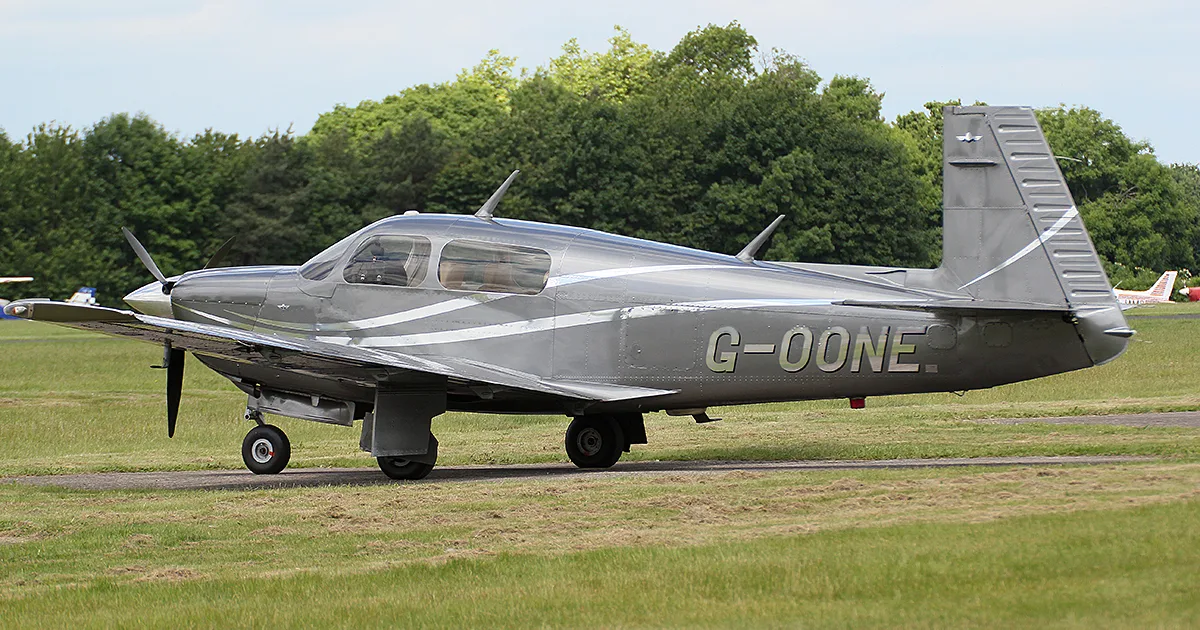


In this document
Specifications
The Mooney M20L PFM features a Porsche PFM 3200-N03 engine producing 217 hp at 2,343 propeller rpm. It has a maximum takeoff weight of 2,900 lbs and a fuel capacity of 66.5 gallons (60.5 gallons usable). The aircraft measures 26.92 ft in length, 8.33 ft in height, and has a wingspan of 36.08 ft.
Performance
The PFM achieves a cruise speed of 155 KTAS at 2,300 rpm with a fuel flow of 9.5 to 10.5 gallons per hour. It has a maximum level speed of 168 knots at sea level and a rate of climb of 1,050 feet per minute. The takeoff distance over a 50-ft obstacle is 2,510 ft.
Engine Management
The PFM is equipped with a Porsche engine featuring microprocessor-controlled ignition and a Bosch K-Jetronic fuel injection system. This system automatically adjusts the air/fuel mixture for optimal performance, with a recommended TBO of 2,000 hours.
Cockpit Features
The cockpit of the PFM is designed for comfort and efficiency, with a raised panel for better visibility and a unique throttle control that combines throttle, propeller control, and mixture adjustment into one mechanism. The interior is designed by Porsche, featuring high-quality materials and ergonomic design.
Safety and Maintenance
The PFM includes two 24-volt batteries and two independent electrical buses for redundancy. The handbook emphasizes the importance of following maintenance schedules, including 100-hour inspections, to ensure the engine's reliability.
Safety notes
- Ensure adherence to 100-hour inspections for engine reliability.
- Monitor electrical systems closely, especially if one bus fails.
Full document text
• offer the PFM 3200 (Porsche Flugmotor, 3,200-cubic-centimeter displacement) engine on a production airframe. Robin, a French company, builds a Porsche- powered sportplane, the DR400, that is popular as a glider tug. In 1985 Porsche asked Mooney to in- stall prototype PFM engines in a pair of 231 airframes. One of the airplanes was flown on an around-the-world trip un- dertaken by Porsche as an engine reli- ability test and for marketing purposes. Mooney then began work on its own Porsche-powered model in secret, al- though it was rumored the project was under way. The Mooney Porsche, or Mooney PFM, was formally unveiled at a No- vember 1987 press conference and dealer meeting. A collection of Porsche cars borrowed from a San Antonio dealer was put on display to comple- ment the airplane's sports-car cachet. The PFM represents a significant de- parture for Mooney. Since the 201 debuted in 1976, Mooney's emphasis has been on speed-more of it. Each new model was named for its top speed in miles per hour. Not so the PFM. Its performance is comparable to a 201 and is even a few knots slower. The PFM's strengths lie elsewhere: style, simplicity of operation, efficiency, and the new technology it incorporates. In eight months of operating a PFM, we have learned to add ·15 minutes to each fuel stop. The airplane attracts a lot of interest on the ramp. People want to look it over, peek inside, ask questions about it. This Mooney looks different than any other. The fuselage is a foot longer aft of the rear seats, the nose- wheel is eight inches farther forward, and the engine cowl is rounder and longer. And yes, it has a bold new paint scheme. The final flourish is the Porsche logo on the cowl. The airplane sounds different, too. The engine revs at more than twice the rpm of the geared propeller. If the pro- peller is spinning at 1,000 rpm when you taxi onto the ramp, the engine is busily churning at better than 2,260 rpm. Mixed in is the whoosh of the en- gine cooling fan. The impression made upon the people who watch you arrive is that this Mooney is special. Pop the door open and show off the inside. It's the work of Porsche design- ers who were given a bare fuselage to use as a template. Fabric color matches the exterior paint and is imprinted with the Porsche logo. The baggage bay is voluminous, and the hatrack has been turned into a handy compartmented chest for stashing cowl plugs, docu- ments, and even a hat or two. Front- and rear-seat indirect lights buried in an overhead console are the best to be found in any single. Mooney also has designed beefy new control yokes for the PFM. The next stop on the tour is the panel, which has been raised a few inches in deference to knees. The pedestal is far- ther forward as well, and the extra space is given to a swing-out rack useful for storing the pilot's operating handbook or charts. J1alcream-colored metal panel contains a new cluster of attractive and functional electronic engine instru- ments. Propeller rpm, fuel flow, fuel quantity, cylinder head and oil tempera- tures, and fuel and oil pressures are dis- played on circular pointer instruments that are both very legible and unusually accurate. Push a small button next to each instrument, and the numerical value appears in a liquid crystal display at the top of the cluster. Trim and flap positions, outside air temperature, and electrical load also are shown on sepa- rate LCDs. The look is state of the art, sophisticated, and very appealing. One last panel item to point out be- fore looking under the hood: It appears to be a grab handle for the pilot to pull himself out of the low-slung seat. It's actually the throttle, propeller control, and mixture adjustment combined into a single towel-bar-shaped control. The power couldn't be any easier to manage. Push the control in to the stop for full power for takeoff, and leave it there throughout the climb. Once you've reached cruise altitude and accel- erated to cruise airspeed, pull the control back slightly to reduce to the desired propeller rpm. That's it, that's all. No need to tweak manifold pressure or prop rpm or lean the mixture according to the exhaust gas temperature. It's all done for you ahead of the fire wall. The control is mechanically linked to the propeller governor and the fuel in- jection system. From idle to 2,300 en- gine rpm (the tachometer displays pro- peller rpm), the control adjusts throttle. Further movement adjusts prop pitch as well as throttle. At 4,200 engine rpm (approximately 1,850 rpm at the prop), the throttle is fully open, and pushing the control in adjusts prop pitch only. AOPA PilOT • 39 Maximum engine speed is 5,300 rpm, which the gearbox reduces to a propeller speed of 2,343 rpm. At 193 cubic inches, the six-cylinder, overhead-camshaft engine has a bit more than half the displacement of the four-cylinder Lycoming 10-360 that powers the Mooney 201, yet it produces 17 more horsepower. With a compres- sion ratio of 10.5:1, forget about pulling the prop through on a frosty mom. The basic design, configuration, and components are based on the Porsche 911 car engine, but the aviation version is manufactured to different tolerances. Parts are not interchangeable. The engine has a host of features new to general aviation: microprocessor-con- trolled ignition, a fuel injection system that automatically selects best-economy or best-power mixture, and fan cooling. Porsche also has a novel cost-assurance program that limits an owner's expense for unscheduled engine maintenance to $2,500 and guarantees an overhaul ex- change price of $14,000. To qualify, the owner must adhere to a policy of 100- hour inspections on the engine. The Bosch K-Jetronic fuel injection system monitors density of the intake air 40. NOVEMBER 1989 The Bosch fuel injection system does a marvelous job of thinking for itself to maintain a lean, best-economy air /
Show full textShow less
fuel mixture of 16:1 at every power set- ting except full power. The system does a marvelous job of thinking for itself. If the OAT rises a degree or two, fuel flow decreases a tenth of a gallon an hour. At full power, a microswitch on the power control activates a second air-density regulator in the Bosch fuel injection unit, enriching the mixture to a best-power ratio of 12.5:1. An Enrich switch is used for starting whenever CHTs are lower than 25 de- grees Celsius. Flipping the switch and engaging the starter squirts fuel into the intake manifold. Cold or hot, the engine routinely starts in one or two revolutions of the prop. Two high-pressure electric fuel pumps supply the engine. A third emer- gency pump is switched on for takeoff and landing. Fuel pressure is high enough to preclude the formation of va- por locks. Hot starts are not even men- tioned in the POH. Porsche has certified a 209-hp version of the engine for auto fuel use, but it is not available in the Mooney Porsche. The engine is the first for general avia- tion to be certified with electronic igni- tion. The heart of the dual, independent Magneti Marelli ignition systems is a pair of microprocessors that continu- ously adjust timing based on crankshaft rpm, absolute manifold pressure, piston top dead center, and intake air tempera- ture. The only moving parts are the dis- tributor rotors. The airplane has two 24-volt batter- ies, two 70-amp alternators, and two in- dependent electrical buses. If a problem should develop on one bus and trouble- shooting proves unsuccessful, the drill is to lift a large red guard at the top of a forest of circuit breakers on the right side of the panel and push the crossover breaker underneath. This pulls the plug on the affected bus and transfers the load to the other. Next, find an airport. With one bus out of the loop, redundancy is lost, and a problem on the remaining circuit could leave you with no electrical options other than battery power to the elec- tronic ignition and electric fuel pumps. ~ The greatest challenge in flying the Porsche Mooney is learning the intrica- cies of the electrical system and memo- rizing emergency procedures. TBO on the engine is 2,000 hours, but with experience, Porsche hopes to reach a 3,OOO-hourTBO. One reason is fan cooling. Air enters the engine plenum through a flush duct on the lower right side of the cowl and cools accessories at the back of the engine before it is sucked into the fan. The fan directs the air through a shroud and over the finned cylinders. The air exits into the slip- stream through louvers on the bottom of the cowl. Two engine-driven V-belts turn the fan, so its speed and, therefore, the vol- ume of cooling air in the shroud is pro- portional to engine rpm. The advantage of the fan and shroud arrangement is that CHTs are consistent and stable, even on a hot-day climb or with gross changes in power. Chop the throttle for a precipitous descent, and fan speed drops in concert with engine and propel- ler rpm. With no ram airflow, shock- cooling ceases to be of critical concern. What burden does all of this new-to- general-aviation technology place on the Porsche Mooney pilot? None, and that is the point. Operating the engine is almost as easy as stepping on the gas pedal in a car. To start it, switch on the master, the two battery switches, and the two fuel pumps, and turn the key. Push the power control in to go, pull it back to slow down. Even shutting down is different. Flip off the two fuel pumps, and the engine and propeller instantly stop as if they have seized. The Hartzell prop is made of Kevlar and is very light, so there is little flywheel effect. Engine and interior furnishings aside, the PFM is much like other Mooneys, which is to say efficient and highly per- sonal. You don't so much climb into the cockpit as slip it on. The seats sit low to . the floor, and the rudder pedals are re- •. cessed deep in the foot wells. The cabin may feel somewhat confining initially, but a Mooney grows on you. Cruise speed on our trips was a con- AOPA PilOT • 41 with experience, Porsche hopes to reach a 3,OOO-hourTBO. One reason is fan cooling. Air enters the engine plenum through a flush duct on the lower right side of the cowl and cools accessories at the back of the engine before it is sucked into the fan. The fan directs the air through a shroud and over the finned cylinders. The air exits into the slip- stream through louvers on the bottom of the cowl. Two engine-driven V-belts turn the fan, so its speed and, therefore, the vol- ume of cooling air in the shroud is pro- portional to engine rpm. The advantage of the fan and shroud arrangement is that CHTs are consistent and stable, even on a hot-day climb or with gross changes in power. Chop the throttle for a precipitous descent, and fan speed drops in concert with engine and propel- ler rpm. With no ram airflow, shock- cooling ceases to be of critical concern. What burden does all of this new-to- general-aviation technology place on the Porsche Mooney pilot? None, and that is the point. Operating the engine is almost as easy as stepping on the gas pedal in a car. To start it, switch on the master, the two battery switches, and the two fuel pumps, and turn the key. Push the power control in to go, pull it back to slow down. Even shutting down is different. Flip off the two fuel pumps, and the engine and propeller instantly stop as if they have seized. The Hartzell prop is made of Kevlar and is very light, so there is little flywheel effect. Engine and interior furnishings aside, the PFM is much like other Mooneys, which is to say efficient and highly per- sonal. You don't so much climb into the cockpit as slip it on. The seats sit low to . the floor, and the rudder pedals are re- •. cessed deep in the foot wells. The cabin may feel somewhat confining initially, but a Mooney grows on you. Cruise speed on our trips was a con- AOPA PilOT • 41 Mooney M20L PFM Base price: $149,900 Average equipped price: $185,000 Specifications Porsche PFM 3200-N03, 217 hp @ 2,343 prop rpm Recommended TBO 2,000 hr Propeller Hartzell composite, two-blade, constant-speed, 74-in diameter 26.92 ft 8.33 ft 36.08 ft 174.8 sq ft 16.6 lb/sq ft 13.4 Ib/hp 4 10.5 ft 3.6 ft 3.7 ft 1,952 Ib 2,1401b 948 Ib 7591b 585 Ib 396lb 2,900 Ib 2,900 lb 66.5 gal (60.5 gal usable) 399 Ib (363 lb usable) 13.5 qt 120 Ib, 22.6 cu ft sistent 155 KTAS at 2,300 rpm. Fuel flow varied between 9.5 and 10.5 gal- lons per hour, depending on altitude and ambient temperature. One flight in particular showcased the PFM's cross-country talents. The itiner- ary was Frederick, Maryland, to Keno- sha, Wisconsin, in the morning and re- turning that same evening. Winds were not a factor westbound, so 12,000 feet was the requested altitude. The POH calls for a cruise climb of 90 to 100 KIAS, but with the short prop, 110 knots works just as well. The initial climb rate with one aboard and full fuel was 1,000 feet per minute, which gradually decreased to 650 fpm at 8,000 feet. The interesting part was watching the Bosch system do its thing, reducing fuel flow from 16 gph down low to 13 gph at 8,000 feet, even though the power control stayed put. The absence of a headwind meant an early arrival for the appointment in Ke- nosha, so the extra time was used to ex- periment. The initial cruise power set- ting was 2,300 rpm, which yielded 153 knots true at 8.8 gph or 16.3 miles per gallon, according to the Arnav 50 loran. Reducing the power 1,000 rpm reduced fuel flow four tenths of a gallon at the expense of two knots. Another 1,000 rpm, another four tenths and two knots. At 2,000 rpm, fuel flow settled on 7.6 gph at 145 knots true, and the noise 129 KIAS 106 KIAS 174 KIAS 195 KIAS 65 KIAS 64 KIAS 57 KIAS Powerplant Length Height Wingspan Wing area Wing loading Power loading Seats Cabin length Cabin width Cabin height Empty weight Empty weight, as tested Useful load Useful load, as tested Payload w/full fuel Payload w/full fuel. as tested Max takeoff weight Max landing weight Fuel capacity Oil capacity Baggage capacity Performance Takeoff distance, ground roll l.250 ft from engine and prop was little more than soothing background music. Vibration and noise levels are notice- ably low in the PFM, which increases the comfort level considerably. The en- gine hangs from a three-point, low-vi- bration mount, and the gearbox is cou- pled to the engine through a fabric- reinforced rubber disk that absorbs torsional vibration. The slow-turning propeller generates fewer decibels, and engine noise is effectively attenuated by the exhaust muffler and also by the inte- rior soundproofing. The flight took exactly four hours. The lineman replenished the tanks with 35.6 gallons. The Mooney could have flown for another two hours and still have had legal IFR reserves. Dinner was waiting at the end of the return leg, so it was flown at high power in 3 hours 24 minutes. The tanks took 41.2 gallons. With 60.5 gallons usable fuel, the PFM has excellent endurance. The com- promise is restricted payload. Our PFM can carry 2.3 170-pound souls with the tanks topped off. With four FAA-stan- dard adults aboard and 50 pounds of bags, you could depart with enough fuel to taxi out and check the ignition before running dry. Between the two ex- tremes-full fuel or full cabin-lies a fair amount of flexibility in trading one for the other. Mooney says it is working Takeoff distance over 50-ft obstacle 2,510 ft Rate of climb, sea level 1,050 fpm Max level speed, sea level 168 kt Cruise speed/endurance w/45-min rsv, std fuel (fuel consumption) @ 2,300 prop rpm 160 kt/4.5 hr 9,000 ft (66.6 pph/11.l gph) @ 2,100 prop rpm 152 kt/5.2 hr 9,000 ft (58.2 pph/9.7 gph) @ 2,000 prop rpm 145 kt/5.9 hr 9,000 ft (51.6 pph/8.6 gph) Max operating altitude 19,300 ft Landing distance over 50-ft obstacle 1,900 ft Landing distance, ground roll 900 ft Limiting and Recommended Airspeeds Vx (best angle of climb) 75 KIAS Vy (best rate of climb) 96 KIAS Va (design maneuvering) 117 KIAS Vfe (max flap extended) 110 KIAS Vie (max gear extended) 129 KIAS Vlo (max gear operating) Extend Retract Vno (max structural cruising) Vne (never exceed) Vr (rotation) Vs1 (stall, clean) Vso (stall, in landing configuration) All specifications are based 011 manufacturer's calcula- tions. All perfonnance figures are based on standard day, standard atmosphere, sea level, gross weight COll- ditions unless otherwise noted. 0 on increasing the useful load. Base price of the PFM is$149,900. Av- erage equipped retail price of an IFR- equipped one is $185,000. The price re- flects an expensive certification effort, the higher cost of the Porsche engine, and Mooney's decision to set the PFM apart with a first-class interior and instrumentation. Mooney has built 41 PFMs, about half of which have been sold. The company admits to a mistake in initially market- ing the PFM to its traditional customer base-existing Mooney owners-rather than to first-time buyers. New incentive programs are being considered to attract PFM sales. Porsche, meanwhile, has had to con- duct some damage control following a decision to sell its Galesburg, Illinois, base and discontinue its effort to reengine Cessna 172s with the PFM 3200. Porsche's aviation activities now will be handled by Porsche Cars North America in Reno, Nevada. Technical support, including parts inventory, spare engines, and customer assistance, are unaffected by the change, except for relocating to Reno. About 100 aviation mechanics have attended special PFM 3200 training classes. The announcement prompted wide speculation that Porsche would soon bailout of airplane engine production altogether. Sales of Porsche cars in the United States have declined steadily since 1986. The company has cut pro- duction of its cars and has altered its marketing approach to emphasize low volume and high exclusivity rather than volume sales. That strategy would ap- pear to fit the PFM 3200 perfectly, but a Porsche spokesman said the likelihood of continued production and develop- ment of the PFM 3200 (a turbocharged version has been tested) has yet to be determined in light of Porsche's woes. The strength of the PFM is not, as some believe, the prestige of driving up to the fixed-base operation airside ramp in a Porsche, although that is a pleasant extra. The benefits are much more prag- matic. They include the ease of manag- ing the power, fuel economy, the ab- sence of vibration and noise, instant starting, and the very real potential for longer, more reliable service. Mooney and Porsche have taken a long step for- ward with the M20L. In an cri-ena in which technology advances almost im- perceptibly, their achievement deserves a full measure of attention, recognition, and support. 0