
Flight Simulation Training Device Qualification Certificate
Training Manual for the Beechcraft King Air 350
PDF, 5 pages, 2.6 MB, from Sprinkle’s own files.
What it covers
This document is a qualification certificate for a flight simulation training device specifically designed for the Beechcraft King Air 350 (B300). It certifies that the Royal Flying Doctor Service of Australia has a simulator that meets EASA Level 1 standards for training purposes. The simulator is equipped with advanced systems including a Proline Fusion avionics suite and is capable of simulating various flight scenarios and instrument approaches. The document outlines the specifications of the simulator, the conditions for its operation, and the training activities that can be conducted using it. It is intended for use by authorized instructors and training organizations to ensure pilots are proficient in operating the King Air 350.
Key points
- The simulator is certified for the Beechcraft King Air 350 (B300).
- It features a visual system with a 180 x 40 degree field of view.
- Training must be conducted by authorized instructors following an approved syllabus.
- Supports various instrument approach procedures including ILS and VOR.
- Includes emergency procedure training for scenarios like rapid decompression.
Main sections
Flight Simulator Qualification Basis
The flight simulator is qualified under FAR Part 60 Change 2, ensuring it meets the necessary standards for training and testing pilots.
Simulator Specifications
The simulator features an aXion visual system with a 180 x 40 degree field of view using laser DLP technology. It does not have a motion system and is fitted with PW PT6A-60A engines.
Training and Testing Conditions
Training for aircraft category ratings must follow an approved syllabus by authorized instructors. The simulator can be used for various instrument proficiency checks and must be operated in accordance with specific regulations.
Instrument Approach Procedures
The simulator supports multiple types of instrument approach procedures including DGA, NDB, VOR, RNP APCH LNAV, and ILS/LOC, allowing for comprehensive training in instrument flying.
Emergency Procedures
The simulator includes training for emergency procedures such as emergency descent and rapid decompression, which are critical for pilot readiness in real-world scenarios.
Safety notes
- Training must be conducted in accordance with the operator's approved syllabus.
- At least one instrument approach operation must be demonstrated in an aircraft or approved flight simulator.
The document’s text
Show the text read from the PDF
Civil Aviation Safety Regulations 1998 – Part 60 Regulation 60.035 FLIGHT SIMULATION TRAINING DEVICE QUALIFICATION CERTIFICATE Number: CASA.FSTDQC-AUS-74B Revision: 6 AUS 74 This is to certify that ROYAL FLYING DOCTOR SERVICE OF AUSTRALIA (SOUTH EASTERN SECTION) NEW SOUTH WALES OPERATIONS ARN: 1004330 BEECH 300 B300 (KING AIR 350) Serial No: SN-001 located at 9 Cooreena Road, DUBBO AIRPORT, NSW 2830 is qualified as a EASA Level 1 Flight Training Device in accordance with Subpart 60.B of the Civil Aviation Safety Regulations 1998. The device specifications including identifying details, types and models of aircraft that are simulated and the capability of the device are described in this certificate. This certificate is not transferable and continues in force until 31 March 2026. Joseph Anthony Rule Branch Manager Flight Standards National Ops & Standards Delegate of the Civil Aviation Safety Authority 27 March 2025 -- 1 of 5 -- Civil Aviation Safety Authority Flight Simulation Training Device Specification AUS 74 a) Type/Variant of Aircraft BEECH 300 B300 (KING AIR 350) b) Flight Simulator Qualification Basis FAR Part 60 Change 2 c) Visual System aXion visual system 180 x 40 Deg FOV laser DLP d) Motion System Nil e) Engine Fit PW PT6A-60A f) Flight Management System Fit Proline Fusion Rel 3 Avionics g) TCAS Fit TCAS II h) Additional capabilities Nil i) Guidance Information: Training, testing, and checking considerations Conditions For the credits specified, the synthetic trainer must be operated in accordance with the following conditions; 1. Training for the grant of an aircraft category rating or operational rating must be conducted in accordance with the operators approved syllabus of training by an authorised instructor. Part 1 - Instrument proficiency checks 1. For 61.695(6) and 61.880(6) – The following instrument approach operations using Instrument approach procedures specified in Part 3 of this schedule. At least 1 instrument approach operation must be demonstrated in an aircraft or approved flight simulator for the relevant aircraft as defined under 61.695(9) and 61.880(9) a. 2D instrument approach operations b. 3D instrument approach operations c. Azimuth lateral guidance d. Course Deviation Indicator (CDI) lateral guidance Note 1: At least 1 instrument approach operation to be conducted in an aircraft of the same category or flight simulator approved under CASR Part 60. Part 2 - Instrument rating or MPL/ATPL recent experience 1. Instrument approach operations 61.645(2), 61.685(2) and 61.870(2) 2. 2D instrument approach operations 61.645(4), 61.685(4) and 61.870(4) 3. 3D instrument approach operations 61.645(5), 61.685(5) and 61.870(5) CASA.FSTDQC-AUS-74B Revision: 6 Page 2 of 5 -- 2 of 5 -- 4. Azimuth lateral guidance 61.645(6), 61.685(6) and 61.870(6) 5. Course Deviation Indicator (CDI) lateral guidance 61.645(7), 61.685(7) and 61.870(7) Note 2: Under CASR 61.645(2), 61.685(2) and 61.870(2) the holder must conduct at least 1 instrument approach operation in an aircraft or flight simulator of the same category within the previous 90 days to satisfy the recent experience requirements. Part 3 - Type of instrument approach procedures 1. For 61.640(3), 61.680(4) and 61.860(5) the following kind of instrument approach procedures can be demonstrated; a. DGA b. NDB c. VOR d. RNP APCH LNAV e. RNP APCH LNAV/BARO VNAV f. ILS/LOC Part 4 - Additional Activities 1. a. Proline Fusion Avionics Systems training b. MCC Training - As approved in theoperators Part 142 training organisation CASA.FSTDQC-AUS-74B Revision: 6 Page 3 of 5 -- 3 of 5 -- Part 5- Type Rating (Initial and Recurrent) - As approved in the users Part 141 training organisation Areas of Operation • Pre-flight Procedures • Preflight Inspection (Cockpit Only) • Powerplant start • Pre-take-off checks • Take-off and Departure phase • Instrument departure procedure • Rejected Take-off (requires visual system) • Departure Procedure • In-flight Manoeuvres • Steep Turns • Approaches to Stall • Engine Failure (procedure only) • Instrument Procedures • Standard Terminal Arrival / Flight Management System Procedures for Arrivals • Holding • Precision Instrument Approach (All Engines Operating) • Non-precision Instrument Approach (All Engines Operating) • Missed Approach (Normal) • Normal and Abnormal Procedures • Powerplant • Fuel System • Electrical System • Hydraulic System • Environmental and Pressurisation Systems • Fire Detection and Extinguisher Systems • Automatic Flight Control System, Electronic Flight Instrument System, and Related Subsystems • Flight Control System • Anti-ice and De-ice systems • Aircraft and Personal Emergency Equipment • Network Server System / On board Information System • Landing Gear CASA.FSTDQC-AUS-74B Revision: 6 Page 4 of 5 -- 4 of 5 -- • Emergency Procedures • Emergency Descent • Rapid Decompression • Post flight Procedures • After landing Procedures • Parking and Securing j) Restrictions / Limitations Nil CASA.FSTDQC-AUS-74B Revision: 6 Page 5 of 5 -- 5 of 5 --
Read from the PDF by machine, so tables and diagrams come out rough. The PDF is the document.
More Beechcraft King Air 350 documents
All 21 →- Beechcraft King Air 350 Model Guide
The Beechcraft King Air 350 is a twin-turboprop in production since 1990. It uses two Pratt & Whitney PT6A-60 engines rated 1,050 SHP each. The technical data lists seating as 1 + 9 / 15 (crew + pax). Broker data shows a 15,000 lb max takeoff weight, 35,000 ft maximum altitude and 320 knot high-speed cruise.
- Halo 350 Ica For Super King Air B300/B300C
This document serves as the Instructions for Continued Airworthiness (ICA) for the Super King Air B300 and B300C series airplanes that have been modified by CenTex Aerospace’s Halo 350 Conversion. The conversion enhances the aircraft's maximum takeoff weight and integrates several safety systems to improve overall safety for both the aircraft and its passengers. This manual is essential for maintenance personnel and operators to ensure compliance with FAA regulations and to maintain the airworthiness of the modified aircraft. It supplements existing Textron Aviation Aircraft Maintenance Manuals (AMM) and provides specific guidelines for the Halo 350 modifications, including maintenance procedures, inspection schedules, and troubleshooting information for newly installed systems.
- Halo 350 Wiring Diagram Manual
The HALO 350 Wiring Diagram Manual provides detailed wiring diagrams for the equipment and modifications associated with CenTex Aerospace's Halo 350 Conversion on Beechcraft Super King Air models B300 and B300C. This manual includes essential safety systems such as the Ice Mode Stall Warning System and the Takeoff Trim Warning System. It serves as a critical resource for maintenance personnel and technicians involved in the installation and upkeep of these systems. The manual also references other Textron Aviation wiring diagram manuals for existing aircraft wiring information, ensuring comprehensive coverage of the electrical systems in these aircraft.
- King Air 300/350 Business Aircraft Maintenance Training
This document is a maintenance training manual specifically designed for the Beechcraft King Air 300 and 350 aircraft. It outlines the training objectives, expectations, and various maintenance training courses available for technicians. The manual emphasizes the importance of proper aircraft maintenance to ensure safety in business aviation. It provides a comprehensive overview of the systems and components of the King Air series, including hands-on training modules and theoretical knowledge necessary for effective maintenance practices. The training is aimed at certified Airframe and Powerplant Mechanics or those with equivalent experience, ensuring that technicians are well-prepared to maintain and troubleshoot these aircraft models.
- King Air Nose Extension & EO/IR Lift
This document outlines the Supplemental Type Certificate (STC) modifications made by Sierra Nevada Corporation (SNC) for the Beechcraft King Air series, specifically focusing on the King Air 350 model. The modifications include a structural extension of the aircraft's nose to accommodate a retractable electro-optical/infrared (EO/IR) sensor. This STC allows for significant flexibility in mission requirements while maintaining the aircraft's original weight and center of gravity limitations. The document is intended for operators and maintainers of the King Air 350, providing essential information about the modifications and their operational benefits.
Supplemental Type Certificate · 2022PDF · 2 pages · 1.8 MB of King Air Nose Extension & EO/IR Lift, opens in a new tabRequest removal of King Air Nose Extension & EO/IR Lift - Family of King Air ISR Aircraft
This document provides a comprehensive overview of the L3Harris SPYDR family of King Air ISR (Intelligence, Surveillance, and Reconnaissance) aircraft, specifically focusing on the Beechcraft King Air 350 model. It outlines the various modifications and capabilities that enhance the aircraft's performance for ISR missions. The document is intended for operators and stakeholders involved in the deployment and utilization of King Air 350 aircraft for complex ISR tasks. Key features include advanced mission management systems, sensor integration, and communication capabilities, all designed to support critical missions globally.
- Type Acceptance Report TAR 98/18 – Textron Super King Air
This Type Acceptance Report provides detailed information regarding the Textron Model 200/300 series Super King Air, specifically focusing on the Beechcraft King Air 350. It outlines the aircraft's certification details, compliance with New Zealand operational rules, and the requirements for obtaining an Airworthiness Certificate. The report is intended for aviation authorities, operators, and maintenance personnel involved with the King Air series in New Zealand. It includes specifications for various models, operational limitations, and compliance with safety standards, ensuring that operators are informed about the aircraft's capabilities and regulatory requirements.
- Installation Of Saddle Tanks For Beechcraft King Air Airplanes
This document is an Airplane Flight Manual Supplement for the Beechcraft King Air series, specifically detailing the installation and operation of CenTex Aerospace's Saddle Tanks and Saddle Tanks Plus systems. It provides critical information for pilots and operators regarding modifications that increase the aircraft's fuel capacity. The Saddle Tanks system adds 190 gallons of usable fuel, while the Saddle Tanks Plus system adds 120 gallons. This supplement outlines limitations, procedures, and performance adjustments necessary for safe operation following these modifications. It is essential for users to familiarize themselves with the content to ensure compliance with FAA regulations and safe flying practices.
Beechcraft 300 for sale now
View all 32 for sale →Aircraft that this training manual covers, listed on the sites Sprinkle reads. Asking prices, not sales. Beechcraft 300 asking prices by year built.
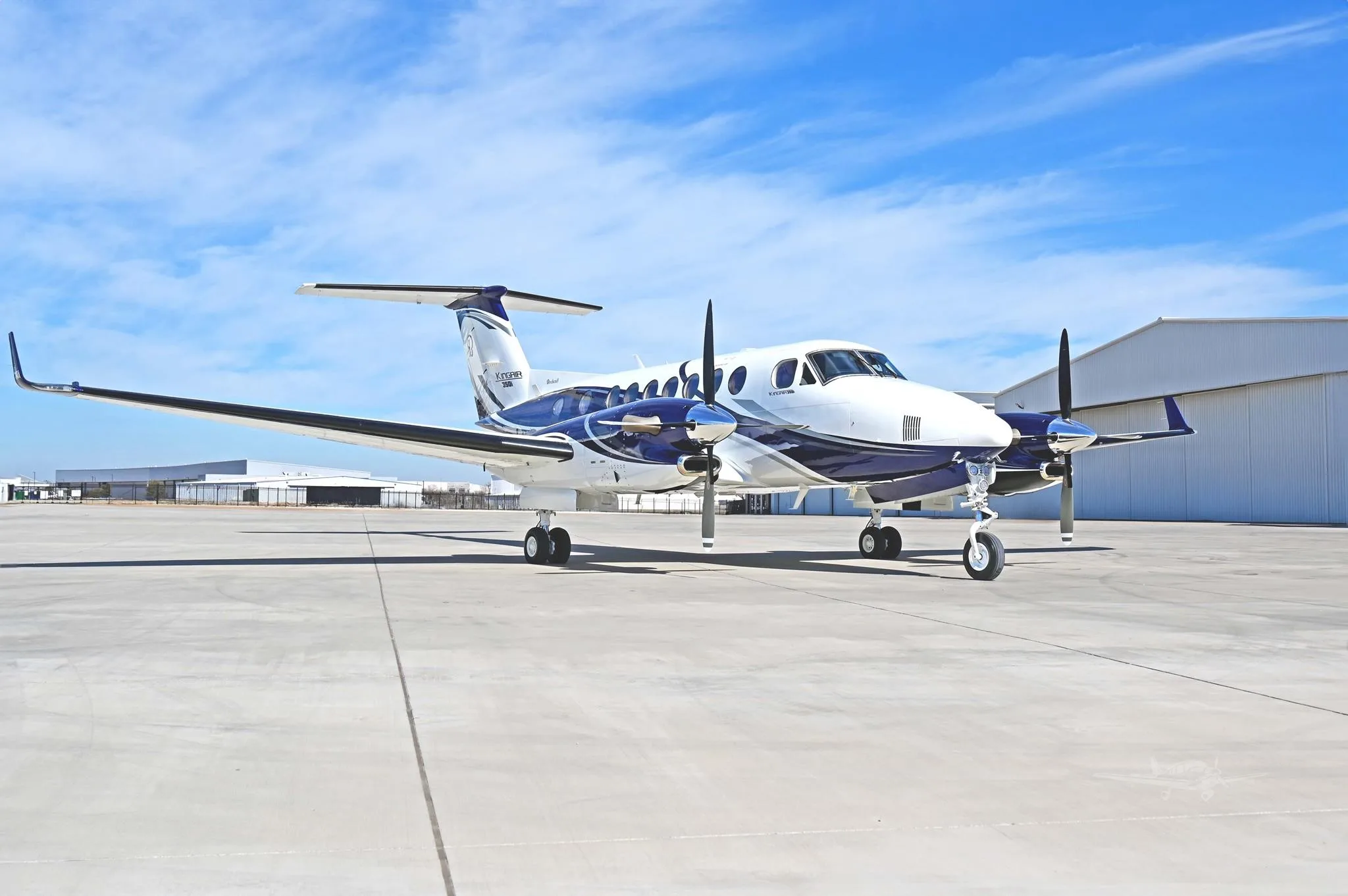

Also useful for the Beechcraft King Air 350
From Sprinkle’s library of aircraft documents. PDFs open from Sprinkle’s own files. Read Feb 24, 2026.
Want this document taken down? Request removal