CESSNA T303 CRUSADER
Cessna 303 Crusader · Pilot's Operating Handbook
Overview
This document is a Pilot's Operating Handbook (POH) specifically for the Cessna T303 Crusader. It provides essential information for pilots operating this aircraft, including performance data, operational procedures, and safety guidelines. The handbook is designed to assist both new and experienced pilots in understanding the unique characteristics of the T303 Crusader, ensuring safe and efficient operation. It covers various aspects such as aircraft specifications, weight and balance, fuel requirements, and emergency procedures, making it a vital resource for anyone flying this model.
- Maximum takeoff weight: 4,600 lbs (2,086 kg)
- Cruising speed: approximately 180 knots
- Stall speed: 60 knots in landing configuration
- Range: approximately 1,200 nautical miles
- Fuel capacity: 100 gallons (378 liters) of 100LL aviation gasoline
Document
Source
Originally published by www.cessnaflyer.org. Sprinkle hosts a reference copy with an added summary, specifications and searchable full text.
Document details
- Type
- Pilot's Operating Handbook
- Year
- 2013
- Pages
- 84
- File size
- 10 MB
- Publisher
- www.cessnaflyer.org
Common. Rarer than 2% of the aircraft models we track.
Most owners only have the POH. Here's the essential set for the Cessna 303 Crusader.
- Pilot's Operating Handbook / AFM
- Checklist
- Maintenance Manual
- Parts Catalog (IPC)
- Systems & Wiring
- Service Bulletins
- Type Certificate (TCDS)
Cessna 303 Crusader for sale now
Free — save the T303 Crusader to your watchlist and track it in one place.
More Cessna 303 Crusadermanuals & documents
See all 21 →- Checklist for the Cessna 303 CrusaderChecklist
- Type Acceptance Report – Cessna T303Pilot's Operating Handbook
- Defending Air Bases in an Age of InsurgencyTraining Manual
- Airworthiness Directive Schedule Aeroplanes Cessna 303 SeriesService Bulletins
- FAA Approved Model List (AML) STC SA02016SE-DType Certificate
- AeroSafety World - April 2009Training Manual
- AAIB Bulletin: 8/2008Service Bulletins
- Approved Model List For STC No. SA02217AKSupplemental Type Certificate
- AAIB Bulletin: 10/2007Other Documents
- AAIB Bulletin: 7/2007 D-IAFC EW/C2006/09/05Other Documents
- AAIB Bulletin No: 11/2004Service Bulletins
- AAIB Bulletin No: 3/99 Ref: EW/C97/9/6Other Documents
If you fly the Cessna 303 Crusader, you may also be researching these.


In this document
Aircraft Specifications
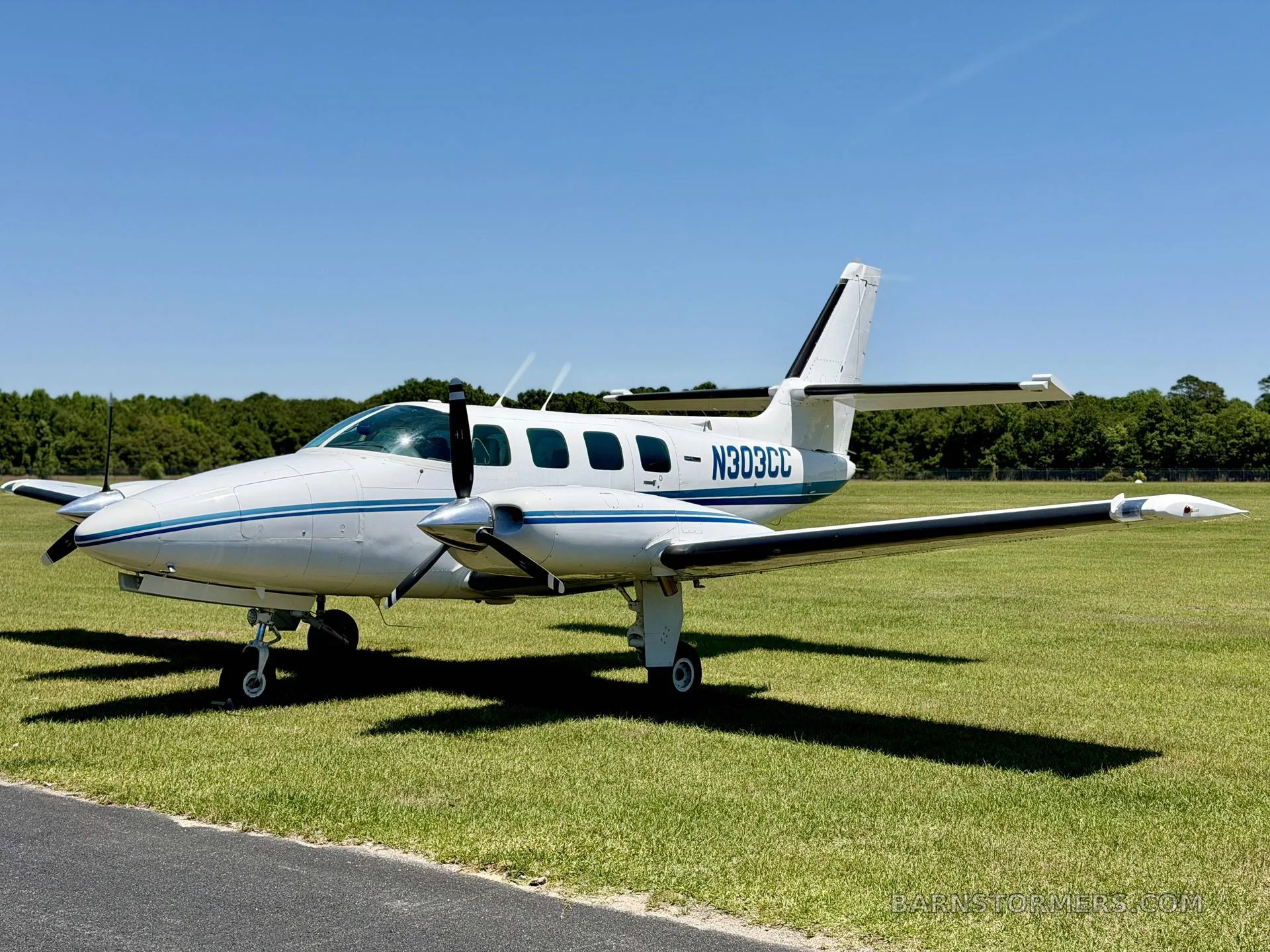
The Cessna T303 Crusader features a twin-engine configuration with a maximum takeoff weight of 4,600 lbs (2,086 kg). It is powered by two Continental TSIO-520-U engines, each producing 300 HP. The aircraft has a wingspan of 38 feet 6 inches (11.73 m) and a length of 30 feet 6 inches (9.30 m). Its cruising speed is approximately 180 knots.
Performance Data
The T303 Crusader has a stall speed of 60 knots in landing configuration and a maximum speed of 200 knots. The rate of climb is about 1,200 feet per minute under standard conditions. The aircraft has a range of approximately 1,200 nautical miles with full fuel.
Weight and Balance
The maximum useful load for the Cessna T303 Crusader is 1,200 lbs (544 kg). Pilots must ensure that the aircraft is loaded within the specified weight limits to maintain safe flight characteristics.
Fuel Requirements
The Cessna T303 Crusader requires 100LL aviation gasoline. The total fuel capacity is 100 gallons (378 liters), with 95 gallons (360 liters) usable.
Emergency Procedures
In the event of an engine failure, pilots should follow the established emergency procedures, which include maintaining control of the aircraft, identifying the failed engine, and executing a controlled descent if necessary.
Safety notes
- Always perform a preflight inspection before each flight.
- Ensure weight and balance calculations are completed prior to takeoff.
- Follow emergency procedures as outlined in the handbook.
Full document text
CESSNA T303 CRUSADER TORQUE WRENCH CARE GREAT ALASKA AVIATION GATHERING VOL 10 ISSUE 08 AUG 2013 cessnaflyer.org Booth #4008 PRSRT STD US POSTAGE PAID PERMIT NO 5377 DENVER, CO CHANGE SERVICE REQUESTED CESSNA FLYER ASSOCIATION 2450 N LAKE AVE #113 ALTADENA, CA 91001 Cessna Flyer is the official publication of the Cessna Flyer Association. Cessna Flyer is published monthly by Avia- tion Group Limited, 2450 N. Lake Ave., #113, Altadena, CA 91001. POSTMASTER: Send address changes to Cessna Flyer, 2450 N. Lake Ave., #113, Altadena, CA 91001. Subscriptions, advertising orders, and correspon- dence should be addressed to 2450 N. Lake Ave., #113, Altadena, CA 91001. Annual dues: $40.00 in the US; Canada and Mexico add $15.00 per year; all others add $25.00 per year (US Dollars only). Eighty percent (80%) of annual dues is designated for your magazine subscriptions. The information presented in Cessna Flyer is from many sources for this there can be no warranty or responsibility by the publisher as to accuracy, originality or complete- ness. The magazine is sold with the understanding that the publisher is not engaged in rendering product en- dorsements or providing instruction as a substitute for appropriate training by qualified sources. Cessna Flyer and Aviation Group Limited will not assume responsibility for any actions arising from any information published in Cessna Flyer. We invite comments and welcome any report of inferior products obtained through our advertis- ing, so corrective action may be taken. 2450 N. Lake Ave., Suite 113 Altadena, CA 91001 Tel: 800.397.3920 www.cessnaflyer.org CES SNA F LYE R A U G U S T 2013 04 The Official Magazine of The Cessna Flyer Association PRESIDENT Jennifer Dellenbusch jen@aviationgroupltd.com VICE PRESIDENT / DIRECTOR OF SALES Kent Dellenbusch kent@aviationgroupltd.com ASSISTANT VICE PRESIDENT Cynthia Maughan ASSISTANT DIRECTOR CESSNA FLYER ASSOCIATION John Bagnas JohnB@aviationgroupltd.com EDITOR AT LARGE Thomas Block CONTRIBUTING EDITORS Charles Lloyd • David Hipschman John Loughmiller • John Ruley Lyn Freeman • Mike Berry Michael Leighton • Steve Ells CONTRIBUTING PHOTOGRAPHERS Paul Bowen • Robb Gessert Austin Brown • Keith Wilson ASSOCIATE EDITOR Heather Skumatz Heather@aviationgroupltd.com CREATIVE DIRECTOR Yee Chan Vol. 10 Issue 08 Aug 2013 A little Attitude for Everyone “The D1, I’ve decided, is perhaps the perfect emergency backup flight display.” - Stephen Pope, Flying, October 2012 “In flight, the D1 is little short of amazing: Roll and pitch displays perfectly match those from the mechanical attitude indicator...” - John D. Ruley, Plane & Pilot, November 2012 * Limited time offer, see website for more details www.DynonAvionics.com info@DynonAvionics.com Seattle, Washington The reviews are in, and they agree: The Dynon D1 Pocket Panel is... Now only $1,295 after rebate! * RMD Aircraft Lighting Inc. PO Box 238 • North Plains, OR 97133 503-628-6056 www.rmdaircraft.com Cessna 172, 180, 182, 185, 206, 210 WINGTIP LANDING RECOGNITION LIGHTS STC and FAA / PMA approved RMD now offers new fiberglass wingtips with landing lights installed for your Cessna aircraft. Can be used continuously for ground operation or in-flight recognition. Instrument Corp. Air Venture Oshkosh July 29-August 4, 2013 Hangar B - Booth 2061 - 2062 Air Venture Oshkosh July 29-August 4, 2013 Hangar B - Booth 2061 - 2062 The US patent office has allowed the G Series patent. It will be the most comprehensive engine monitoring patent ever granted. All of the G Series unique and revolutionary ideas are protected for 20 years. • • • I like to stay ahead of my airplane. So if I’m 40 miles out with weather rolling in, I’m listening to what’s happening in front of me. AWOS. Pilot chatter. A quick check with flight service. Sometimes, there’s a lot to decipher. But I need to hear it clearly. Because when I do, I feel confident. Prepared. In the moment. And that allows me to just focus on what matters, flying. MORE NOISE REDUCTION. LESS DISTRACTION. Better sound can make all the difference, especially where you go. Which is why, with 30% greater noise reduction than conventional noise reducing aviation headsets, the A20 headset lets you hear more of what you need to hear. While proprietary cushions and minimal clamping force let you fly comfortably for hours. Meets or exceeds TSO standards. To order 1.800.905.0870 | Learn more at Bose.com/A20_17 ©2013 Bose Corporation. Delivery is subject to product availability. Made in U.S.A. Bose® A20® Aviation Headset Cover: Cessna T303 Crusader by Keith Wilson 54 34 60 42 30 Flight Test: Cessna T303 Crusader by Peter Underhill Trusty Companion: The Venerable Lap Desk by Jeffrey Chipetine Tugs, Tow Bars and Winches by John D. Ruley Take Care of Your Torque Wrench by Tim Kern Great Alaska Aviation Gathering by Jennifer Dellenbusch THE VIEW FROM HERE Jennifer Dellenbusch LETTERS to the EDITOR CESSNA FLYER EVENTS LEFT COAST PILOT John Ruley HEADING BUG David Hipschman QUESTIONS & ANSWERS Steve Ells PRODUCT GUIDE NEWS ADS & ALERTS ADVERTISER INDEX FLYER’S MARKETPLACE TAILWINDS 08 08 10 14 18 24 28 68 73 80 81 82 Photo: Keith Wilson AUGUST 2013 Brand Awareness LETTERS to the EDITOR Send your letters to editor@cessnaflyer.org “Shane 1” by John Loughmiller, July 2013 Hi Kent, I just got the July issue of Cessna Flyer on my desk this afternoon… and I just finished reading “Shane 1: An Unforgettable First Flight.” It touched my heart because we used to live in South Bend and love Notre Dame. It also touched my heart because I have a grandson who has been the recipient of the Make-A-Wish foundation. I hope this article is going to be front and center on your home page for all to read. What a fantastic story—and so well-written. I’ve been choking back tears for the last 15 minutes. Thank you! Teresa Ganser Director of HR, Marketing & Quality SCS Interiors Duluth, Minn. “Hypoxia: The Silent Killer” by Brent Crow, July 2013 Dear Editor,
Show full textShow less
I enjoyed your article about hypoxia and Brent Crow’s information. My wife had pulmonary disease and does not fly with me. She does have sev- eral FAA certified concentrators. I am curious to know if they would be suitable for a GA pilot in an unpressur- ized cabin up to the rating altitude for the pilot. Meaning, if rated to 10,000 feet MSL, could I use them in a Cessna 182 while piloting to provide oxygen? Thanks! David Novelli Author’s Reply David, Thanks for your question. Medical oxygen concentrators have been devel- oped for individuals, such as your wife, We’ve tried over the years this magazine has been published to see the glass as half full. It’s been a mission of sorts to seek out the good news and look for solutions and to spotlight the people making a positive difference in aviation. Sometimes, though, it helps to do a reality check and make sure that opti- mism isn’t overriding common sense. This month David Hipschman writes about his concerns for aviation and outlines what he sees as the issues facing us. It’s a sobering bit of writing and our challenge is to look clearly at the con- cerns that David raises without losing hope. As I touched on last month, I do believe that despite tons of good inten- tions, good programs and good people, we haven’t done the right things to increase the pilot population. There’s been too much preaching to the choir and too many programs that take place at the “micro” level. We’re trying to win over new pilots a handful at a time and while we definitely need every handful, we need to supplement those initiatives with some that are much broader-based. We need brand awareness for General Aviation. I’d love to see a billboard on Interstate 15 between Los Angeles and Las Vegas (a famously jammed stretch of highway) showing the benefits of General Aviation travel. It wouldn’t feature a plane, it would show people having fun in Vegas or relaxing at home with a smaller image of a plane and a tagline like, “If you flew GA, you’d already be there.” Corny? Maybe… and there are some bril- liant marketing people out there who could do better, I’m sure. The point is we need something to pique people’s interest, get them to think about General Aviation outside of a news story about a plane crash. But who is going to finance something like this? How will it be managed? Maybe we need a crowdfunding initiative for General Aviation marketing. Maybe there is something else we should be doing. These are questions we need to start asking. What are your ideas? I’d love to hear them. In the meantime, there’s still a lot of life left in aviation and a lot of enjoy- ment to be gained through flying, so to paraphrase the old military phrase, “Fly ‘em if you’ve got ‘em.” We have two new venues to help you do just that: our Gatherings in Ohio and Texas. See listings in the Events calendar on page 10 for details. I hope to see you there, where you can share your thoughts and ideas about aviation’s future in person. Blue skies, Jennifer Dellenbusch THE VIEW FROM HERE CES SNA F LYE R A U G U S T 2 0 1 3 08 continued on page 78... where you’ll be free to take in the sights and have dinner on your own—or get together with other flyers. Rooms at the hotel and space for lunch are limited, so RSVP soon. Note: there may be a small cost per person for the group transporta- tion from Fredericksburg to Boerne and back. We’ll know more once we have a head count. Email johnb@aviationgrou- pltd.com or phone Cessna Flyer Associa- tion at 800-397-3920. FEATURED EVENTS Aug 3 – Fayetteville, N.C. Fayetteville Re- gional (KFAY). Fly-in sponsored by Land- mark Aviation and All American Aviation Services. 11 am to 5 pm. Barbecue lunch (free with fuel top-off); two free T-shirts per family, full service fuel discounts. Free in- troductory lessons on our flight simulator. Discovery flights for $79. Live band; kids’ zone. Vendors will also be present. Contact All American Aviation at 910-483-3315. Sept 7 — Burlington, WA. Skagit Re- gional (KBVS). Skagit Flight Fest 2013. Aerobatics show featuring father-and-son team of Bud and Ross Granley, “The Flying Tenor” Will Allen and female aerobatic and racing pilot Vicky Benzing. A wide variety of static displays, youth activities and vendors. No admission charge. The event is a unique partnership involving the Port of Skagit, Burlington Chamber of Commerce and Skagit Air- port Support Association. Contact Carl Molesworth, 360-757-0011 or email carl@portofskagit.com. Sep 25-29 — McCall Mountain/Canyon Flying Seminars, LLC. Fall Canyonlands Flyin’ Safari. Visit mountaincanyonfly- ing.com for more information. Contact Lori MacNichol or Rhonda Yost, 208-634-1344; email admin@mountaincanyonflying.com. Oct 10-12 – Fort Worth, TX. Fort Worth Meacham International (KFTW). AOPA Aviation Summit. Don’t miss the most interactive, expert-packed Summit ever! The exhibit hall will bring you 400 live- action opportunities to reach out and try things, talk with pros and make money- saving deals. Then, it’s out to the airport to climb into some great airplanes and enjoy live music, speakers and learn-to-fly displays. Contact AOPA staff at 301-695- 2000 or visit aopa.org/summit. Oct 24-26 – Casa Grande, AZ. Casa Grande Municipal (KCGZ) Copperstate Fly-in and Aviation Expo. Now in its 41st year, the family-friendly Copperstate Regional Fly-in is a great place to see a diverse blend of aircraft in action, attend informative workshops and check out the latest, greatest aviation products. Attendees particularly enjoy the wide variety of aircraft on the ground and in the air—from ultralights, to World War II fighter jets, to microjets and much more. For details, see copperstate.org. OTHER EVENTS AUGUST 2013 Aug 10 – 11— Olympia, WA. Olympia Airport (OLM). 15th Annual Olympic Air Show. 9 am to 5 pm. Many recog- nized aerobatic performers and aircraft, as well as heritage aircraft from the mu- seum’s collection. This year we showcase aircraft from the Golden Age of Aviation CFA EVENTS Aug 23-24 — Kidron, OH. Stoltzfus Airfield (OH22). Preferred Airparts and Cessna Flyer Association present the Gathering in Ohio. Join us at Preferred Airparts headquarters in Kidron, Ohio. We’ll have two days of fun and camara- derie including a hangar party/barbecue, tour of the beautiful local countryside and historic Amish country, and Saturday night dinner. For details visit CessnaFlyer. org or call 800-397-3920. Sep 20-21 — Fredericksburg, TX. Gath- ering in Fredericksburg 2013. Join us at the Hangar Hotel in Fredericksburg, Texas.Friday night we’ll have a meet-up in the Officer’s Club at the hotel. Satur- day we’ll head to Boerne to tour Texas Skyways and see the latest and greatest of Jack Johnson and his team’s innova- tions. Texas Skyways will treat us to Rudy’s Barbeque for lunch. We’ll return to Fredericksburg Saturday afternoon CES SNA F LYE R A U G U S T 2 0 1 3 10 continued on page 12... New art to come (1920-1949). Bring your Golden Age aircraft to be put on static display at our show. Accommodations, food and vehicles will be provided. Contact Kollene Iwai to reserve your spot at info@olympicflight- museum.com or call 360-705-3925. For details, visit olympicairshow.com. Aug 10 - 11 — Detroit, MI. Willow Run Airport (YIP). Thunder Over Michigan Air Show. 9 am to 4 pm. Ground reenac- tors, aerobatic acts and many warbirds, from World War II to the present. Origi- nally scheduled on June 16-17. Contact Kevin Walsh, 734-483-4030, ext. 241. Visit yankeeairmuseum.org. Aug 16 - 18 — Denver, CO. Jeffco Airport (KBJC). Rocky Mountain Airshow. Three BIG events over three days: The Rocky Mountain Airshow, Fly-in and Balloon- Fest! Free admission for fly-in pilots and passengers. Contact John Scott, 303- 596-6139. Aug 17 — Bloomington/Normal, IL. Central Illinois Regional (KBMI). Prairie Aviation Museum Open Cockpit Day. 10 am to 4 pm. Visit our museum and get a close-up look at the seven airplanes and three helicopters in the airpark. We will have pilots who flew many of the aircraft there to tell stories and answer ques- tions. A family-friendly event that is fun for children from 2 to 100 years of age. Contact Mike Sallee, 309-663-5083. Visit prairieaviationmuseum.org. Aug 17 — Indianapolis, IN. Post-Air Air- port (7L8). Taildraggers Rendezvous. 10 am to 2 pm. Join us again for a great day at the annual Taildraggers Rendezvous. GA, warbirds, homebuilts, antiques wel- come. We will also be having a car show. Grilled burgers and hot dogs with all the sides. Hope to see you again this year. Contact Ryan Allen, 317-979-9752. Aug 17 — Philipsburg, PA. Mid-State Airport (KPSB). Fly-in Breakfast. 8 am to 4 pm; rain date 8/18. Honoring the 60th anniversary of Korean War with M.A.S.H. helicopters, Korean War-era military vehicles and more. Veterans Flag Ceremony at 1 pm. Young Eagle Rides. Pancake and sausage breakfast 8 to 11:30 am; lunch from noon to 4 pm. Visit www. midstateairport.com for airport details. Contact M.A. Williams or Shawn Kirk, 814-342-6296 or 814-345-5023. Send events to editor@cessnaflyer.org. CES SNA F LYE R A U G U S T 2 0 1 3 12 EVENTS continued from page 10... FLY-IN & AVIATION EXPO OCTOBER 24-26, 2013 Casa Grande Municipal Airport Casa Grande, Arizona COPPERSTATE The Southwest’s Premier Aviation Event • Educational Workshops • All Types of Aircraft to See • Rides available in Vintage Aircraft • Many Aircraft & Non-Aircraft Exhibits • Learn how You could be a Pilot! • And Food! Something for Everybody! copperstate.org Gates open at 9am Reduced Admission on Thurs. Under 15 FREE with an Adult 41 st ANNUAL 41 st ANNUAL October 24-26, 2013 Rooms starting at $85* Hotel of choice for CESSNA FLYER www.franciscogrande.com 12684 West Gila Bend Highway • Casa Grande, AZ 85193 Book your room for the COPPERSTATE FLY-IN Reservations – 520-381-8100 Mention Copperstate Fly-In to receive discounted rate *Price is valid for Standard Tower accommodations, plus tax, per night for single or double occupancy. Rates are valid 3 days prior and post event dates. Other Continental Engine Installation STCs for Cessnas IO-520-D (300 HP) 182H through P IO-550-D A185E and A185F McCauley Propellers for Cessnas 401 80” to 88” 3-blade 180 and 182 (with O-470-50 engines) 185 models (with IO-520-D and IO-550-D engines) 401 80” to 84” 3-blade 207, 207A, T207 and T207A 402 80” to 88” 3-blade 206, U206, U/TU206A-G, and P/TP206A-E mt-propellers for Cessnas 2- and 3-blade propellers available for all our conversions. Hartzell Blended Airfoil 82” or 84” 3-blade 180 and 182 (with stock or O-470-50 engines) FAA/PMA Approved Parts Cessna Model Landing Gear Attachment (Beef-Up) Kit 170, 180, 185, 305 Outboard Gear Box Brackets 170, 180, 185 Inboard Attach Angles 170, 180, 185 Corrosion Resistant Elevator and Rudder Bearings 180, 182, 185, 206 AVIATION P. PONK AVIATION 1212 Moore Road #2 Camano Island WA 98282-8820 Voice: 360-629-4812 • Fax: 360-629-4811 Web Site: www.pponk.com Email: info@pponk.com Specializing in Continental and Cessna Maintenance, Overhauls and Modifications Since 1970. 0-520 Super Eagle Engines P. PONK The P. Ponk SUPER EAGLE engine con- version puts additional 35 to 45 horse- power under your cowl for about the same price as a factory rebuilt engine. Your aircraft will takeoff shorter, climb faster, cruise faster and be less expen- sive to operate on a per mile basis. 265 HP & 275 HP carbureted for Cessna 180s and Cessna 182 thru R SHORTER TAKEOFF • INCREASED TBO • INCREASED RATE OF CLIMB LOWER PER MILE OPERATING COST • FASTER CRUISE SPEEDS In any case, it’s much easier to fly in Class B airspace on an IFR flight plan. Before departure with Larry a day later, I’d told him that I planned to start with a GPS approach making maximum use of the autopilot—and at his request, fly the published missed ap- proach, which he’d never actually flown. Then I planned to fly two ILS approaches: one by hand with the full instrument panel, and then one using partial panel with the autopilot (wing leveler only). With those three approaches, I’d be both legal and fairly confident (assuming, of course, that I flew them okay). I should have known better than to ask a CFII along as just a safety pilot. They’re too devious for that! Larry pretty much let me fly (or rather, supervise the autopilot while it flew) the first approach and miss, but while I was hand-flying the second approach, he told me to keep speed up for a simulated airliner behind—then added yet another one landing ahead of us, and asked me to stay a dot high on final and land long. That completed, I demonstrated my version of partial panel using the wing leveler and substituting GPS track for mag- netic heading. I was getting along fine when Larry tossed in a simulated wind change requiring a circling approach. I used circling methods I’d learned in Wisconsin years back (but had not remembered perfectly!), wound up high and used full flaps to dive-bomb Runway 28L—and pulled off what Larry called “a nice save” (not an arrival, phew!). Afterward he agreed that while I was dishiveled, I was still a competent instrument pilot and offered to sign an instrument proficiency check “so you can stop counting approaches.” With that out of the way, it came time for the flight. Larry’s extra preparation paid off as Approach told me to keep speed up on the way into Oakland, which I did, until starting to descend toward the cloud tops at 2,000 feet. We popped out at into clear air at 700 feet. A line guy from Kaiser guided us to a parking spot next to a much bigger single in front of a line of jets and brought the van to take us to BART. We had about a 10-minute wait for a train, then 20 minutes for the #2 muni bus, and arrived at the hospital about noon. After Kate’s appointments, another bus ride, BART and Kaiser’s shuttle got us back to the airport. It was after 5:00 p.m. by the time we got off, and while ATC gave me several short- cuts, we didn’t get parked at KFUL until 8:45—just 15 minutes before the FBO closed. There were just a few scattered stratus on departure from Oakland, and we were vectored well to the east before turn- ing south on course. We picked up a tailwind, which I thought might help make up for lost time, until ATC rerouted us. Then came something I hadn’t prepared for: vectors for the VOR-Al- pha approach. Fortunately, visibility at dusk was good and the approach set us up on a 45 to downwind for Runway 24. After a day’s worth of meetings, driving in L.A. traffic, dinner Our May 2013 trip to the Bay Area was a special case. Regular readers of this column will know that my wife and copilot, Kate Bolton, was diagnosed with ovarian cancer last fall. I am happy to report that after surgery and aggressive che- motherapy she is in complete remission and back to work part- time! But we still have to go into San Francisco, about a 90-mile drive each way, every three weeks for maintenance therapy that will (hopefully) keep her in remission. Months ago, I wondered if there was any way we could fly to the Bay Area for Kate’s chemo, and dismissed it—we were under enough stress without adding turbulence, weather and ground transportation issues—but our May 2013 trip was a special case. Kate’s appointments are always on a Friday. This time we had obligations in Los Angeles on Saturday. I had resigned myself to spending a lot of time in the car, but when we discovered that Kate’s infusion was scheduled in the afternoon, instead of the morning—meaning we’d have to leave at rush hour, get out of the Bay Area and then drive to L.A., arriving oh, around midnight—I wondered, might there be an alternative? Years ago, I had a job that required attending meetings in the San Francisco area. I’d found a way to use an airplane for that: fly into Oakland, where the nice people at Kaiser Air charged a ramp fee that was actually less than what I’d pay to park my car in town, and for that fee, the staff would drive me to a nearby Bay Area Rapid Transit (BART) station. I’d take BART into town, walk to my meeting, BART back to Oakland, and fly home. It provided an excuse to fly and definitely beat sitting in rush hour traffic. A call to Kaiser Air confirmed its courtesy van was still available. I checked weather and it looked flyable here in Modesto (KMOD), at Oakland (KOAK) and Fullerton (KFUL)—the clos- est airport to some friends who could put us up for two nights between all-day meetings. Kate called the infusion center for ground transportation instructions and confirmed it was pos- sible to get there from BART. It started to look good! Just one more thing to check: was I instrument current? No, but with a week to play with, I could fix that. Larry Askew, the CFII who coached both Kate and me through our pilot certificates, and me through my instrument rating, owed me a favor. I called and asked if he might be avail- able as safety pilot. Before getting together with Larry, I spent a couple of hours using Microsoft Flight Simulator, which I find really helps if I haven’t logged any instrument time for awhile. I also used it to preview the legs from KMOD to KOAK and KOAK to KFUL, with the real-world weather option. Doing so confirmed that I’d probably need to penetrate at least one thin cloud layer—and in any case, it’s much easier to fly in Class B airspace on an IFR flight plan. Planes, Trains and Buses! John Ruley LEFT COAST PILOT John Ruley LEFT COAST PILOT CES SNA F LYE R A U G U S T 2 0 1 3 14 given a series of radar vectors (including one across a leg of the Anaheim Three departure procedure) and eventually given a vector “to intercept” another leg, which I did—just before the point where we needed to make a turn. I was not certain whether I was cleared to do that or was sup- posed to remain on the existing heading, and asked. The reply was, “Are you instrument qualified and equipped?” I answered in the affirmative and received, “Then continue on Anaheim Three...”. Thus a question: does a vector “to intercept” imply clearance to continue with a departure procedure? The reason I ask is it does not imply clearance on an approach! Other than that, it was a pretty good flight and the overall experience was positive—I’m still able to keep up in very busy airspace. Total time for all legs (including hood work Friday): 6.3 hours, including over an hour simulated instrument time and about five minutes of actual instrument time. John D. Ruley is an instrument-rated pilot and freelance writer. He holds a master’s degree from the University of North Dakota Space Studies program (space.edu). Until recently he was a vol- unteer pilot with ligainternational.org and angelflight.org, two charities which operate medical missions in northwest Mexico and provide medical patient transport, respectively. He hopes to fly with both organizations later this year. Send questions or comments to editor@cessnaflyer.org. with old friends—and one very long night’s sleep—we got up late Sunday morning and checked weather to find KFUL socked in, so we dawdled over breakfast and didn’t get out until almost noon, by which time it was VFR. The flight home was routine with two exceptions... Before filing my flight plan, I used a feature on ForeFlight Mobile (on my iPad) that lets you look up clearances ATC has used for other airplanes with the same departure and destina- tion. That clued me in to expect the Anaheim Three departure procedure. So I requested that, and got it—but with a small change that I didn’t catch. I’d asked to fly direct from Lake Hughes (LHS) to Shafter (EHF) VOR, and instead they cleared me via V165, which has a dogleg to the west. The reason for that was probably a TFR at Shafter-Minter field (KMIT) for an aerobatic display, which closed airspace below 9,500 feet. I knew about that, so requested 10,000 feet and fly over it—but ATC still caught me headed the wrong way. I promptly corrected and didn’t get yelled at or (worse) given a phone number to call on the ground. We also encountered unexpected weather over the mountains. The forecast was clear with haze, but of course on FAA weather briefings, “clear” means “clear below 12,000,” so I guess the broken cloud layer at about 14,000 didn’t count. That’s where the haze tops were, and at 10,000 feet we were in continuous light (occasionally moderate) bumps until we popped out from under the clouds just before Bakersfield. From that point on we had a smooth ride until descending for landing at Modesto. One more anomaly: after takeoff from Fullerton, we were CES SNA F LYE R A U G U S T 2 0 1 3 16 1-800-647-6148 • www.ffcfuelcells.com All FFC fuel bladders are manufactured with REGISTERED TSO-C80 constructions... KNOW what you are installing. Quality products at competitive prices. TSO-C80 FUEL CELLS Why settle for anything less than the best? For the aerobatic pilots of Team Aerostars, anything but the best is simply not an option. That is why the team chooses to fly their formation routine with the S1 DIGITAL by Sennheiser. The S1 DIGITAL is a headset like no other. Its innovative design offers the ultimate in customization and comfort while digitally adapting to your aircraft and every variation in engine noise. Adjustable clamping pressure, precisely engineered eyeglass comfort zones, treble boost and full Bluetooth connectivity all work together to create the quietest and most customizable cockpit environment. When you fly with the best, the choice is simple. Join Sennheiser in your pursuit of perfect sound. www.sennheiser-aviation.com S1 DIGITAL - The Quiet Revolution When you are flying with the best, the choice is simple. CES SNA F LYE R A U G U S T 2 0 1 3 18 debate about whether flying a private aircraft means giving up your Fourth Amendment rights under the U.S. Constitution, the looming challenge of finding a way to replace leaded fuels, to say nothing about the effect of ADS-B on airspace, instrument panels in legacy aircraft or our pocketbooks. But as I write this (see, exploring in words does work!) I realized that my unease is not at all work-related; instead what I realized is that everyone I know in aviation has at least one if not more of these issues on his or her mind. That’s why I keep running into the aviation issues conversation. The issues are even more broad then the aforementioned. The “what-will-replace-100LL?” conversation is actually part of a larger discussion of environmental and health issues related to aviation which include noise pollution, land-use planning and zoning, and the perception in many state and local governments that small airports are much more trouble than they are worth. The federal Environmental Protection Agency (EPA) has been an active participant in the FAA’s Unleaded Avgas Transition Aviation Rulemaking Committee, which in June 2012 issued its recommendations for implementing a fuel development road- map to find a safe alternative to 100LL by 2018. Lead is rightfully a problem not only for health (reputable studies show lead in the blood of people living near airports), but for the owners of roughly 165,000 General Aviation planes whose engines still need it, which according to some sources is about 75 percent of private aircraft. And to muddy the water, some estimates show that of these 165,000 aircraft, 80 percent can get an STC for mogas—which eliminates the leaded fuel issue but leaves about 33,000 aircraft that must have leaded gas. Mogas isn’t problem-free, for two reasons: ethanol-free fuel is hard to find, and fuel with ethanol will eat the hoses and tubes supplying your engine. Some states even mandate ethanol in fuel as part of economic development for farm- ers who supply the biomass (mostly corn) used in its production. Like most change, change in aviation takes time. It took until last June, after lots of lawsuits, until the FAA finally created its Fuels Program Office to deal with leaded Avgas by 2018—24 years after lead was banned in cars. Meanwhile, the ADS-B issue is part of the implementation of Next- Gen. ADS-B stands for automatic dependent surveillance-broadcast and comes in two forms: “Out,” which periodically broadcasts out aircraft information (ID, position, altitude, etc.); and “In,” which is the reception of information from nearby aircraft. Aircraft flying in the United States will require some form of ADS-B Out by Jan. 1, 2020 everywhere Mode C transponders are required today. rightfully Lead I feel comfortable asking for your advice and suggestions about these troubling issues on my mind as I ponder the state of General Aviation. Maybe you’ll have ideas or solutions where I have found none. Are We Fooling Ourselves about Flying’s Future? Before you begin reading this column I feel that I should warn you that it does not have a happy ending. But maybe the ending has not yet been written. Maybe the ending is for you to create in how you react to what you read, and what—if anything—you do about it. I tried as I wrote to see the glass half-full rather than half-empty, but I fear that I failed in that hope… and the glass itself may be leaking. For many years, being a pilot—and the awareness that comes along with that role—and the flying of airplanes (especially my own airplane) has been a source of passion, learning and joy for me. But of late I have found the passion waning and the joy surfacing less and less often. After I recognized what I was feeling, I decided to explore the phenomenon here in words as thinking things through by writ- ing about them has always helped me. In addition, by sharing these thoughts with you here after our long acquaintanceship (after all, I have been writing for Cessna Flyer for some years now) I feel comfortable asking for your ad- vice and suggestions about these troubling issues on my mind as I ponder the state of General Aviation. Maybe you’ll have ideas or solutions where I have found none. At first I thought my unease was kind of normal, possibly an occupational hazard of sorts. Although I am not a professional pilot, my work has been writing about aviation either full-time or part-time for about the past 14 years. I figured that I was suffering from some sort of overexposure brought on by writing these columns and also serving as editor of the National Association of Flights Instructors (NAFI) publi- cations, preceded by a few years at EAA as director of publica- tions at its headquarters in Oshkosh. I drew the occupational hazard conclusion after realizing that the people I ran into at my local airport when I went out to knock the rust off my flying skills by boring holes in the sky would invariably want to discuss “issues” in aviation, rather than asking about the flight I just logged, studying the quality of the sunset, discussing the softness of the air at dusk or telling me what hangar flying adventures and/or fantasies they had up their sleeves. Nope. Maybe the pilots, owners and aircraft builders at my airport talk about that stuff with other folks, but it seems like all I get is complaints (as if I could do anything about them) or questions. What about? You name it—fuel costs, maintenance costs, the price tag facing student pilots, the difficulty of finding a good flight instructor who will still be around when you get to the checkride, the additional costs of advanced ratings, the steady decline in the pilot population, the slow aging of those of us left, the paucity of women and people of color in aviation, increas- ing federal regulation, the stultifying effect of government’s obsession (rightly or wrongly) with security and the resultant David Hipschman HEADING BUG David Hipschman HEADING BUG UNLESS YOUR SATELLITE COMMUNICATOR SENDS AND RECEIVES, YOU’RE WINGING IT. inReach SE from DeLorme. The next generation of the most affordable satellite communicator that sends and receives text messages when up in the air or out of cell phone range. And with the ability to adjust your tracking intervals down to 1 minute, and pair inReach SE with your smartphone or tablet in the cockpit, your family and friends will have peace of mind knowing that you can be tracked, reached, and rescued anywhere in the world. Make being in the air even better, visit inreachdelorme.com Compatible with Smartphones & Tablets These new technologies, which in most cases will be more ac- curate than the current radar-based system most of us are used to, translate into an economic issue for aviators. First, in case you haven’t looked, you can still buy a nice used airplane (remember that word “legacy” above?) for between $15,000 and $30,000 and fly the heck out of it. But it prob- ably uses 100LL, so you’ll have to deal with that in the next five years, and within the next seven years you’ll have to install ADS-B Out. The economics work in interconnected ways. If you are a cur- rent owner you’ll be thinking about the NextGen costs for your airplane, or maybe you’ll sell out and leave that for the next owner. So the prices of used planes are affected—and the entry cost for new owners as well. The total cost of equipping a typical certificated General Aviation aircraft with ADS-B Out starts at about $10,000 (about $7,000 if WAAS GPS is already installed), according to AOPA—excluding installation, and if a Mode C transponder is already installed. Will the prices of these new technologies keep coming down as they have been? Certainly they will. But do you have time? According to AOPA more than 100 aircraft will have to be out- fitted each day between now and Jan. 1, 2020 to complete the entire transition, so waiting may be problematic. “It’s a pretty safe bet that new aircraft and fuel prices are not going down, and new regulatory demands for ADS-B Out capabil- ity coming our way will only make flying more expensive. Even the FAA cannot say with any amount of certainly what the actual buy-in will be to retrofit older aircraft for everything needed to legally fly in the vast majority of U.S. airspace,” Dan Pimentel, founder of the aviation blog Airplanista, recently wrote. The issues still loom. But I wonder at our continued “inside the airport fence,” or “preaching to the choir,” responses. I still have not seen a billboard or non-aviation publication advertise- ment pertaining to learning to fly, flying, or aircraft ownership and the benefits thereof. The AOPA, through its Center to Advance the Pilot Commu- nity, has launched a program to help people create flying clubs to grow aviation by reducing costs with shared ownership. I applaud the effort. But although it seems a great idea, it may not be. The unsuc- cessful history of mass transit in the United States may be a har- binger. Americans seem to have a slavish devotion to using their cars, even in the few places where a train or bus is available. I wonder if the same cultural tradition will doom the flying club effort as a viable alternative—and even if dozens are successful, it will only be a drop in the bucket in the General Aviation economy. EAA will help you build your own plane with its laudable programs and support. That will cut your costs, but not every- CES SNA F LYE R A U G U S T 2 0 1 3 20 has launched In 2012, the FAA says, there were only 610,576 active civilian pilots. That’s a drop of 43,512 pilots in less than 20 years. one is so inclined. And I have flown my share of Young Eagles and the EAA program is a marvelous, joyous thing for both pilots and the kids they fly. EAA says more 1.78 million Young Eagles have been flown since the program launched in 1992. But there is no evidence that it has helped create new pilots. According to FAA statistics, there were 654,088 active civilian pilots when Congress passed the General Aviation Revitalization Act of 1994, “saving” General Aviation by changing product liability laws, which allowed U.S. aircraft manufacturers to try a comeback. In 2012, the FAA says, there were only 610,576 active civilian pilots. That’s a drop of 43,512 pilots in less than 20 years. And while we’re losing pilots, new aircraft production is also dropping, as prices increase. Not healthy signs at all. Since 2000, U.S. aircraft manufacturers have experienced a 59.3 percent drop in aircraft production, from 3,279 to 1,334 units, according to the General Aviation Manufacturers Association (GAMA). Meanwhile, from 2007 to 2010, the average price of a Gen- eral Aviation aircraft almost doubled. Prices went up every year from 2003, peaking in 2010, GAMA reported. In 2011, General Aviation aircraft prices dropped 8 percent followed by a 1.5 percent drop last year. These uncomfortable facts come against the backdrop of a federal government that seemingly believes that pilots flying private aircraft are somehow the enemy. You have no doubt read reports of General Aviation aircraft “secured,” their pilots detained and their planes and belongings searched without war- rant by U.S. law enforcement and quasi-military agents armed with automatic weapons. And the government agencies involved won’t even say why, despite legal action and Freedom of Information filings from the aviation media. I suppose it’s all in the name of the War on Terror or the War on Drugs. One of the most shocking reports was in Flying magazine, which quoted its sources as saying the warrantless intercepts were the work the Department of Homeland Security (DHS) and Customs and Border Protection, which is part of DHS. The source told Flying he was told during his training that pilots were to be treated as though they had no right to refuse searches. Are we being realistic about the future of private aviation? With apologies to Frank Baum, I wonder if we’re ignoring the man behind the curtain while we are enthralled by the wizard- ry—or is it a fiction?—engendered by our love of flying. As pilots, we are taught to be realistic in order to safely fly. We are taught to recognize illusions and to not be fooled by them. We are taught to consider the facts as communicated by our instruments and to not trust our feelings. How do you think we’re doing with that? David Hipschman is a pilot, a lapsed newspaper editor and re- tired police detective. He teaches journalism at the University of Florida, once served as the director of publications at EAA, and is the editor of the National Association of Flight Instructors’ print and electronic publications. Send questions or comments to editor@cessnaflyer.org. CES SNA F LYE R A U G U S T 2 0 1 3 22 CES SNA F LYE R A U G U S T 2 0 1 3 24 Steve Ells QUESTIONS & ANSWERS Cessna 180 Mod Recommendations, ADC Oil Filters money to find the airplane I wanted. It took almost a year of part-time looking, some cash, and lots of weekends and late nights, but I finally found the right airplane by word of mouth through my flight instructor. Are there any improvements or modifications you recommend for both safety and utility? —Roughing It Dear It, The Cessna 180 Skywagon is a versatile airplane that is equally at home on a dirt strip in the Northwest Territories as it is on the ramp with Learjets and Citation Xs. It’s also a good floatplane. The modifications I recommend include inertia reel shoulder harnesses, a windshield V-brace, an updated fuel strainer and landing gear attachment reinforcements. I like the shoulder harness kit from BAS for a couple of reasons. It’s a well-designed kit that does the job and looks good. The harness attaches to a clevis bolt that is attached very securely to the wing main spar carry-through structure. The spar carry-through is the backbone of the fuselage—it’s the best place to tie the shoulder harness to. There’s an inertia reel between the clevis bolt and the shoul- der harness that permits the pilot (and copilot, if installed on both sides) to bend over for chores such as pulling the manual flap handle, adjusting the stabilizer trim wheel and picking up things on the floor. The windshield V-brace is part of a seaplane kit that Cessna developed for later model 180s. This brace prevents the forward part of the fuselage from flexing excessively during float or Hi Steve, I just bought a 1957 Cessna 180. I love the reputation of the 180 as an all-around good airplane. I live on a farm and wanted an airplane that I could land and operate off grass and turf. And I wanted to do my part to preserve a piece of aviation history—many people don’t realize that flight had only been possible for 53 years when my 180 was built, and it’s now been thriving for 110 years. It took a while for me to find a good one. I subscribed to Trade-A-Plane and kept my attention focused on websites such as Controller.com and ASO.com, and I even looked at aircraft listings on eBay. I knew that I needed to get a pre-purchase survey and I’m glad I did because the first two I looked at—which sounded good during phone conversations and looked good on paper— were pretty beat-up. And I knew I would have to spend some rough terrain operations. This is important especially since the windshield “floats” in channels. If you’re hearing a lot of windshield rattling noise when taxi- ing over rough ground, this brace will cut down on that noise. F. Atlee Dodge manufactures and sells an FAA approved V-brace for earlier model 180s such as yours; McFarlane Aviation Prod- ucts is a Dodge distributor. The original fuel strainer in early 180s consisted of a top plate with a wire bale, a bottom plate with a quick drain and a glass tube as the body of the strainer. The glass in the tube was very thick but was susceptible to breakage. In addition that that weak point in the fuel system, the top and bottom plates were manufactured out of cast metal—not the strongest material. In a misguided or rushed attempt to solve leaking or seepage problems, when the clamping screw was over-tightened it caused deformation of the top and bottom plates resulting in still more leakage and seeping. The gascolator by Steve’s Aircraft is a huge improvement over the original gascolator. Steve’s gascolators are approved for installation in wide range of GA aircraft under STC, are machined out of a solid block of aluminum, are anodized for corrosion protection and seal with a single O-ring. I have one on my airplane. (By the way, I’m not the Steve in Steve’s Aircraft.) Finally, the spring steel gear legs in your Cessna 180 fit into an outer gearbox bulkhead at the fuselage wall. The inner end of the leg rests on a casting and is secured by a single bolt. This ar- rangement is sufficient for normal operations, but is not strong enough to secure the gear when excessive side loads occur. Ground loops generate excessive side loads. This type of load creates tension on the bolt and nut far in excess of the design load and can strip the threads of the bolt or bend the bolt. When the bolt gives way, the inner end of the gear leg is released to flop around in the fuselage casting. The result is fuselage and (usually) wing damage—big bucks, and lots of downtime. The P. Ponk landing gear beef-up kit doubles the gearbox shear load strength and triples the gearbox side load strength. The kit consists of a left and right gear leg casting that captures and secures the inner end of each gear leg. So there you are. The installation of these four upgrades will save your life, fix a weak spot in the fuel system and make your airplane sturdier and more dependable. Happy flying. The landing gear beef-up kit from P.Ponk Avia- tion doubles the gearbox shear load strength and triples the gearbox side load strength. CES SNA F LYE R A U G U S T 2 0 1 3 26 Hi Steve, I just bought a 1960 Charlie 150. I know a lot of people diss these little units but I love this one—it’s easy to maintain and inexpensive to fly. This one has a different kind of oil filter. The data plate on the filter says “ADC.” What can you tell me about this? —Charlie 150 Flyer Dear Charlie, I like Aviation Development Corp.’s (ADC) filter system. The stain- less steel screen traps debris well, is easy and inexpensive to clean, and is plenty tough. The ADC oil filtering system also provides additional oil cooling due to its aluminum housing construction. Unfortunately, the company is now out of business. The original owner, Joe Brewer, has closed up shop after 26 years. There is no longer a stock of FAA approved replacement screens or O-rings. The ADC property, which includes drawings, vendor lists, FAA approvals and two STCs—one for a long list of approved airframe installations, the other for an equally long list of engine installation approvals—is for sale. In order to put the ADC system back into production the pur- chaser would need to work with its local FAA offices to transfer the STCs, obtain parts manufacturing approval (PMA) and comply with the requirements to maintain the approvals. The complete package is being advertised for sale on eBay, and Garner Rice at FletchAir can answer questions. See Re- sources for more information. Happy flying. Know your FAR/AIM and check with your mechanic before starting any work. Steve Ells has been an A&P/IA for 39 years and is a commercial pilot with instrument and multi-engine ratings. Ells also loves utility and bush-style airplanes and operations. He’s a former tech rep and editor for Cessna Pilots Association and served as associate editor for AOPA Pilot until 2008. Ells is the owner of Ells Aviation (EllsAviation.com) and lives in Paso Robles, Calif. with his wife Audrey. Send questions and comments to editor@cessnaflyer.org. Resources BAS, Inc. basinc-aeromod.com F. Atlee Dodge fadodge.com FletchAir, Inc. fletchair.com McFarlane Aviation Products mcfarlane-aviation.com P. Ponk Aviation pponk.com Steve’s Aircraft stevesaircraft.com PRODUCTS &01 Parker/Cleveland Wheels & Brakes With its worldwide distribution net- work, Parker/Cleveland Wheels & Brakes the one-stop manufacturer for all your wheels, brakes, hydraulics and components replacement needs. Over 75 years of manufacturing experience and an industry leader in customer service and technical/engi- neering support. 800.272.5464 parker.com/cleveland 02 Alpha Systems – AOA Industry-leading technology is utilized in these angle of attack indicator display kits. Alpha Systems – AOA offers electronic and mechanical kits and many accessories for customizing installation. The world’s best pilots put their faith in AOA technology. Maximize perfor- mance and maximize safety with Alpha Systems – AOA. 763.506.9990 alphasystemsaoa.com 03 Ocean Signal rescueME PLB1 The world’s smallest PLB may be your lifesaver in a land or sea emergency. When activated, it transmits your posi- tion and your ID to a rescue coordina- tion center via satellite link. 888.280.9272 Banyanpilotshop.com/PLB1 CES SNA F LYE R A U G U S T 2 0 1 3 28 SERVICES 04 Caravan Main Landing Gear Spring Puller Preferred Airparts has the tool required to remove the main gear spring from the center spring— without having to remove the axle fitting. It incorporates saddles for the hydraulic jacks, reducing the number of personnel required to operate the tool from three to two. Part number PM01320001. $6,500 800.433.0814 preferredairparts.com 05 Acorn Welding C-180/182/185 Series Exhaust Upgrade Kit This kit increases exhaust diameter at the cylinder and at the exhaust muf- fler, and a reliable carb heat source is added to all aircraft for those cold morning flights. Older aircraft will see benefits from the elimination of six clamped joints that often leak, leading to costly engine mount replacements. Designed to improve durability and service life while providing perfor- mance benefit for any serial number 180, 182 or 185 with a single muffler exhaust. Same noise signature as the OEM unit. Prices vary; starting at $2,700 Canadian dollars. 888.388.8803 acornwelding.com you, Lisa, for your ongoing, and some- times unearned, trust). Both training and line rental aircraft were ancient, clapped out and leaked as much oil as they burned gasoline (only a mild exaggeration). The airplane I had rented for our first trip had a puddle of oil under it that should have caught the attention of the EPA, and a check of the dipstick (the one for the engine, not the hopeful PIC) confirmed that the puddle had recently been resident in the crank- case of our prospective wings. Back to the FBO, a second set of keys for a second airplane, and another dead aircraft. We did not fly that day, and I despaired in the thought that all the training had been for nothing if one could not rent a decent airplane in which to squire his wife about on a sunny Sunday. This was actually a good thing as it prompted us to search for an aircraft of our own that we could maintain to a higher standard. All-too-frequent IMC We live on Long Island in New York. It’s a maritime climate with the usual bouts of maritime weather that includes fogs, low ceilings and showers that can CES SNA F LYE R A U G U S T 2 0 1 3 26 CES SNA F LYE R A U G U S T 2 0 1 3 30 a peculiar one-half-legged suntan. It took seven months, 43 flight hours, two CFIs and no fewer than three different brands of aircraft. In the 150 trainer, the yoke would give the kneeboard and the knee to which it was attached an occasional bash depend- ing on how uncomfortable a seating posi- tion you were willing to accept. In the 80 hp Katana, I acquired that unique suntan mentioned above, and a constant welt on the outside of my left wrist which otherwise insulated the stick from where the sharp aluminum edge would rest. I also developed what my CFI called the character trait of patience as we both waited for the airplane to reach rotate speed and then again to climb high enough to avoid the 650-foot Northport stacks that were only nine miles to the north of the runway threshold. The kneeboard was a painful tool in all but the cavernous Beech Sierra (which, for all I know, is still up there training another hopeful at the speed of blight). With a fresh private pilot certificate in my pocket, I went out soon after to take my wife on the first of what has been many trips to wonderful places. (Thank My folding lap desk started as fine brushed aluminum, but these days is showing some scars and scuffs. Soldiering on, it continues to serve the mission for which it was so well designed. The dark ages My “student days” attempt at some method of organizing personal cockpit clutter involved a kneeboard fastened to my thigh with the airborne version of a portable tourniquet. With comfort just an afterthought, the designer of the thigh-clamp knee- board system doubtlessly had his eureka moment while in convalescence from a sprain held in compression by an Ace bandage. Thus he engineered two options for the wearer: Very Tight, and Ouch. With my left leg swollen below the thigh and my kneeboard crammed with all manner of pens, parallel rules, E6B, flashlight and preprinted flight plan forms, I was sometimes able to squeeze in a sectional chart—if I folded it tightly enough so that James Bond could use it as a weapon. Those were great days. Early training earned me a private pilot certificate and Trusty Companion: The Venerable Lap Desk By Jeffrey Chipetine A pilot’s lap desk is more than just a tool of the trade. span the course of days to weeks depend- ing on the season. I had our “new” 25-year-old Cessna 172 for about a week before it became apparent that an instrument rating would be required if I were to be able to both enjoy the airplane and get back for work following my day off. When Lisa picked me up at the train station after my third flight (I’d left the airplane in Westchester when the weather went down the tubes faster than a speeding bullet), the decision to begin training for the instrument ticket had been reached. The Skyhawk was a terrific airplane. I could leave my stuff in it and had room for a friend or two if we were careful with the fuel and OATs. Not too expen- sive to fly or maintain, either. Owning the Skyhawk also allowed me to schedule at will for my IFR training. Not wanting to merely pass, but to try for genuine proficiency, a recommenda- tion came my way of a guy named David Zeidler. Those that trained under his guidance held him out as the genuine ar- ticle who didn’t wince about flying actual, and he wasn’t a kid building time before going on to the airlines. (I wanted to minimize my chances of having to switch instructors mid-curriculum.) Well, they were right. David was not a kid. He was fit (running-miles-a-day-fit) and a super-sharp older guy with the right look. Three questions So one hot May afternoon, my new CFII gets into the cockpit of the 172 for our first IFR lesson and sees me squeez- ing my leg with the elastic to fasten the Velcro on my kneeboard and asks three questions: “What the hell are you plan- ning to do with that thing?” “Are you ex- pecting to do aerobatics?” and “You are aware that the FAA will take your pilot’s license from you when the surgeon cuts off that leg once the gangrene sets in?” He had a point, of course. In addition to the VFR charts, I now needed to carry along the IFR charts and the approach plates and a lot more stuff on which to make notes. And I was supposed to be able to do so without too much drama. David’s personal lap desk was some- thing to behold. Like him, it had seen a few laps around the track. It had weath- ered the best and the worse of his career to that point, and taken a nick or two along the way. It had room to organize the IFR stuff with two clips on each side and he had fabricated a custom stopwatch holder on the upper right side. (For those joining Log on to cessnaflyer.org/forum JOIN the DISCUSSION ONLINE Joining the club The first thing to be done was to go over to the Sporty’s catalog (it was kind of pre-Internet back then—at least, it was for me) and buy one of those flight lap desks. Two days later, mine arrived wrapped in foam and plastic. It had much good information etched in the faces about light gun signals, Flight Watch and emer- gency frequencies, a compass depiction overlain with odd/even direction of flight rules, and a bunch of other stuff. The clips sprung with new-steel tension; the legends stood out in harsh relief. It gleamed in its new and brushed alu- minum state. It was perfect, and therefore completely sterile, devoid of character. If there were any statement inferred about the owner, it was that the guy in the left seat didn’t necessarily know what he was the program already in progress, it has only been in the last few years that ap- proach timers were just “thrown in” as additional features on modern avionics. Before that, you used an actual stopwatch or the hideously difficult-to-see liquid crystal display panel clock—assuming all the LCD segments were working and it wasn’t below 45 degrees F in the cockpit). That lap desk positively reeked of Ex- perience, Talent, Reason and Confidence. The surfaces had some scuffs; the hinge squeaked with age as it was unfolded. It had polished where he rested his forearm for countless hours, sweating through so many student attempts at erasing both he and them from this earth. That desk told a story without a word. It said that this thing belonged to a man in whom you could place your trust. While David carried it as a tool of his trade, I, the impressionable student, saw it almost as a talisman. If you went aloft with such a desk on your lap, your chances of coming home in one piece were certainly far better assured, for this tool had seen the beast and left it hungry. I looked on that scarred desk with what approached reverence. CES SNA F LYE R A U G U S T 2 0 1 3 32 doing. This unproven tool held no magic, nor did I. In use, the lap desk proved its worth from the start. Two rubber strips kept it from sliding about, even given my prefer- ence for wearing shorts in the cockpit. The new desk held to the promise of keeping me organized. Always there, steady, constant and useful. The IMC cockpit is a most critical place, where function outweighs other considerations. Like any good tool, it never turned in my hand to bite. It helped get me through that difficult initial learning phase of IFR when the information comes at you as if through a fire hose. Checkride, too. (Two check- rides, actually: I failed the first with an altitude bust the DPE just couldn’t in good conscience ignore—but that’s another story.) It has been soldiering on ever since. It has been more than a few years since Sporty’s sold that desk. My airplane has changed to a little faster platform, and I continue to enjoy any instrument time that comes my way. David Zeidler is retired to Florida and we speak to one another with the irregu- High power dual LED lighting on your Cessna 206 dramatically enhances day and night traffic recognition and landing safety. > Available for 206G and 206H/T206H (piston or Soloy turbine) > Adds second light source to right side of 206H/ T206H complementing factory left side source > Mounts light on both wings of 206G while retaining factory nose cowl lights CESSNA 206 DUAL LED RECOGNITION AND LANDING LIGHT KIT .........SEE AND BE SEEN. > Converts aircraft to vastly brighter LED illumination > 1000+ lumens at 45W of power. Same as 1000W of halogen light with half the required power of original equipment > 50,000 hours of operation > Pulse light capability or constant dual illumination > Diffused recognition lens casts wider beam, while landing light is narrower and focused LED lighting gives you more for less Any way you want better visibility SEEING IS BELIEVING! VISIT SOLOY.COM AND WATCH THE VIDEO WWW.SOLOY.COM | 360.754.7000 | SALES@SOLOY.COM Another bright idea from It was a satisfying and pow- erfully happy moment when I realized the lap desk would survive the iPad Revolution. lar frequency of friends on two different schedules, yet his words and encourage- ment are with me for every hour I have flown since we met. A place to rest A couple thousand-plus flight hours later, the “new” lap desk is still steadying my hand and gives me a known place on which to rest. The brushed aluminum is worn to a shine where I rest my forearm. Nowadays, the left-side clip no longer nestles a series of charts and carefully se- quenced approach plates; instead, an iPad now sits where the paper used to reside. It was a satisfying and powerfully happy moment when I realized the lap desk would survive the iPad Revolution. So, the old tool now cradles the mod- ern chart display and the spiral notebook still rests on the right side. I put down a deposit on an Avidyne IFD540 Nav/Com that should be ready this year. That radio shows the facility name you’ve got dialed in, so one day soon my spiral notebook will have a little more room between the entries. The disjointed notations in the spiral book are as much a record of the flight as are the logbook entries made on the ground. A new page for every flight, with cross-country work taking up as many pages as needed. When the book is full, it gets filed. Those scribbled entries combine with the photographs, and the memories of people and places visited to bring the flights of the past back to life. It has a few nicks, and the lettering is getting faded with time. My lap desk has been across our country end to end, north to south, many times. It knows me, it knows shadow and light, having now seen hundreds of sunsets and sunrises from the cockpit. I can’t answer the question of trust, but the hinge is starting to squeak. Jeffrey Chipetine is an instrument-rated private pilot with 2,500-plus hours, flying for 14-plus years. Chipetine owns a 1979 Cessna R182. He boasts no aviation awards, certificates of achievement or acclaim. Despite his skill set, he manages to arrive at his destinations and return home. His sole qualification? He man- aged on a single occasion to demonstrate the minimal standards to pass an FAA PP-Instrument checkride. Send questions or comments to editor@cessnaflyer.org. steadying forearm. se- iPad Excellence Defined. Performance Driven. Top Prop ™ for Cessnas. Experience enhanced performance from one or more significant benefits: shorter take-off distance, lower noise levels, better ground clearance, reduced tip erosion, increased climb rates & cruise speeds, and smoother operation. It’s what you expect from the market leader. Unbeatable Plus-Three™ warranty – 3 years or 1,000 hours. Tel: 1-800-942-PROP (7767) or (937) 778-4201 Email: TopProp@HartzellProp.com www.HartzellProp.com TOP PROP PERFORMANCE CONVERSIONS TOP PROP PERFORMANCE CONVERSIONS 170A, B, 172 & 175 w/O-360 (2-blade) 177B & 177RG Cardinal 310-310H & E310H (2-blade) 180 Skywagon 310I-R & T310 All 182, R182, T182 (2 & 3-blade) 185 & A185 (78" to 86") 208-208B Caravan 106" (3-blade) 96" (4-blade) A188 441 Conquest II (4-blade ) 206 & T206 (78" to 86") 207 & T207 205, 210, T210 & P210 (2 & 3-blade) CESSNA R172K Hawk XP 170 / 172K / 177 / 180 182 / 185 / 188 / 206 207 / 208 / 210 310 / 310 441 Built on Honor – since 1917. CES SNA F LYE R A U G U S T 2 0 1 3 34 Photo: US Industrial Tool & Supply Tempest Dash Cessna Flyer, Piper Flyer Magazine- 1/3 Page Vertical 2.25 x 10 Introducing the new Dash II Oil Filter Available Now !! Filter Available Take Care of Your Torque Wrench Interestingly enough, most of the times when we use our torque wrenches, it’s not so much the torque we’re interested in. It’s the amount of tension or crushing force we’re exerting on the assembly through the tightening of the fastener. by Tim Kern >>> continued on page 38 CES SNA F LYE R A U G U S T 2 0 1 3 36 Because the threads, materials and finishes in high-quality nuts and bolts are standardized, a given amount of torque (or twisting force) on a given threaded fastener will produce a fairly consistent amount of tension in the fastener. Because it’s difficult if not impossible to directly measure the tension in the fastener, we do the next-best thing: we check the torque applied to the nut. Only with correct tension can any fastener deliver its optimum strength. Thus it follows that the best-maintained structures may be built with fasteners that are as light as possible. The trade-off is that significant care must be used in assembly and maintenance. Since aircraft are designed closer to “optimal” (as op- posed to, say, your wheelbarrow), aircraft fasteners need more attention. A good torque wrench will deliver a predictable amount of torque to a fastener, time after time. A simple “bar” torque wrench uses a stiff handle and an indicator with a free end. As more torque is applied to the work, the free end of the indicator shows the amount of bend in the handle, giving a reasonable indication of the torque being applied. A more sophisticated device called a “snap” torque wrench uses a compres- sion spring to hold the drive head of the wrench in position inside a hollow tube handle. When sufficient torque is applied to the head, the compression spring can no longer hold all the internal parts in alignment, and the parts snap out of line, indicating that a preset torque has been reached. Because the parts are more consistently made and quality-controlled, and because the design is more protective of the criti- cal parts, the snap torque wrench and its derivatives are favored by professionals. How do you know it’s working? When you use any style of wrench, you have a feel for how tightly you’re twisting the nut. If you do a lot of work with a particular size and type of fastener under controlled conditions, your hands will eventually become extremely accurate in judging torque. A good mechanic will often apply an adequate torque, but the more critical A good torque wrench will deliver a pre- dictable amount of torque to a fastener, time after time. #1 for Aircraft Parts Support Since 1984 Same-Day Worldwide Shipping We Price Match! Parts avionics EnginEs ProPs Over 5 MilliOn in-StOck PartS! Over 5 MilliOn in-StOck PartS! Search our Parts for Free 24/7 DoDSon.coM cAll uS toDAy At 785-878-8000 Starting issues? Rough running engine? engine? Maintenance Guide Aviation Spark Plug Resistance • 500 - 3000 Ω = New - Good • 500 - 5000 Ω = Used - Good • 5000 Ω & Up = No Good - Hard Starting - Misfire - Poor Combustion - Pollution OHM METER Starting issues? Rough running engine? engine? Guide Plug Resistance OHM METER SOLUTION: Check resistance of spark plug. Replace with new Tempest spark plugs. by Robb Thomas, Lab Manager, Tool Testing Lab Most of the torque wrenches being used on aircraft are the same tools that car mechanics are using in auto shops. Most are made to ANSI or ASME specs. Airline mechanics generally use the same makes and models as other professional mechanics, but their wrenches are tested on a regu- lar cycle, using measurements that trace back to the government through an unbroken chain. Our lab has tested many old Craftsman wrenches that have the same accuracy as the more expensive Snap-ons. Here’s the explanation of torque tolerances: CLICK TYPE Some are certified both direc- tions; some are clockwise only. They may be 3 percent both directions, or have different tol- erances in different directions: 4 percent clockwise and 6 percent counterclockwise, for example. This is based on the manufac- turer’s specs. DIAL TYPE Most are certified in both direc- tions with a typical tolerance of 2 percent both ways. DIGITAL TYPE They are much like the click type when it comes to tolerance, though in general they tend to be a bit more accurate. Torque Wrench Types and Typical Tolerances Photo: Imada, Inc. Photo: Sporty’s Photo: US Industrial Tool & Supply continued on page 41 CES SNA F LYE R A U G U S T 2 0 1 3 38 the assembly—and aircraft are critical!— the more important it is to get the right torque on the assembly. A torque wrench is essential. When we work on experimental or homebuilt airplanes, we are not required to use calibrated torque wrenches, or to ever calibrate them. But it’s a good idea to know what we should do to ensure our wrenches’ accuracy and protect their precision. The only way to know your torque wrench is working properly is to have the torque wrench calibrated—professionally checked. A metrology lab is the place to send it. While visiting the Dayton, Ohio airport (KDAY), I was invited to the nearby Tool Testing Lab (TTL), a broad-service metrology lab that does 60 percent of its business testing torque wrenches and transducers up to 2,500 foot-pounds (the twisting force exerted by a 2,500-pound mass at the end of a foot-long lever). Robb Thomas, TTL’s lab manager, said his most common repairs have to do with tools that are misused or dropped; some lived in difficult environmental situa- tions; and some just had stripped ratchets (“You get what you pay for,” he noted) or suffered other damage. Most wrenches, though, are sent in just to be sure they were working properly. For all the sophistica- tion of the test equipment, the basic torque wrench is a pretty simple de- vice, so its calibration is straightforward. Allowing variances in manufacture means that whatever inevitable errors are built into the wrench are in the calibra- tion phase placed as near the middle of the range as practical so that, overall, er- rors are minimized. For the wrench to be certified, no error throughout the tool’s range may exceed manufacturers’ toler- ances. (See the sidebar on page 37 for more about types and tolerances. —Ed.) TTL sells professional grade torque wrenches and can recondition many brands. They also sell and service tensi- ometers, so you’ll know that your cables are under proper tension. Tool Testing Lab’s other services range from mechanical gauge size verification (down to a millionth of an inch) and For a wrench to be certified, no error through- out the tool’s range may exceed manufacturers’ tolerances. continued from 36... Tips and Wisdom from the Fastener Industry Most of these caveats are of much more importance when the fas- tener is used in tension rather than in shear. • Bolts (or studs), nuts and washers are designed as sets. Don’t mix different grades. • Nuts are softer than their corresponding bolts or studs and wear out sooner. Wear occurs each time a nut is tightened. Ideally, you should not reuse nuts in tension applications. • Washers are designed to deform—once. Don’t reuse washers. Use a washer under every nut. • When you have the choice, don’t turn the bolt head; turn the nut. • Don’t bottom the nut on the threads of the bolt. • Unless specified otherwise, torque ratings are given for new, dry, clean assemblies. Oil, water, sweat, dirt or an anti-seize or anti-corro- sion coating on the threads will change the required torque. Consult both the fastener and the coating manufacturer before torquing. • “Checking the torque” does not mean “tightening it some more,” • …and always use safety wire where called for. PowerFlite® Starter Starter Approved on many TCM models 20% less current draw • Long life brushes • New field wound electric motor design with no permanent magnets • Ball bearing design with low internal friction and heat • No internal clutches or planetary gears Bigstockphoto.com CES SNA F LYE R A U G U S T 2 0 1 3 40 Torque Wrench Do’s and Don’ts • Don’t use a torque wrench to break nuts loose. • Don’t use a torque wrench beyond its setting or its limits. • Do reduce the tension on a torque wrench when you’re through using it, but • Don’t “unwind it all the way,” especially beyond its lowest calibrated setting, and • Don’t drop it, • …and don’t use it as a pry bar, hammer, doorstop, etc. A good mechanic will often apply an adequate torque, but the more critical the assembly—and aircraft are critical!—the more important it is to get the right torque on the assembly. Bigstockphoto.com electronics instrument testing; cable and thermal (thermocouple) testing and veri- fication; some weights and measures… well, you get the idea. The obsessive-com- pulsive television detective Adrian Monk would be in heaven in a place like this! For reference, torque wrench calibra- tion fees run from $31.50 (for a 1/4-inch drive) to $115 (for a 2,500 foot-pound, one-inch drive unit). Your typical half- inch ratchet drive wrench will be tested, calibrated and certified accurate for $41.50. Tim Kern, CAM, MBA, has authored features in over 40 aviation publications. He writes technical, publicity and exposi- tory pieces for several companies in the aviation industry. Kern is a private pilot with a seaplane rating, and is listed as the manufacturer (“with a lot of help!”) of an experimental aircraft. Send questions or comments to editor@cessnaflyer.org. Resources Tool Testing Lab, Inc. 11601 North Dixie Dr. Tipp City, OH 45371 (937) 898-5696 ttlcal.com US Industrial Tool & Supply Company ustool.com ________________________________ TTL was kind enough to let us into their lab, but they stress that there are many metrology labs than can help you, if you know where to look. Here’s where to look: The Thomas Register Thomasnet.com is a favorite industrial source for metrology labs. At the main page, type “Metrology Services” into the search bar on the home page for a listing of companies. An Internet browser search of “torque wrench calibration service” will also yield a number of possibilities, and adding your location will narrow it down very quickly. Just be sure that the service is certified before you send your tools to what could be an unknown lab. continued from 38... CES SNA F LYE R A U G U S T 2 0 1 3 4 2 The 303 is an excellent value for the money with a large, well-equipped easy-access cabin and particularly sweet handling—if a poor rate of climb on one engine. Flight Test: Cessna T303 Crusader By Peter Underhill Photographs by Keith Wilson One privilege of conducting air tests is that one gets to fly airplanes the like of which one would not normally experience. However, I have no desire to become a profes- sional pilot, and am happy to remain a club-level PPL and react as one in such a situ- ation. So, when an invitation was received from Roche Bentley (a true multi-business entrepreneur) to fly his uncommon and desirable twin, it was accepted with alacrity. In January 1953 Cessna flew the prototype of one of their most successful light twins, the Model 310. This was at first deemed to be something of a “hot ship,” but with continued improvement over many years it became one of Cessna’s all-time greats. Over 5,730 were built—the most numerous version being the last, the 310R with three-blade props, a lengthened nose and a maximum all-up weight (AUW, or max gross) increased by a massive 65 percent over early 310s. The objective was to make the operation of the Cessna 303 as uncomplicated as possible… CES SNA F LYE R A U G U S T 2 0 1 3 45 A REPLACEMENT FOR THE 310 Cessna discontinued its Model 310 in the face of stiff competition from Piper, Beech and Grumman. The 310 replace- ment that emerged in late 1978 (also intended to replace the less popular Model 336’s and 337’s “push-me/pull- you” design) was confusingly given the type number 303. The design concept was masterful, but the quality of construction of early examples somewhat less so. If one believes the buzz surrounding its release, the Crusader was the first Cessna twin design to incorporate aerodynam- ics, systems, human factors, materials and manufacturing methods gained from experience with both the military A- and T-series jets and the 500-series Citations. It looked set to take a sizeable chunk of the market from the most popular twin at the time, the Seneca. Although it was in the same class, Cessna eschewed the traditional climb-on-the-wing method of entry and produced instead something akin to a mini-commuterliner complete with club seating and a proper airstair door. But other factors—the low demand for new aircraft in the early 1980s, and the beginning of the product liability prob- lems which decimated the United States’ once-burgeoning light aircraft industry— resulted in only 297 examples being built. In pure performance the old 310 had been better than the newer Crusader, but the Crusader was a far better aircraft overall. Unfortunately, the original specifica- tion suffered from the malaise of “we can make that part a lot cheaper,” resulting in the Crusader acquiring early a poor reputation for quality. This occurred especially in small detail areas such as interior fitments which, while not affect- ing the safety or integrity of the airframe, nevertheless annoyed customers. After all, you don’t feel too happy impressing your friends in a new aircraft in which ashtrays disintegrate or the airstair retain- ing cables fray and snap! The problems went deeper, too, result- ing in ADs for the turbos and anti-icing equipment, and a number of minor mods to undercarriages, shimmy dampers, mag- netos and alternators. Initially, the type did not have a very happy service record. FEATURES OF THE 303 With 250 hp aside the Cessna 303 is more powerful than the Beech Duchess or Piper Seminole or Seneca III; yet unlike those designs, it has the look and feel of a CES SNA F LYE R A U G U S T 2 0 1 3 46 whereby the lock automatically disen- gages at the point one pulls back on the column to rotate—assuming you’d gotten that far and still hadn’t noticed! At several places on the fin, fuselage and wings, variously shaped metal strips, tabs and deflectors are found. All have a part to play in keeping the airflow smoothly attached, turbulently unat- tached, or otherwise flowing over the relevant bits of the airframe in the man- ner desirous of both the designers and the laws of aerodynamics. Many of these were added as a result of early testing— particularly those below the horizontal stabilizer which serve to remove what Cessna described as “mild oscillation” (but which can actually be quite dramat- ic) during the landing phases. The objective was to make the opera- tion of the Cessna 303 as uncomplicated as possible; thus one finds an absence much larger and more powerful beast. The clean-sheet design approach en- abled Cessna to incorporate a number of desirable features, many apparent on the initial walkaround. The wings are slightly tapered, with neat Fowler-type flaps simi- lar to those fitted to the high-wing singles, while the trailing link undercarriage suggests smooth landings, and the Frise ailerons provide excellent roll control. The tail end has a smart cruciform arrangement, neither standard fin-and- rudder nor T-tailed, intended to reduce vibration (by keeping the tailplane out of propwash) and increase elevator effective- ness. A small handle protrudes from the rear tailcone by which one can engage a gust lock for the rudder. Scatterbrains who don’t unlock same (notwithstand- ing the fact they then cannot steer on the ground with the rudder pedals) are protected from themselves by a device The starting sequence is relatively straightforward, almost as easy as starting a Cessna 182 twice. a further 200 pounds can be distributed inside the cabin, this gives a massive 590 pounds of luggage capacity, or almost 100 pounds per person. There is however, a price. If all six adults pack 100 pounds of luggage each, you can only uplift enough fuel for about 35 minute of flying, so Cessna 303 own- ers (like those of almost any light twins) must play the weight/balance/range game in order to extract the best overall perfor- mance from the airplane. INTERIOR Entering the 49-inch wide cabin, one finds four extremely comfortable-looking passenger seats arranged club style, two facing forward and two aft across an eight- inch central aisle—which leads to the equally roomy cockpit. The mini-airliner style continues, and you almost feel able to stand up—but this is pure illusion; you can’t. Going forward to the cockpit you find a full flight deck which boasts just about everything including RNAV, GPS, full autopilot and color weather radar. A comprehensive switch panel forms the greater part of the left-side cockpit wall, while the main facia carries all the instru- ments even an airline pilot could wish for. Underneath the main panel is a familiar Cessna subpanel with ignition, battery master and various other minor controls and switches. In the usual place are two each of throttle, prop and mixture levers protruding from a central console, below which is the familiar black pitch trimmer, plus smaller ones for the rudder and aile- rons. Lower still is the fuel system (“on,” “off” and “crossfeed”), which is simple in the extreme. Pilots of the larger Cessna singles (182, 210, etc.) will naturally feel right at home in this airplane—naturally, for this was just the impression Cessna of cowl flaps, with cooling provided by louvres cut into the engine cowlings. Each nacelle contains a 250 hp Continen- tal, to which Cessna grafted a compact AiResearch turbocharger giving a relatively small boost to 32.5 inches of manifold pressure. This was the first Cessna twin to fea- ture counter-rotating engines. They drive large three-bladed props and are modified to run at a higher than normal compres- sion ratio of 8.5:1 to improve specific fuel consumption, requiring a reduced maxi- mum continuous power setting to prevent predetonation. Unusual for turbos, they have a high TBO of 2,000 hours. A fire warning system in each nacelle is also a welcome standard feature. Opening a panel in the rear of each nacelle reveals a baggage locker with a 120-pound load limit. Since the nose locker can hold up to 150 pounds, and CES SNA F LYE R A U G U S T 2 0 1 3 48 Aviation Insur ance for over 50 Years! • Single and Multi-Engine • Pleasure & Business Use • Aerobatic • Flying Clubs • Dual Instruction / Rental • Aerial Photography, Banner Towing, Sightseeing 800-536-2011 forestagency.com Dan Browne, President dbrowne@ forestagency.com Mindy Bass, Account Executive mbass@ forestagency.com A friendly place to do business. rotation on takeoff (“just tickle it off,” advised the owner), but even with this caution the Cessna 303, lightly loaded as we were, fairly leapt off the ground into an enthusiastic climb in pursuit of Bentley’s other aircraft, his Cessna 172P acting as camera ship. We established a shallow ascent to keep the Cessna 172 in sight, but it was soon obvious that the relatively lightly-laden Crusader was climbing much quicker at over 2,000 fpm. Even at max AUW a climb of almost 1,500 fpm is possible, but that drops to 220 fpm on one engine, so for safety (as in all twins) Vmc must be achieved soonest. In the climb the aircraft needed little or no rudder thanks to the counter-rotating props. Once settled in, I discovered that the Crusader is a joy to fly, even in close for- mation. Roll control is light and positive, the aircraft is very responsive to power changes (even though we were having to fly with one stage of flap deployed to keep station) and, once trimmed out, not as pitchy-twitchy as the initial take- off had suggested. The aircraft proved extremely easy to place accurately, and as the aerial shots may illustrate, the Crusader has a decidedly solid “sit” in the air which is reassuringly transmitted to the pilot. I’m told that the Crusader looked as wanted to create to promote brand loy- alty among its upgrading clientele. As I didn’t want to fly formation for the air-to-air photography peering between the central screen frame and the rather horrid windscreen de-icing strip, I flew right-seat for this trip to enjoy the uninterrupted P2’s view. The de-icer looks like a stuck-on afterthought and is one of the poorer design features of the cockpit. (The other is propeller pitch levers which are black, not blue.) ENGINE STARTUP AND FLIGHT The starting sequence is relatively straightforward, almost as easy as start- ing a Cessna 182 twice. While the engines were stabilizing at the correct tempera- tures and fuel flows, and all the avion- ics and other electrickery were checked against the lists, our solitary passenger closed the airstair door, satisfactorily extinguishing the appropriate light on the comprehensive annunciator panel in front of me. Taxiing the Crusader is simple and straightforward; by leaning forward one can see the farthest wingtip from either seat. A little circular mirror on the inner face of each nacelle enables either crew member to visually check that the nose- wheel is in the down position. I had been warned to avoid over- 406 MHz ELTs Tel: 914-235-9400 Fax: 914-576-7075 Email: emergencybeacon@verizon.net www.emergencybeaconcorp.com Manufacturer of Top-of-the-Line Products FAA REPAIR STATION #EYCR588X EBC-406 AP Portable, Cabin-mounted No Remote Control Monitor EBC-406 AF Fixed, Tail-mounted Has Remote Control Monitor EBC-406 H Helicopter models in both portable or fixed versions ELTs, DFs and Batteries for EBC, DEFT-1 and SHARC-7 ELTs Approved in Canada! www.aircapitoldial.com sales@aircapitoldial.com If your cockpit panel components are faded, need repairs or just need some touch-up, we’re ready to serve you. We’re an FAA Certified Repair Station. Call us, we’ll take care of you. Air Capitol Dial 877-269-2483 Air Capitol Dial Specialists in Repair and Refurbishing nice as she felt as we formatted over some excellent cloudscape, but I sympathized with owner Bentley’s nervousness at the sight of one of his airplanes in close formation with his other—and flown by someone in each whose formation-flying abilities were unknown to him! ISSUES AND OBSERVATIONS One early Crusader design problem was a tendency to “hunt” in yaw. In com- pany with most 303s, G-ROCH has the optional yaw damper fitted to counteract this design quirk. It also possesses an auto-sync facility—although inoperative this day due to a problematic tachom- eter; I was left to resort to the “MK1 ear’ole” (listening) method of synchro- nizing the engines. We used headsets to obviate having to mess about with the hand mic during formation, but once clear of the camera ship these were discarded. The cockpit was, with the exception of an annoying whistle from the emergency exit hatch by my right shoulder, pleasantly quiet and normal speech easily conducted. Although not pressurized, the Crusader is capable of cruising—with oxygen for passengers and crew—at 20,000 feet (ceiling is given as 25,000 feet), at which it will turn in an honest 195 knots; but even at the levels we were operating (be- Preferred Airparts and Cessna Flyer Association present The Gathering in Ohio August 23-24, 2013 Join us at Preferred Airparts headquarters in Kidron, Ohio (Stoltzfus Airfield - OH22). We’ll have two days of fun and camaraderie including a hangar party/BBQ, tour of the beautiful local countryside and historic Amish country and Saturday night dinner. For details visit CessnaFlyer.org or call 800-397-3920. Our first ever fly-in at Preferred Airparts! tween 4,000 and 6,000 feet) we saw over 140 knots with an economy setting fuel burn of around 28 gph. With full tanks, four occupants and the weight and balance sorted, the Cessna 303 is capable of over 1,020 nm cruising at a passenger-comfortable 10,000 feet. Obviously the higher one flies the better will be the overall performance equa- tion—but many pilots and passengers don’t like wearing oxygen masks for long periods. HANDS-OFF FLYING Once set up, G-ROCH can be flown for hours on autopilot, which is fine for those who enjoy them. Indeed, profes- sional button-pushers would have a ball with this bird, as it can almost be flown hands-off from just after takeoff, via the en route waypoints, down to decision height on the glideslope. To prove the point Bentley set up a descent in which the technical wizardry intercepted the deserted-but-operational ILS of a nearby weekday-only airfield, locked-on and descended (he did have to pull power back, though), and we were lined up with the runway and well on course down the glideslope—all without him touching the yoke—before breaking off to climb away. Me, I prefer to hand-fly my aircraft, thanks very much—especially one so beautifully stable as the Cessna 303 with the yaw damper engaged. In due deference to the comfort of Bentley and our passenger, I did not engage in stalling or shutting down either engine, so was unable to investigate single-engine handling. Others who have flown the type seem satisfied, and asym- metric handling is apparently excellent, even though full rudder trim doesn’t completely cancel out the rudder forces— which I find surprising in view of those counter-rotating props. The main thing to be aware of is the poor single-engine climb rate, which requires fast cleanup actions if one is to ascend out of trouble should one engine die just after takeoff. LANDING Returning to the airfield of depar- ture, I discovered the high gear and flap extension speed of 150 knots, allow- ing some power on final to keep the engine temps up. Between the seats is the emergency landing gear extension handle; Bentley keeps this unstowed at all times. (As he says, what good is it if it’s “frozen” from lack of use and the pilot can’t exert sufficient force to make it operate in an emergency?) In its class the Cessna 303 Crusader represents excellent value for money, and has a larger and better-equipped cabin with easier access than any other similarly powered light twin. CES SNA F LYE R A U G U S T 2 0 1 3 51 The designed solution. Solite 250 lightandmotion.com 20 hrs on low 149 grams CES SNA F LYE R A U G U S T 2 0 1 3 52 A good initial approach speed is 120 knots, reducing to 100 on short final—al- though this could be lower with just the pilot on board. The approach speeds and handling are like those of a big friendly single, leading to a tendency to float. Aim to finally touch down at 80 knots whereupon the trailing-beam main gear flatteringly absorbs the sink as the final power comes off. With practice, roll out can be well inside 1,300 feet—which together with its ability to operate off grass makes the Crusader a favorite plane for the jockey and horse-racing fraternity in the UK and Europe, whose aircraft sometimes don’t feel tarmac beneath their wheels for weeks at a time. The Crusader can also integrate more easily than most into busy commercial airports, where ATC exhortations to “keep the speed up” won’t cause too many problems when it comes to dis- sipating stored energy before landing. AN IDEAL BUSINESS TWIN When new, the Cessna 303 Crusader sold for around $300,000. There are around a dozen on the UK register, and about 82 on the FAA registry; G-ROCH was imported by its owner after serious comparison against the Seneca III and the Partenavia P-68. He promotes it as ideal for his particular requirements, since it carries his family of five plus luggage and enough fuel for five hours endurance. In its class the Cessna 303 Crusader represents excellent value for money, and has a larger and better-equipped cabin with easier access than any other simi- larly powered light twin. It is economical, sweet-handling, comfortable to fly (on autopilot or not!) and easy to land. G-ROCH’s equipment gives it the capability of going anywhere even in poor weather. At the time of the flight test evaluation, Bentley was training for his instrument rating on the beast. Shortly afterward he successfully completed the course and can now fulfill his ambition to make full use of the Cessna 303’s par- ticularly capable “go anywhere, anytime” business twin. I’m grateful to him for allowing me to sample it. Peter Underhill was a graduate of the Rolls Royce Engineering Apprentice School and subsequently worked for the company for many years. He loved flying and owned a variety of aircraft. Under- hill was an active member of the UK’s TIRES • LANDING GEAR • TAILWHEELS • WHEELS • TAILSPRINGS ALASKAN BUSHWHEEL INC. 83496 E. Russell Ln. • PO Box 2380 • Joseph, OR 97846 Phone: 800-442-8473 • Fax: 541-432-0649 541-432-8473 E-mail: info@akbushwheel.com www.akbushwheel.com NEW PRODUCTS TO BE ANNOUNCED SPRING 2013 YOUR SOURCE FOR LANDING SOLUTIONS. • Tires • Landing Gear • Tail Wheels • Wheels • Tailsprings • Bushwheel Care homebuilding movement. He went on to become a regular contributor to the UK’s leading General Aviation magazine, Pilot, where he wrote a wide range of flight test articles in his own inimitable style. Send questions or comments to editor@ cessnaflyer.org. Cessna T303 Crusader SPECIFICATIONS DIMENSIONS Span: 39 feet, 0 in Wing area: 189.2 sq ft Length: 30 feet, 5 in Height: 13 feet, 4 in WEIGHTS AND LOADINGS Max Takeoff Weight: 5,175 pounds Empty Weight (as tested): 3,605 pounds Useful Load: 1,545 pounds Wing Loading: 27.2 lb/sq ft Power Loading: 10.3 lb/hp Max Useable Fuel: 152 US gallons Max Baggage: 590 pounds PERFORMANCE 72 percent cruise at 10,000 feet: 180 knots Max range (at 10,000 feet): 1,020 nm Rate of climb, two engines: 1,480 fpm Rate of climb, single engine: 220 fpm Stall speed (flaps/gear down): 62 knots Max service ceiling: 25,000 feet Single engine service ceiling: 13,000 feet Takeoff run to 50 feet: 1,750 feet Landing run from 50 feet: 1,450 feet ENGINES Two Continental TSIO-520AE equipped with AiResearch turbochargers producing 250 hp at 2,400 rpm PROPELLERS McCauley 74-inch propellers Innovative & Engaging Designs TAKE A SEAT AviationsCreations.com 480-998-1752 Creating aircraft interiors second to none need bio Tugs, Tow Bars and Winches CES SNA F LYE R A U G U S T 2 0 1 3 54 When you take flying lessons, you learn the basics of moving an airplane on the ground. At first, you’ll help your instruc- tor, then you’ll do the moving under his or her supervision. If your trainer is kept on a tiedown, most of what’s involved is just taxiing but from time to time you’ll have to move the airplane without using the engine. Where modern trainers are concerned, this is just a matter of muscle power—attach the tow bar to the nosewheel, and push or pull on the prop, near the hub. Older tailwheel trainers are even easier—just lift the tailwheel (or skid) and push or pull as required. As you graduate to bigger airplanes, though, more muscle power is needed. Most of us can comfortably move a small two- or four-place single, but it gets tougher as you move up to heavier air- planes. By the time you get to a six-place single or twin, forget it—especially if you have to push uphill! A few years ago, I moved up from a four-place single to a retractable, and into a new hangar that was uphill. I could still manage it with a running start, but my wife couldn’t. She had to ask passing pilots for help. (For some reason, they’re more likely to be around when she needs help than when I do!) Neither of us is getting any younger and I could easily see the day coming when I won’t be able to get the darned thing in there by myself, so I started look- ing for mechanical assistance. I found three main options: gas-, electric- and muscle-powered tugs, vehicle tow bars and winches—and even a new device that looks for all the world like a scaled-up model of an armored tank! Tugs The most popular option by far for moving light airplanes (at least in my neck of the woods) is a tug. Tugs look like lawn mowers and are usually powered by a small gasoline engine with a pull starter, though electric powered variations are available. The gas-powered variants seem to be more popular (prob- ably because they don’t require charging, and many hangars don’t have electricity). Some tugs require adapters to work with particular airplanes, so it’s a good idea to check before ordering. There are many tugs available from a bunch of different manufacturers, priced from under $1,000 to over $3,000. Dragger™ (formerly Skyline Aviation) offers low-profile tugs for both nosewheel and tail- wheel aircraft, in gas and electric variations. Moving your airplane without breaking your back! By John D. Ruley The AC TrackTech from AC Air Technology looks a bit like a scaled- up version of an armored tank. It’s battery-operated, remotely controlled, and at 45 pounds, is portable. CES SNA F LYE R A U G U S T 2 0 1 3 56 Wag-Aero’s Tow Buddy is a cordless elec- tric tug that comes with a trickle charger. Powertow has gas and electric tugs that will handle airplanes weighing up to 12,000 pounds, with options that include snow chains and headlights. Aircraft Dynamics offers several Ro- botow models, including an 18V cordless version that’s portable (29 pounds with battery and adapter), and a 120V version that comes with an 80-foot extension cord, among others. Sporty’s Pilot Shop sells the Robotow and several aircraft tugs in electric and gas variations. Airtug offers gas and electric pow- ered tugs with a winch/ramp design that doesn’t require an adapter. Besides the adapter, you should check to make sure that any tug you look at has enough horsepower to handle your airplane. Entry-level models usually have a 4 hp engine (or motor) that’s adequate to move a four-place single, but would be hard-pressed to handle a twin. Vehicle tow bars The next option—and the least ex- pensive, if your car or truck has a tow hitch—is a vehicle tow bar. Basically, this is an oversized version of the tow bar that comes with your airplane, with a ring on one end for a standard vehicle tow hitch. Your vehicle provides the motive power to move the airplane. The downside is that towing isn’t the easiest thing to do, particularly when backing up. Most of the trouble people seem to have moving airplanes involves pushing uphill into a hangar. It’s cheaper than a tug or winch (often just a few hundred dollars) because there’s no gas engine or electric motor, and provides an easy, inexpensive way to move your airplane from one point to another on the ground without an un- necessary engine start. Wag-Aero’s Universal Joy Bar is a good example of a vehicle tow bar. It has an adjustable fork that will fit most light aircraft, a 7-foot, 6-inch bar, and a standard tow ring. My mechanic uses one of these with an electric golf cart to move airplanes between his shop and tiedowns or hangars. I seriously considered this option—I have experience with trailer towing cour- tesy of the Ohio Air National Guard— but my wife wasn’t comfortable with it, so I had to pass. Winches Most of the trouble people seem to have moving airplanes involves pushing uphill into a hangar. That being the case, another option is to use an electric winch that’s attached to the hangar’s back wall. Pull out line from the winch, attach it to the tail tiedown, and you can winch the airplane into the hangar. As with vehicle tow bars, this is a less expensive option than tugs. Wag-Aero sells a standard aircraft winch rated for up to 3,000 pounds and a heavy-duty model rated for up to 8,000 pounds. Both models come with a remote-control cord A vehicle tow bar costs less than a winch, and provides an easy, inex- pensive way to move your airplane from one point to another on the ground without an unnecessary engine start. www.acairtechnology.com / 885.884.7222 / Contact: info@acairtechnology.com acairtechnology.com “The World’s First Portable Aircraft Tug” This device easily tows any 5,000-pound aircraft; tailwheel or nosegear. Just throw it in the backseat of your airplane and take it anywhere with you! ALL MODELS ARE REMOTE CO
252 Cessna 303 Crusader parts for sale
See all →

Parts listed for sale by vetted eBay sellers — confirmed on eBay at checkout.