Cessna Flyer - Cessna 414A Chancellor
CESSNA 414A · Other Documents
Overview
This document is a magazine issue of Cessna Flyer, specifically focusing on the Cessna 414A Chancellor. It includes articles and features relevant to owners and pilots of this aircraft model, discussing various aspects such as maintenance, performance, and operational tips. The magazine serves as a resource for both enthusiasts and professionals in the aviation community, providing insights into the Cessna 414A's capabilities and experiences from other pilots. It emphasizes the importance of understanding the aircraft's performance characteristics, especially in challenging conditions like high density altitudes and thunderstorms.
- The Cessna 414A is a twin-engine aircraft designed for versatility in personal and business aviation.
- Understanding density altitude is critical for safe operations, especially in summer conditions.
- Regular maintenance is essential for the safety and reliability of the Cessna 414A.
- Pilot experiences shared in the magazine provide practical insights and tips for operating the aircraft.
- Engagement in aviation events fosters community and shared knowledge among Cessna 414A owners.
Document
Source
Originally published by www.cessnaflyer.org. Sprinkle hosts a reference copy with an added summary, specifications and searchable full text.
Document details
- Type
- Other Documents
- Year
- 2015
- Pages
- 84
- File size
- 15 MB
- Publisher
- www.cessnaflyer.org
Common. One of the most common aircraft types we track.
Most owners only have the POH. Here's the essential set for the CESSNA 414A.
- Pilot's Operating Handbook / AFM
- Checklist
- Maintenance Manual
- Parts Catalog (IPC)
- Systems & Wiring
- Service Bulletins
- Type Certificate (TCDS)
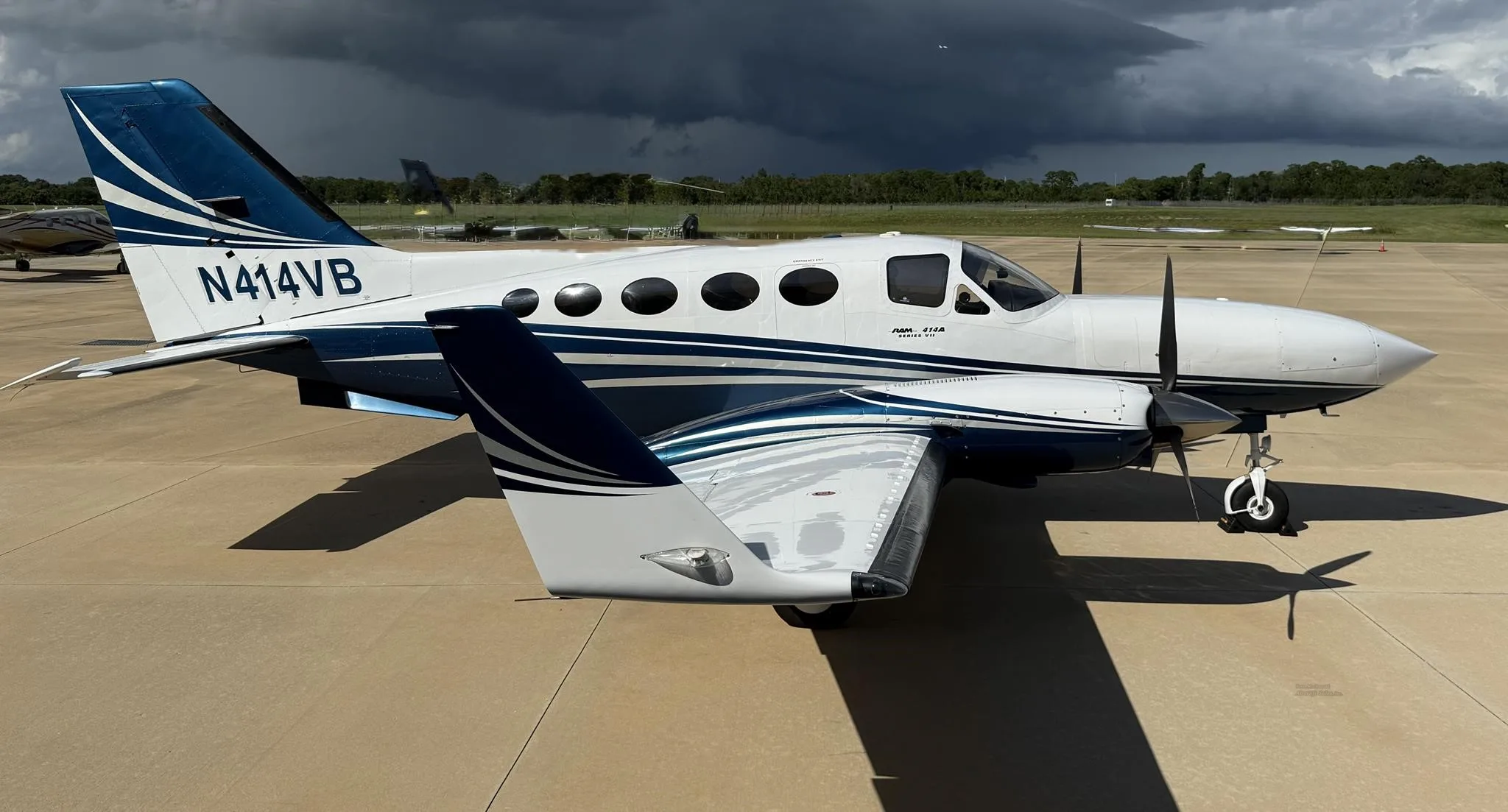
CESSNA 414A for sale now


Free — save the 414A to your watchlist and track it in one place.
More CESSNA 414Amanuals & documents
See all 13 →- Twin & Turbine - December 2024Other Documents
- Rosen Sunvisor Systems PMM / IPC for Sunvisor Assembly (p/n R1181300)Systems Description
- NACELLES/PYLONS - ENGINE NACELLE FITTING REPLACEMENTService Manual
- Rosen Sunvisor Systems CMM / IPC for Sunvisor AssemblySystems Description
- Airworthiness Directives; Cessna Aircraft Company AirplanesAirworthiness Directives
- Electronics International Inc Operating and Installation InstructionsWiring Diagram
- Specifications Subject to Verification/Inspection.Specifications
- 1979 Cessna 414A ChancellorPilot's Operating Handbook
- 1979 CESSNA 414A SALES BROCHURESpecifications
- AIRCRAFT INSPECTION FOR THE GENERAL AVIATION AIRCRAFT OWNERChecklist
- Automatic Propeller SynchronizationWiring Diagram
- The Cessna 414A: A Reliable and Versatile AircraftMaintenance Manual
If you fly the CESSNA 414A, you may also be researching these.



In this document
Cessna 414A Overview
The Cessna 414A Chancellor is a twin-engine aircraft known for its spacious cabin and versatility. It is designed for both personal and business use, offering a balance of performance and comfort. The aircraft is equipped with advanced avionics and systems that enhance its operational capabilities.
Summer Flying Hazards
The magazine discusses the challenges pilots face during summer flying, particularly regarding high density altitudes and thunderstorms. It emphasizes the importance of understanding how these factors affect aircraft performance, especially during takeoff and landing.
Maintenance Tips
Regular maintenance is crucial for the Cessna 414A to ensure safety and reliability. The magazine provides insights into common maintenance practices and the importance of adhering to service schedules.
Pilot Experiences
The magazine features stories from pilots who share their experiences flying the Cessna 414A. These anecdotes provide valuable lessons and tips for both new and experienced pilots.
Upcoming Events
The magazine lists various aviation events and gatherings, encouraging Cessna 414A owners and enthusiasts to participate and connect with the community.
Safety notes
- High density altitude can significantly affect aircraft performance during takeoff and landing.
- Pilots should be aware of the risks associated with thunderstorms and plan accordingly.
Full document text
Hartzell Engine Technologies CESSNA 414A VOL 12 ISSUE 08 AUG 2015 cessnaflyer.org Insuring to Value Cluster Gauge Replacement with Electronics International 42 page PRSRT STD US POSTAGE PAID PERMIT NO 5377 DENVER, CO CHANGE SERVICE REQUESTED CESSNA FLYER ASSOCIATION PO BOX 6203 ALTADENA, CA 91003 B/E Aerospace Ice Shield™ De-icing Systems For more information, please contact: Jack Samuels | Phone (951) 549-7789 | jacksamuels@aircraftspruce.com Cessna Flyer is the official publication of the Cessna Flyer Association. Cessna Flyer is published monthly by Avia- tion Group Limited, PO Box 6203, Altadena, CA 91003. POSTMASTER: Send address changes to Cessna Flyer, PO Box 6203, Altadena, CA 91003. Subscriptions, advertis- ing orders, and correspondence should be addressed to PO Box 6203, Altadena, CA 91003. Annual dues: $44.00 in the US; Canada and Mexico add $15.00 per year; all others add $25.00 per year (US Dollars only). Eighty per- cent (80%) of annual dues is designated for your magazine subscriptions. The information presented in Cessna Flyer is from many sources for this there can be no warranty or responsibility by the publisher as to accuracy, originality or complete- ness. The magazine is sold with the understanding that the publisher is not engaged in rendering product en- dorsements or providing instruction as a substitute for appropriate training by qualified sources. Cessna Flyer and Aviation Group Limited will not assume responsibility for any actions arising from any information published in Cessna Flyer. We invite comments and welcome any report of inferior products obtained through our advertis- ing, so corrective action may be taken. PO Box 6203 Altadena, CA 91003 Tel: 800.397.3920 www.cessnaflyer.org The Official Magazine of The Cessna Flyer Association PRESIDENT Jennifer Dellenbusch jen@aviationgroupltd.com VICE PRESIDENT / DIRECTOR OF SALES Kent Dellenbusch kent@aviationgroupltd.com MANAGING EDITOR Heather Skumatz heather@aviationgroupltd.com CREATIVE DIRECTOR Yee Chan EDITOR AT LARGE Thomas Block CONTRIBUTING EDITORS Mike Berry • Steve Ells • Lyn Freeman Kevin Garrison • David Hipschman Michael Leighton • Charles Lloyd • John Loughmiller Dan Pimentel • John Ruley • Scott Sherer CONTRIBUTING PHOTOGRAPHERS Paul Bowen • Robb Gessert • Keith Wilson Vol. 12 Issue 08 AUG 2015 CES SNA F LYE R (04) AUGU S T 2 015 Since 1967, Superior Air Parts has built its reputation on delivering products that make flying more affordable, attainable and reliable for aircraft owners around the world. Take our Millennium Cylinders for example: With a list of advanced features, complemented by their unmatched reliability and overall value, today Millennium is the #1 name in replacement cylinders. FEATURE FOR FEATURE. DOLLAR FOR DOLLAR. NOTHING BEATS SUPERIOR’S MILLENNIUM cyLINdERS. MillenniumC y l i n d e r s ® MillenniumC y l i n d e r s ® Making Flying More Affordable Since 1967 Millennium Cylinders is a registered trademark of Superior Air Parts, Inc. AdvANcEd ALUMINUM ALLOy HEAdS vOLUMETRIcALLy MATcHEd PORTS INcREASEd PORT WALL THIckNESS vERy HIGH QUALITy cASTING THROUGH HARdENEd AMS6382 STEEL BARRELS IMPROvEd cOOLING cOMPUTER- GENERATEd HEAd FIN cONFIGURATION AdvANcEd cyLINdER BARREL cHOkE THEy’RE IN-STOck ANd REAdy FOR dELIvERy FROM yOUR NEAREST MILLENNIUM cyLINdER dISTRIBUTOR! FOR A cOMPLETE LIST, vISIT SUPERIORAIRPARTS.cOM ® 54 36 26 56 42 32 Less Gets More: The Cessna 414A Chancellor by Jerry Temple The Best ATC Controllers by Mike Magnell Just Wonderful: Public Benefit Aviation by Peter Bernardin Trading Six Instruments for Two: Cluster Gauge Replacement by Steve Ells Insuring to Value by Michael J. Adams Destination: Great Alaska by Scott Sherer THE VIEW FROM HERE Jennifer Dellenbusch LETTERS to the EDITOR CESSNA FLYER EVENTS LEFT COAST PILOT John Ruley THE HIGH AND THE WRITEY Kevin Garrison QUESTIONS & ANSWERS Steve Ells NAVIGATING CESSNAFLYER.ORG Scott Sherer NEWS ADVERTISER INDEX BACK WHEN: VINTAGE CESSNA ADVERTISING AND MARKETING 08 08 10 16 20 22 28 66 80 82 AUGUST 2015 Cover: Cessna 414A Chancellor Photo: Adam Wright Photo: RAM Aircraft, LP Turning pages LETTERS to the EDITOR Send your letters to editor@cessnaflyer.org “No OTG Equals AOG: Replacing an Inop Oil Temp Gauge” by Hiram Lopez, June 2015 Heather, You did a fantastic editing job on the OTG. I made copies and people com- mented on the editorial manipulations that you did. Thanks for your effort on making the OTG a great article. Hiram Lopez Tucson, Ariz. “Retro Wonder: Skylane Hangar Find” by Heather Skumatz, July 2015 Heather, The article is perfect. It could not look or be better! Great work!! The issues showed up today—on my birthday! My wife loved that! What a surprise and what a gift. Thank you so very much. Rod Stalkup Casper, Wyo. “No Mistaking the Quality: Hartzell Engine Technologies” by Dale Smith, July 2015 Hi Kent, I just received my copy of the July issue of Cessna Flyer. Thank you and Jen for running the story on Hartzell Engine Tech. Mike Disbrow Hartzell Engine Technologies Maybe you’ve noticed—I hope you have—that your Cessna Flyer magazine has more pages per issue of late. This is due in great part to the fantastic support we get from you and from our advertisers. It’s also part of our continuing effort to improve the maga- zine and several other of your Cessna Flyer Association benefits. If you have a topic you’d like to see us cover in the magazine, please email or call and we’ll try to accommodate. As you read through this month’s issue, those of you who have been members for a number of years will notice a familiar face. Kevin Garrison, who started with us in our very first issue 11 years ago, is back. Kevin took a few years off, but like Kotter, “Those dreams have remained and they’re turned around. Who’d have thought they’d lead ya… back here where we need ya…”. You’ll see when you read his column on page 20 that Kevin really is living the dream. And we say, “Welcome back!”
Show full textShow less
We’re also pleased to have another offering from Jerry Temple this month. Jerry is a Cessna twin expert and is a welcome addition to our stable of contributors. His article on the 414A begins on page 42. We hope you enjoy this month’s issue and please continue to weigh in with your opinions, ideas and suggestions so that we can continue to improve your CFA. Blue skies, Jennifer Dellenbusch THE VIEW FROM HERE CES SNA F LYE R (08) AUGU S T 2 015 CES SNA F LYE R (10) AUGU S T 2 015 FEATURED EVENTS Aug 14–15 — Muskegon, MI. Muskegon County (KMKG). Michigan Air Rally. A proficiency challenge that offers aviators the opportunity to demonstrate their fuel planning, pilotage and dead-reckoning skills on a cross-country flight without the use of any advanced navigation equip- ment in the Analog Traditional Class and with the use of advanced equipment in the Digital Class. Contact Herb R. Harney, 616-401-3637 or email hharney@sbc- global.net. Visit miairrally.org. Oct 10 — Corona, CA. Aircraft Spruce West Customer Appreciation Day. 7 am to 3 pm at Aircraft Spruce & Specialty Co., 225 Airport Circle in Corona, Calif. This is the time of year when we go all- out by offering spectacular discounts on our most popular products and provide a chance for our loyal customers to meet our vendors. Come join the fun and get a chance to win big prizes. Enjoy a free grilled hot dog and cold soda on us! For more information, call 951-372-9555 or 800-861-3192. OTHER EVENTS Aug 8 — Bradford, PA. Bradford Region- al Airport (KBFD). Wings Over Bradford 2015 Fly-in. General Aviation celebration day at the birthplace of General Aviation manufacturing—historic Bradford, Pa. Pancake breakfast, aircraft and helicopter rides, simulators, great food & lots of family fun. 8 am to 4 pm. Go to wing- soverbradford.com for details. Aug 8 – Sandpoint, ID. Sandpoint Airport (KSZT). 10th Annual Wings Over Sand- point Fly-in. Premier fly-in with a great va- riety of aircraft and the best breakfast in the CFA EVENTS Jul 23–24, 2016 — Waupaca, WI. Waupaca Municipal (KPCZ). The 12th Annual Gathering in Waupaca. We’ll do it again in 2016: CFA’s annual pre-OSH event with fun, food and friendship. Watch this space and CessnaFlyer.org for more information in coming months. CFA SPONSORED EVENTS Oct 15 – 17 — Palm Springs, CA. Flying Aviation Expo. A world-class weekend of seminars and workshops, outdoor displays, indoor exhibits—and even an aircraft parade. Thousands of pilots and industry experts from around the world are expected to attend. Learn about new products, receive technical advice and par- ticipate in hands-on demonstrations. For more information, visit aviation-xpo.com. SEND EVENTS to editor@cessnaflyer.org Once upon a flight. Our patented AutoSquawk technology allows you to automatically communicate with any transponder without an upgrade. So you only enter your squawk code once. It talks to your onboard transponder and provides a single point for data entry for required ADS-B “out.” No extra expense. And no extensive modifi cations to your panel. Our technology works seamlessly behind the scenes so you can focus on fl ying. Discover the advantages of safety now. See which ADS-B solution is right for you at garmin.com/ADS-B. AutoSquawk Technology ©2015 Garmin Ltd. or its subsidiaries Pacific Northwest by EAA Chapter 1441. Experimental, classic, antique, floatplanes, LSA and GA aircraft. Classic cars from Injectors Car Club. Contact Jan Lee, 208- 255-9954. Visit WingsOverSandoint.com. Aug 8 — Frankenmuth, MI. William ‘Tiny’ Zehnder Field (66G). 7th Annual Grassroots Fly-in/Camp-in. 11 am to 5 pm. Evening bonfire, concessions, con- tests from noon to 3:30 pm, fun awards at 4 pm. Sponsored by Grassroots Aviators, Preferred Avionics and Instruments, Windsock Aviation, Air Docs and Armchair Aviation Photogra- phy. For more information, visit GrassrootsAviators.com. Aug 8 — Middle River, MD. Martin State Airport (KMTN). Open Cockpit Day at Martin Aviation Museum. From 11 am to 2:30 pm, the Glenn L. Martin Maryland Aviation Museum offers visi- tors tours of its exhibit galleries and the opportunity to sit in the pilot seats of the museum’s outdoor flightline of airplanes. Admission is $3. Contact Debi Wynn, 410-682-6122. Visit mdairmuseum.org. Aug 9 — East Troy, WI. East Troy Mu- nicipal Airport (57C). East Troy Airport Open House and Pancake Breakfast. Sponsored by the Friends of East Troy Airport. Airplane and helicopter rides! Vintage, homebuilt and warbird aircraft! Antique and classic car show, RC aircraft display, World War II display. Raffle priz- es. Photo contest (recognition only). Free admission and free parking. Breakfast: $6 adults; $4 children eight and under. Contact Christina Liepina, 414-801-0110 or email eagleswing777@charter.net. Aug 9 — Ray, MI. Ray Community Airport (57D). Dawn Patrol. A breakfast fly-in, including show planes and RC planes, from 7 to 11 am. Cost is $7. Contact Peter Diugdale, 586-219-7907 or email 2madphd@gmail.com. Visit go2ray.com for more information. Aug 9 — Mt. Sterling, KY. Mt. Sterling- Montgomery County (KIOB). Mt. Sterling-Montgomery County Annual Aviation Day Fly-in. Pancake Breakfast! Airplane rides! Vintage, Homebuilt and Warbird Aircraft! Free admission, free parking. Breakfast: $6 adults, $4 children eight and under. 9 am to 4 pm. Sponsored by EAA Chapter 1227. Contact Rick Gunderson, 859-585-1332 or email rick@kywifi.com. Aug 15 — Westfield, IN. Westfield Air- port (I72). Westfield Aviation Days. Come join us for our annual LSA/Aviation Days fly-in. Come see airplanes of all types from LSA to GA. Visit indyflyers.org. Aug 15 — Indianapolis, IN. Post Air Air- port (7L8). Annual Taildragger Rendez- vous. EAA Chapter 900 hosts this annual midday fly-in, which attracts a wide vari- ety of aircraft and pilots for a fine lunch, tire-kicking, story trading, Young Eagles flights and a classic car show. Approxi- mate start/end time, 10 am/2 pm. IL8 is a privately owned, public use airport with no services. Admission $8. Contact Steve Delaplane, EAA 900 president, at 317-581-1142 or email eaachapter900@ gmail.com. Visit 900.eaachapter.org. Aug 15 — Big Bear, CA. Big Bear City Airport (L35). Big Bear Air Fair. For more than 30 years, the airport has welcomed audiences young and old to experience the thrill of aviation. The whole family will enjoy incredible vintage planes, classic cars and skydiving exhibi- tions from 9 am to 4 pm. Community group exhibits, current aircraft displays and a wide array of souvenir and food vendors will add to the fun. Also, we’ll 1-800-647-6148 • www.ffcfuelcells.com All FFC fuel bladders are manufactured with REGISTERED TSO-C80 constructions... KNOW what you are installing. Quality products at competitive prices. TSO-C80 FUEL CELLS CES SNA F LYE R (12) AUGU S T 2 015 www.wipaire.com South St. Paul, Minnesota 651.451.1205 352.323.4809 Leesburg, Florida Aircraft Sales ∙ Wipline Floats ∙ Aircraft Skis ∙ Modifications by WipairePAINT INTERIORS AVIONICS MAINTENANCE Restoration, Repair & Maintenance Repairs, Renovations & Executive Interiors From Touch- Ups to Full Refinishing Installation, Repairs & Bench Work AIRCRAFT SERVICES by Wipaire have attractions just for kids. Best of all, it’s free. This day promises to be filled with fun, food, fresh air and fantastic flying. We look forward to seeing you. Contact Diane Cartwright, 909-585-3219 or email diane.cartwright@bigbearcityair- port.com. Visit bigbearairfair.com. Aug 15 — Mason, MI. Mason Jewett Field (KTEW). Mason Aviation Day. Hosted by EAA Chapter 55 from 7:30 am to 2 pm. “All-U-Can-Eat” Pancake Breakfast (served with eggs, sausage, juice and coffee) from 7:30 to 11 am. Grilled Steak Lunch from noon to 2 pm (sand- wiches will also be available). Gift bags for the first 50 registered pilots, plus door prize drawing. Many homebuilt, antique, warbird and General Aviation aircraft are expected along with a variety of exhibits and displays. Parking and admission to Mason Jewett Airport is free. Contact Steve Houghton, 517-290-7528 or email vickie@eaa55.org. Visit eaa55.org. Aug 15 — Scappoose, OR. Scappoose Industrial Airpark (KSPB). Second An- nual NWAAC and Highway 30 Cruisers Fly-in and Drive-in. Gate opens at 0800. Pancake breakfast to 1100. Aircraft and autos on display for judging; awards banquet at 1600. Merchandise and food available all day, as well as live music. Admission is $5. Contact Paul Silveria, 360-607-6005 or email paul.silveria@ comcast.net. Visit nwaac.com. Aug 18 — Independence, IA. Indepen- dence Municipal (KIIB). Grill Out at the Airport. Join the staff of Walter Avia- tion at the Independence Municipal and Vinton Memorial Airports for a series of free Grill Outs! Open to pilots and public alike, and held from 5 to 8 pm. Come check out your local airport and learn about the exciting world of aviation— free to attend! Food is $5/person (PICs and children under five free). Airplane rides and aerobatic rides available. Con- tact Jonathan Walter, 319-334-4000. Visit walteraviation.com/#!grill-out-2015/c2r3. Aug 20 — Cleveland, OH. Cleveland- Hopkins International (KCLE). Women in Aviation Cleveland Chapter Monthly Social at The 100th Bomb Group. The WAI-CLE Social is a time where any member or non- member can come together over a beverage and enjoy aviation talk and watch the Hop- kins airplanes land with delight. The social starts at five o’clock in the bar area of the restaurant. Stop in any time after five—even if it is for five minutes or two hours, we would love to meet you. Contact Leah by email, wai. cleveland@gmail.com. Visit waicleveland.org. Aug 22 — Mukilteo, WA. Paine Field (KPAE). Challenge Air for Kids and Friends. Challenge Air builds self-esteem and confidence of children and youth with specials needs through the experi- ence of flight. Challenge Air’s mission reflects the life-changing impact the flight experience has on children, families, donors, sponsors and communities as a whole. Contact Juliet Siddons, 214-351- 3353 or email events@challengeair.org. Visit challengeair.org. Aug 22-23 — Camarillo, CA. Camarillo Airport (KCMA). 2015 Wings Over Camarillo Airshow. See the Marine Corps MV-22 Osprey, Red Bull aerobatic heli- copter, Vicky Benzing, Dr. D, Judy Phelps, and much more. Military aircraft, antique cars and motorcycles on display. Air- show runs from 12 to 4:30 pm. General admission $15. Gates open at 9 am, and parking is free. Contact Linda Ehrlich, 747-666-5995 or email linda@av8chicks. com. Visit wingsovercamarillo.com. CES SNA F LYE R (14) AUGU S T 2 015 continued on pg 81... Aviation Group Ltd. 7.125”x4.9375 -- PRINT W H E R E A V I A T I O N I S A L I F E S T Y L E 2015 FLYING AVIATION EXPO | OCTOBER 15 –17 | PALM SPRINGS, CA —— register today at aviation-xpo.com —— W H E R E A V I A T I O N I S A L I F E S T Y L E Join FLYING Aviation Expo presented by Scheyden — the industry's unique event for pilots and aviation enthusiasts. Be treated to the ultimate experience from morning 'til night with over 300 brands featuring the newest market trends; the highly anticipated parade of planes; premier education and hands-on training; and sophisticated social events. Trade your chocks for S T A R T I N G B L O C K S . U. S . + 1 . 8 4 4 . 4 4 .T X TAV | I N T E R N AT I O N A L + 1 . 3 1 6 . 5 1 7. 8 2 7 0 © 2015 Cessna Aircraft Company. All rights reserved. TTx is a trademark of Textron Innovations Inc., used by permission. Garmin and G2000 are trademarks of Garmin International or associate companies. CESSNA TTx This beautiful sprinter was born with the heart of a racer. A twin-turbocharged racing powerplant that speeds the TTx™ to the top of its class at 235 knots. Elegant gull - wing doors float up to reveal sleek, custom cabin schemes and a Garmin® G2000™ flight deck. The all-composite airframe makes it tough enough for Utility Category certification. There’s also an economy cruise setting – but – really? On your mark. Get set. Go to Cessna.com to catch the TTx. KTVL, Runway 36 points toward the lake, which gives you lots of room for a slow spiral climb. On my trips there I’ve always taken off that way—and while my departures haven’t been knuckle-biters, I’ve been very glad to have extra time to climb! Some pilots haven’t been as fortunate. Between 1990 and 2010, the NTSB accident database showed 27 accidents at and around KTVL. Eight of the 11 fatal accidents happened after departure from Runway 18 and witnesses in several cases men- tioned extremely long ground rolls (suggesting an overloaded airplane, failure to lean for best power, or both). The airplanes got up into ground effect, but either flew straight into high ter- rain or stalled and spun in when attempting to make a cross- wind turn. If you’re flying out of a high-altitude airport on a hot day, do yourself and your passengers a favor: Get out your POH and check the ground roll distance for the field elevation and air temperature. Review procedures for high-altitude departure. If there’s any doubt at all, consider taking off by yourself and flying a pattern around the field before loading passengers and bags—that way, you’re guaranteed to be below max gross. Check out the local terrain and ask what the standard depar- ture procedures are on hot days. And if there’s any question about whether you can make it, don’t go! Arriving at a high density altitude airport also presents a challenge: just as the takeoff roll increases, so does the landing roll. And a go-around involves the same risks as a departure. In 2004, my wife and I flew ourselves from California to Wisconsin for AirVenture. By early afternoon there were good- sized cumulus clouds blowing up (fortunately, widely scattered). For the second time in my flying career I found myself looking at lightning from above and decided to find a place to land. The nearest airport was Kemmerer, Wyo. (KEMM), field elevation of 7,825 feet. As the thunderstorms indicated, it was a hot day. Kemmerer didn’t have an ATIS or AWOS and I couldn’t raise anyone on Unicom, so there was no way to find out the density altitude. When you plan a flight more than halfway across the continent in the summer, thunderstorms are practically certain. Summer! The season where kids are out of school and fami- lies pack up everyone and everything (including the family dog) and head for the beach, national monuments, family reunions, holidays and cookouts. Others take the family car, but we pilots take the family airplane. As I write, my wife Kate and I are less than a week from our planned departure for a trip from California to Ohio in a four-place, fixed-gear single; with stops planned near Mount Rushmore and in the western suburbs of Chicago to visit one of Kate’s sisters. As with any such trip, we are facing summer flying hazards: high density altitudes (particularly on our first couple of legs over the Rocky Mountains and High Plains), thunderstorms, and low visibility including both summer haze (mostly east of the Rockies) and smoke. Of those hazards, density altitude may be the most insidi- ous. It doesn’t announce itself with towering cumulus clouds or smoke palls, but it regularly kills unwary pilots, particularly in areas with high field elevations. We all learn about density altitude in flight training, but those of you who don’t live near the mountains probably don’t have a seat-of-the-pants feel for it. My home airport at Modesto, Calif. (KMOD) has a field elevation of 91 feet, but on a warm summer day with a temperature of 90 degrees, the den- sity altitude can reach 2,000 feet. That’s not a huge issue—the takeoff ground run is just a little longer and climb performance is just a little less than on a cooler day, but there’s no real safety risk even at max gross weight. Just 88 miles to the northeast is an airport where a warm summer day can be deadly: South Lake Tahoe (KTVL) has a field elevation of 6,264 feet. On a 90-degree day, the density altitude approaches 10,000 feet. Unless you have a turbocharged engine, you’ll see drastically reduced performance—on the order of 55 percent of sea level power. Even with a turbocharged engine, the thin air lengthens your ground run because true airspeed is around 15 percent higher than at sea level. Add all this up and it turns into signifi- cantly longer ground runs—on the order of double the ground run and half the rate of climb you’d have at sea level. That’s assuming you do everything right: leaning the engine for best performance before beginning the ground roll, retract- ing the flaps (and gear, if you’re flying a retractable) as soon as climb is established and resisting the temptation to pull the nose up until the airplane accelerates to best rate of climb speed. If you don’t get it right, or if the airplane is overloaded, you may not be able to climb out of ground effect. One thing that can help—if wind permits—is choosing a runway that will put you on a heading toward lower terrain. At Summer Flying Hazards Others take the family car to go on holiday, but we pilots take the family airplane. John Ruley LEFT COAST PILOT John Ruley LEFT COAST PILOT CES SNA F LYE R (16) AUGU S T 2 015 It’s a computer. It still works. Don’t be this guy. It’s time to upgrade. Your old GNS530 can be traded up to the Plug & Play IFD540 for less than you think! Flying Made Simple ™ IFD540 FMS/GPS/NAV/COM Plug & Play for GNS530! Call Brian for a value estimate 781-402-7520 continued on page 78... I shouldn’t expect updates until I hit the Plains States east of the Rockies. So my plan in the high country is to stay out of clouds. The other problem is that datalink weather is never com- pletely up-to-date. Weather radar images can be as much as 20 minutes old, and a cell can move quite a ways in one-third of an hour. There is an old rule of thumb that wise pilots should avoid major thunderstorms by at least 20 miles and all storms by at least five miles. Using datalink weather, I think those distances may be difficult to achieve. I’m going to back up the datalink weather info with an hour- ly call to Flight Watch for updates along my route. To make sure I can do that, I’ll be flying mostly along airways—unless I need to deviate around something like an isolated thunder- storm—and when possible, above the IFR MEA, even if I file a VFR flight plan. Which brings up the third major summer flying hazard: smoke. As I worked on this column, I took a look back at my log- book and got something of an eye-opener: since 2006, smoke from forest fires comes up just about every other year—includ- ing during more than half of the long cross-country trips I’ve taken. It’s a particular problem here in California given that so much of the state is experiencing a severe drought, but I’ve seen them as far east as Yellowstone. If you get a full weather briefing, you’re likely to get a heads- up because TFRs will be declared—but that doesn’t always I assumed it was above 10,000 feet. We weren’t anywhere near max gross, but I didn’t want to think about trying a go- around. I set up on downwind for Runway 34 (the longest) and as we rolled on final, I put in full flaps and told Kate, “We’re committed.” We spent the night and left the following morning in cool air. Which brings me to the second summer flying hazard: thun- derstorms. Of course, powerful frontal systems can arrive at any time of year, but at least where I live, convective activity in a preflight briefing is rare enough that my usual response is to leave the airplane in the hangar. But when you plan a flight more than halfway across the continent in the summer, thunderstorms are practically cer- tain. Isolated storms don’t worry me all that much—you can fly around them. Lines of storms also don’t worry me because when those show up in a preflight briefing I will either come up with a route to give them a wide berth or wait for them to pass. The ones that worry me are embedded thunderstorms. You can’t see them, and therefore (in the absence of onboard weath- er detection equipment) you can’t avoid them. This makes fly- ing IFR around embedded thunderstorms little short of playing Russian roulette. Of course nowadays onboard weather equipment is easily available. I have a Stratus ADS-B receiver which works with ForeFlight Mobile on my iPad and gives me weather radar imagery. I expect it to be a big help for our trip, but there are at least two potential problems. One is limited ADS-B coverage, particularly in the moun- tains. One of my partners has used the Stratus and tells me CES SNA F LYE R (18) AUGU S T 2 015 NEW IC-A220 Engineered for the Serious Pilot Built upon history and innovation, Icom is proud to announce the new IC-A220 Air Band Panel Mount Radio. The A220 shares the same great features as the celebrated A210 with additional enhancements. Automatic squelch control with manual fine tuning capability. The bright white OLED display and back-lit keys are visible in any environment. Improved connectivity using the D-SUB 25-pin connector makes for easy installation. Engineered with the serious pilot in mind. • Automatic Squelch Control • Bright White OLED Display and Backlit Keys • New D-Sub 25-pin Connector on Back Panel • Easy Channel Selection • Easy Installation Introducing Icom’s NEW IC-A220 ©2015 Icom America Inc. The Icom logo is a registered trademark of Icom Inc. 41931 Facebook “f” Logo CMYK / .eps Facebook “f” Logo CMYK / .eps View our entire avionic product line at: www.icomamerica.com/avionics events unfolded that led to a 40-year flying career that included being a senior airline captain and a writer. What were the chances that a kid with no exposure to fly- ing would end up within a sweaty bicycle ride of the home of the Sun ‘n Fun fly-in? What were the chances that I would have become an aviation writer if I didn’t take care of Richard Bach’s airplane that was in our hangar and marvel that if that guy could write, I sure could? Some would say the odds that I would be in the exact posi- tion to have my dreams come true at exactly the right time in my life for it to happen were almost nil. I would say that I was a solid lock to become what I became because that is the way the universe works. Now, wait a minute while I look outside my window for that pesky 182 to show up. Nope. The airplane of my dreams could show up, though, and it could show up soon if I combined my dream and belief into a single phone call or email. Marketing people from Cessna are standing by right now—and if I got in touch with them, you can bet your last out-of-date sectional that they would do everything they could to get that 182 parked outside my window. Here is what I believe I believe that our thoughts and beliefs—the real, nitty-gritty ones that make our hearts race—can be brought into our per- sonal universe simply because we want them to. I believe that in order for this to happen, you have to com- bine your strong belief with just the slightest effort and motion. You can’t begin your aircraft’s takeoff until you push the throt- tle up. Being so near the airport in Lakeland would have meant nothing if I hadn’t put out the effort to pedal my bike there every chance I got. How come my sparkling new Cessna 182 is not outside my window right now? I wished for it really hard! Some celebrities and New Age thinkers out there in the world trust in the idea that you can create and change your circumstances in life by simply believing they are different. For example, if you think you are rich, good-looking and popular, you very quickly will become all of those things if you picture them in your mind and believe them hard enough. Okay. I am picturing a brand-new Cessna 182 that has a cockpit full of television-based avionics. One, two, three… Ta-da! Hmmm. It’s not there. But I wished for it really hard! And I believed in it way more than I believe in the TSA, Prohibited Areas and the high cost of aviation fuel! So how come those things exist even though I don’t particularly believe in them, and my sparkling new Cessna 182 is not outside my window right now? Maybe it isn’t just wishing and hoping that will put that new Cessna into my hangar (a hangar which I am also envisioning really hard). Perhaps the best way to go about it is to combine the dream and the belief with some sort of action. For example, you might want to win hundreds of millions of dollars in the lottery. You may even firmly believe you will win that money. But it will never happen in any universe unless you buy a ticket. My life has been a series of dreams that have come true. None of them have come true in the way that I expected, and some of them haven’t come true yet. Dream of being a pilot? No way… I wanted to become a pilot ever since I could utter the word “airplane” and look up in the sky. However, there really was no chance of me ever becoming a pilot. I lived nowhere near an airport, and airplanes hardly every passed over our little town in southern New Jersey. Nobody in my family flew, or was the least bit interested in aviation. To get a solid early start in flying, the universe knew— even though I didn’t know—that I needed to be near a really cool airport. A few years later when I was a preteen, we moved to Lakeland, Fla. because my dad underwent a random job trans- fer. Living six-and-a-half miles from the airport allowed me to ride my bike to the field and hang out around airplanes and aviation-oriented people. As a matter of fact, by the time I was a teenage lineboy, I thought that everybody got to go for rides in warbirds, work on Corsair fighters and go flying after work. My dream, which was impossible a few years before, became effortless and easy to obtain—and I knew that it would happen. Once I made that first trip on my bike to the airport, a series of John Ruley LEFT COAST PILOT Kevin Garrison THE HIGH AND THE WRITEY continued on page 79... Believe and Take a Step This is the funny way the universe works. CES SNA F LYE R (20) AUGU S T 2 015 The KMA 30 Bluetooth Audio Panel, KSN 770 WAAS- Enabled GPS/Nav Com and the KT 74 ADS-B-ready Mode S Transponder deliver modern air-transport grade functionality at a price that you can afford. And best of all, the BendixKing Trade-Up program allows you to cash in on the value of your older BendixKing avionics to help offset the cost of your retrofit. Plot your course to the future and great value. Contact your BendixKing dealer to find out more about the all new BendixKing avionics and your Trade-Up options. The BendixKing avionics stack delivers today’s best technology without costing a premium. BendixKing.com PUTTING YOU ON COURSE TO GREAT VALUE. TRADE↑UP Qualifying products include KMA 30 Bluetooth Audio Panel, KSN 770 WAAS-Enabled GPS/Nav Com and the KT 74 ADS-B-ready Mode S Transponder Steve Ells QUESTIONS & ANSWERS Installing a bigger engine in a Cessna 120 and oil leaks in the pushrod tubes of a Cessna 150 tons increases the engine displacement by 13 cubic inches and increases the compression ratio from 6.3:1 to 7.0:1. The result is more torque that translates to better climb rates. This upgrade is a winner if your case is in good shape. If the case is worn out, Don’s Dream Machines has an STC to replace your C-85 case with an O-200 case. According to one engine specialist I spoke with, the center main bearing on the C-85 is a bit on the light side. This often causes accelerated wear to the crankshaft and these crankshafts are as scarce as $3 Avgas. Randy Thompson has an STC to remove the C-85 and replace it with a 100 hp O-200. Thompson said that the O-200 engine upgrade does require the installation of a new engine mount (the mount for a C-90 engine will work) and a new pro- peller. According to John at Acorn Welding, the mount for the C-90 is stronger than the C-85 mount due to thicker tubing. There are additional advantages to O-200 upgrade. The first advantage is that Continental built thousands of these little engines, so getting parts won’t be a problem. Another advan- tage to upgrading to the O-200 is that the engine is very well designed and can be rebuilt without extensive case or crank- shaft rework. In addition, Gus Warren has an STC to install a 108 hp Lycoming O-235. I contacted Victor Grahn, one of the technical advisors at the International Cessna 120-140 Association to find out more about these options. Grahn said the best bang for the buck is using the O-200 crank in your C-85 case. If that is not an option due to the cost of repairing your case, Grahn recommends the O-200 upgrade. The dry weight of an Hi Steve, I just bought a super-clean Cessna 120. I’ve been looking for a little two-place for a long time and finally narrowed the search down to either a 120 or a 140. I wanted a simple air- plane that is easy and pleasing to fly, is easy to maintain and wouldn’t break the bank. I found this airplane within 50 miles of home so that made it easy to check out and easy for my mechanic to inspect. Since I had never flown a taildragger and I had heard all kinds of stories about how difficult they are to fly, I didn’t even consider one when I started my search. But I couldn’t find a 150 that I liked—and when my instructor told me that the 120 was a very well-mannered taildragger, I reconsidered. Last Wednesday after only six hours of dual, my instruc- tor signed off my tailwheel endorsement. This Cessna is really something. I’ve never flown such a pilot-friendly airplane! However, the little 85 hp Continental engine in my 120 is showing signs of exhaustion. The oil turns black right after I change it; it’s using more oil than I would like; and I haven’t been able to tame a couple of oil leaks. I’ve heard that there is a way to install a bigger engine. Do you think that’s a good idea? —The One-Twenty Kid Dear Kid, The 120 and 140 are great little airplanes. In case you didn’t know, in March 1946 Cessna sold its first 140. It was an immediate success and by the end of 1946 Cessna has delivered around 5,000 120/140 airplanes. The 120 is a stripped-down version of the 140 that was intended to be used as a trainer. Cessna 140s have flaps and rear side windows; 120s don’t. The C-85 is a sturdy little engine but some critical parts such as replacement crankshafts are out of production and are getting hard to find. One option if your crankshaft is bad is to replace the old C-85 crankshaft with a crankshaft out of an O-200 Continental engine. Aircraft Specialties Services of Tulsa and Don’s Dream Machines of Milner, Ga. both hold STCs for this change. Aircraft Specialties can sell you the paperwork so your engine mechanic can shop the parts needed and assemble the engine, or you can buy one of three or four parts kits. For instance, you can buy kit three, which includes a new Continental crankshaft, reworked and yellow-tagged connecting rods and four new ECI steel or nickel cylinder assemblies with O-200 pistons. The cost for the kit is around $7,700. According to information on the Dream Machines’ website, an upgrade to the O-200 crankshaft, connecting rods and pis- CES SNA F LYE R (22) AUGU S T 2 015 The rubber seal at the cylinder end of the tube is shown above in item 12. The seal part number is 539840. The same pushrod tube seal is used on the A-65, A-75, C-75, 85, 90, 125 and 145 and O-200, 300 and GO-300 cylinders. avemco.com/CessnaFlyer *Not all coverages or products may be available in all jurisdictions. The description of coverage in these pages is for information purposes only. Actual coverages will vary based on local law requirements and the terms and conditions of the policy issued. The information described herein does not amend, or otherwise affect, the terms and conditions of any insurance policy issued by Avemco. In the event that a policy is inconsistent with the information described herein, the language of the policy will take precedence. Free hat offer not available in New Mexico. When you call Avemco Insurance Company, you know who answers the phone? An Avemco® Aviation Insurance Specialist at our home office in Frederick, Maryland. Somebody who knows a 180 from a 182. Somebody empowered to make decisions, solve problems and customize a policy based on what you fly and how you fly it. And, if you ever have a claim, Avemco can help you get back in the air fairly and quickly. Because we don’t simply insure Cessnas, we insure the people who love them. A subsidiary of HCC Insurance Holdings, Inc. ADS0126 (11/13) WE TREAT CESSNA OWNERS LIKE A NAME, NOT AN N NUMBER. Call (800) 822 9123 or visit avemco.com/CessnaFlyer Get a personalized quote and get a free hat. Dear Al, It’s not uncommon for these pushrod tubes to leak. Provided there are no holes in the tube itself, leaks can originate from two places. The first spot is at the top (head end) end of the tube. This end of each tube is inserted into the aluminum head casting. Then the tube is swaged into a groove in the head casting. It’s not unusual for the tube to come loose at the top end, especially if the cylinder is picked up by the pushrod tubes. These tubes can be re-swaged without removing the cylinder from the engine after removing the rocker arm and pushrod from the leaking tube. A pushrod flaring tool is then inserted down into the pushrod tube. The tool is adjusted to push the beaded section of the tube out against the aluminum head casting. Aircraft Tool Supply Co. in Oscoda, Mich. offers a flaring tool; it’s part number 4915A. If the rubber seal at the cylinder end of the tube is leaking, the exhaust and induction systems must be removed from the cylinder prior to removing the cylinder base nuts. The cylinder can then be pulled out far enough (but not too far because you don’t want to upset the ring to cylinder seal) to remove the old seal and install a new one. The seal part number is 539840. The same pushrod tube seal is used on the A-65, A-75, C-75, 85, 90, 125 and 145 and O-200, 300 and GO-300 cylinders. The final option is to remove the swaged-in pushrod tubes and install an FAA approved pushrod tube seal kit from Real Gaskets of Tennessee. The installation of these kits will elimi- O-200 is only 10 pounds more than the C-85; according to Grahn, the weight change is so slight that you will still be able to fill the tanks and take a friend flying. The Lycoming O-235 is one tough engine, but it weighs around 50 pounds more than the O-200. Grahn said this engine upgrade provides the best performance—but the added engine weight cuts into the useful load enough to limit fuel- or people- loading options. Those are your rebuild options. I’d advise sending your engine mount to a reputable shop such as longtime CFA sup- porter Acorn Welding when you rebuild your engine. Happy flying. Hi Steve, The engine in my Cessna 150 leaks oil. My mechanic says the oil is coming from the pushrod seals. I gave him the okay to go ahead and change them, but he said it’s not that easy. He took me to the engine and showed that the tubes are swaged into the cylinder heads which means that the cyl- inders have to be removed to change the pushrod seals. “Boooogggguuuussss,” to quote my Click and Clack, my favor- ite mechanics. Is there anything I can do to stop these oil leaks short of removing all four cylinders to change the seals? —Oily Al CES SNA F LYE R (24) AUGU S T 2 015 As the LARGEST Single-Engine Cessna Used Parts Dealer IN THE WORLD, we’ll help you find everything you need ...with only ONE call! AIRFRAME Wings, Cowlings, Interiors, Control Surfaces, Landing Gear, Tail Surfaces, Engine and Flight Instruments AVIONICS King, Narco, ARC, Collins, Nav/Com, Transponder, AME, DME, Autopilot Trays and complete harness included! All units 100% satisfaction guaranteed Wentworth Aircraft Inc. • 6000 Douglas Drive N. • Crystal, MN 55429 CESSNA | PIPER | HOMEBUILTS WENTWORTH AIRCRAFT, INC. Huge Volume | Fresh Stock | 80,000 Sq. Ft. of Indoor Storage | 30-Day Satisfaction Guarantee RFQs Online, Fax or Phone Hard-to-find parts aren’t hard to find here! Phone 763-231-8484 Fax 763-231-8482 Email wentacpart@aol.com ENGINES LYCOMING O-235 to IO-540 CONTINENTAL O-200 to IO-520 Complete engines with accessories and complete logs! Also Cylinders, Mags, Accessories PowerFlite® Alternator Approved on Cessna 172R, 172S, 182S, 182T & T182T Direct identical FAA/PMA certified replacement • Identical mounting points and drive pulley • No modification necessary • Lower "Come-In Speed" • Competitive cores accepted • 2 year warranty nate pushrod tube leaks because the seal- ing system is better and because leaky seals are easy to change. Know your FAR/AIM and check with your mechanic before starting any work. Steve Ells has been an A&P/IA for 43 years and is a commercial pilot with instrument and multi-engine ratings. Ells also loves utility and bush-style airplanes and operations. He’s a former tech rep and editor for Cessna Pilots Association and served as associate editor for AOPA Pilot until 2008. Ells is the owner of Ells Aviation (EllsAviation.com) and lives in Templeton, Calif. with his wife Audrey. Send questions and comments to editor@ cessnaflyer.org. Resources Crankshaft STCs Aircraft Specialties Services aircraft-specialties.com Don’s Dream Machines donsdreammachines.com O-200 engine STC Randy Thompson 530-357-5440 C-90 engine mounts Acorn Welding acornwelding.com O-235 engine STC Gus Warren 386-341-6172 Further information International Cessna 120-140 Association cessna120-140.org Pushrod flaring tool, rubber seals Aircraft Tool Supply Co. aircraft-tool.com Pushrod tube seal kit Real Gaskets Tennessee realgaskets.com Shown here is a closeup of two Continental tube seals. One option that will eliminate leaks is to remove the swaged-in pushrod tubes and install an FAA approved pushrod tube seal kit from Real Gaskets of Tennessee. CES SNA F LYE R (26) AUGU S T 2 015 “How do I know if I have enough insurance on my airplane? “What’s the hazard of insuring it for too little? “How much is too much?” These are questions I hear all the time. Determining the proper insured value is one of your most important consider- ations in purchasing aviation insurance. Insured value The insured value is a major factor in how much you’ll pay for your policy. It also plays a big part in what happens if you have a major claim.1 Unlike automobile policies, most air- craft insurance policies are written on a “stated value” basis. 2 This means you and the insurance company agree what the aircraft is worth before the policy goes into effect. Then, in the event of a total loss, the company pays the agreed amount. A good rule of thumb is to insure your aircraft for the amount you could sell it for on the open market. This requires an honest appraisal of its worth. The hazards of too much and too little Say you spend $35,000 loading your Cessna 172 with an amazing avionics package. Usually, your airplane’s market value won’t increase as much as you’ve put into it. It might make a buyer decide on your airplane over other similar ones that are for sale, but it probably won’t make him or her pay much more for it. Thus, the insured value should be an amount you could realistically sell it for, not what you’ve spent on it. Too much insurance can be just as big a problem as too little. Not only will you pay more in premiums than you need to, you might find yourself in a position where the insurance company repairs your airplane when it was damaged to the point you’d rather walk away with an insurance check. Underinsuring your aircraft has a sig- nificant and often misunderstood down- side. Aviation insurance policies generally have a “constructive total loss” provision that defines when the insurance company can declare the loss a total, pay you the insured value and take possession of the salvage. Avemco’s policy, for example, speci- fies it can exercise the constructive total loss option “when the estimated costs to transport and to repair or replace parts of your insured aircraft exceed 70 per- cent of the insured value.” Guess what? An underinsured airplane can be totaled pretty fast. And that new $35,000 avionics stack is part of the air- plane, so it’s no longer yours, either. Here’s another example. Suppose you have an aircraft worth $100,000 in fair market value. You insure it for $60,000 to save on insurance premiums. One day, a storm damages your bird to the extent that it will cost $42,000 to repair. Under these circumstances, your insur- Insuring to Value By Michael J. Adams When it comes to insuring your aircraft, think like an aviator. Unlike automobile policies, most aircraft insurance policies are written on a “stated value” basis. This means you and the insurance company agree what the aircraft is worth before the policy goes into effect. Engine Preservation System Model Nos. AA1000EPS, AA1000EPS-INT (international version) Condensation build up inside your engine can and will cause oxidation, resulting in rusty corroded internal parts. Tempest’s engine preservation system (EPS) could save you hundreds of dollars in repairs by reducing engine condensation that results in corrosion. Kit Includes: EPS system, 1 lb of desiccant, oil filler adapters for both TCM and Lycoming. International version includes all this plus 220V convertor and all adapters for various plug-in styles. ance company has the option of declar- ing a total loss, paying you the insured value of $60,000, and keeping the sal- vage. You would be without an aircraft and $40,000 short of what you’d need to replace it. From these examples you can see why you should always insure your aircraft at an adequate value. Think like an aviator If you are not sure what your aircraft is worth, Avemco can help you determine an approximate book value. You will be asked to provide basic information about the aircraft and its equipment. The value determined this way may not be exactly what you could sell the aircraft for right now, but it will give you a good ballpark idea. When you’re thinking about the value of your airplane, think like an aviator. Be honest with yourself; be accurate; get it right. Michael J. Adams is the Senior Vice President of Underwriting at Avemco Insurance Co. A pilot since 1983, Adams learned to fly in Hillsboro, Ore. One year later he became an agent for a local aviation insurance agency. Adams now holds a property/casualty insurance license in all 50 states, and combines his knowledge of both aviation and insur- ance to help pilots understand how Avemco’s coverage decisions are designed to help keep them safe. He routinely presents safety-based forums at Sun ‘n Fun, EAA AirVenture and other events around the country. Send questions or comments to editor@cessnaflyer.org. 1 Articles and news items provided by Avemco are not intended to provide technical or legal advice. Content is for general information and discus- sion only, and is not a full analysis of the matters presented. The information provided may not be applicable in all situations, and readers should always seek specific advice from the FAA and/ or appropriate technical and legal experts before taking any action with respect to any matters dis- cussed herein. 2 Not all coverages or products may be available in all jurisdictions. The description of coverage in these pages is for information purposes only. Actual coverages will vary based on local law requirements and the terms and conditions of the policy issued. The information described herein does not amend, or otherwise affect, the terms and conditions of any insurance policy issued by Avemco. In the event that a policy is inconsistent with the information described herein, the language of the policy will take precedence. New CFA members post their initial greetings to the forum frequently. You should, too! A Guided Tour of Your Member Website Improvements to the ADs section, and some real variety in the forums. CES SNA F LYE R (28) AUGU S T 2 015 This CFA website column is pub- lished in order to alert you to recent changes in and improvements to our member website. This month I’ll be focusing on two areas: ADs and the forum. Airworthiness Directives (ADs) The ADs section of the website has been updated. You may access it by click- ing on the Knowledge Base button on the main menu at CessnaFlyer.org. After selecting Knowledge Base, you will see “ADs/Alerts” as the second item in the list. Click on it to access the ADs. Forums The forums are an online discussion medium for our members to ask ques- tions, communicate with other members, staff and vendors, and share information related to Cessna airplanes, the Cessna Flyer Association and the industry. Here’s a listing of the topics discussed over the early summer 2015. “Rough Running with Carb Heat” A CFA member has a Cessna 182 with a new engine that runs rough using carb heat. If you have advice, please respond to this message. “Fourth of July Greetings to fellow CFA members” Yes, you can use the forums to broad- cast your best wishes to the entire group. “Garmin GDL-69 Datalink Weather Receiver For Sale” If you’re looking for a reasonably priced weather receiver compatible with Garmin and Avidyne products, you might consider contacting this CFA member. “NavWorx ADS-600: Any Users Out There?” I’m sure we all agree that ADS-B is the Avionics Topic of the Year (if not the decade!). If you have experience with products from NavWorx, please respond to this forum topic. “Third Row Child Seat” A CFA member is looking for a solu- tion to his need to add a third-row child seat to his 182. If you have a solution, our member needs to hear from you. “Greetings to my fellow CFA members” New CFA members post their initial greetings to the forum frequently. You should, too! “Flight Planning Software –What Do You Use?” This is a topic that every member should chime in on. What software do you use on your PC, Mac, tablet or phone? Let us know! “ADS-B: What are you doing?” Have you dealt with the ADS-B prob- lem on your plane? Are you pondering solutions? It’s time to get involved on the forum, and share what you know—and learn what you don’t. “T210M 1977 Landing Gear Fretting Noise” A member residing in Italy needs your help with a noise being made by his landing gear during retraction and exten- sion. If you can lend assistance, please respond on the forum to this message. “T210M Loss of fuel while parked on a slight slope” A CFA member has fuel draining out when his airplane is parked on a gentle slope. If you have an answer or can help find one, please respond. “Alaska Aviators” The FAA’s Alaskan Aviation Weather camera program is a popular tool for Alaska flyers. Read the message thread and try it out for yourself. “182L for Sale” A member is selling his 182L after 41 years of ownership. If you’re inter- ested, the information is available on the CFA forum. “New Floatplane Flyer” If you’re a floatplane pilot, consider accessing this thread on the forum and joining in the discussion. Everything to do with floats is fair game. The CFA website is a content-rich dynamic source of information avail- able for every member. Access it at CessnaFlyer.org. It comes with your membership and it’s a major benefit to you! If you would like to make website rec- ommendations to correct errors, update content or improve functionality, click on “Contact Us” under the About/Contact menu, or email Jen@CessnaFlyer.org. Scott Sherer is a multi-engine and instru- ment rated private pilot. He flies a light twin based at Burlington Municipal (KBUU) in Burlington, Wis., and has logged over 2,600 hours. Send questions or comments to editor@cessnaflyer.org. Scott Sherer NAVIGATING CESSNAFLYER.ORG Avionics is one of the most popular categories on the CFA forums. Access ADs by clicking on the Knowledge Base button on the main menu. Aviation alerts including ADs, SAIBs and NPRMs can be opened in your browser or be saved in PDF format. The innovative exclusive features of Tempest's Spark Plugs and Oil Filters makes Tempest the Supplier of Choice for Continental Motors! Selected by the Gold Standard Discover true engine performance, Upgrade your engine to Tempest today! Aviation Spin-On Oil Filter EXCLUSIVE FEATURE: Magnetic Secondary Filtration Aviation Spark Plug EXCLUSIVE FEATURE: Fired In Resistor - Guaranteed to Never Exceed 5k Ohms Thank you To all of our sponsors for ThEIr gEnErous 2015 door prize donors conTrIbuTIons To our 11 Th annual gaThErIng In waupaca. 2015 GatherinG at waupaca SponSorS motor coach to airventure compliments of “WORLD’S BEST AVIATION SPARK PLUGS” tempestplus.com avemco.com evening banquet hosted by insurance.aopa.org cocktail reception sponsored by scs-interiors.com sunday lunch courtesy of parker.com CES SNA F LYE R (32) AUGU S T 2 015 I recently took one of my best friends and his wife on a day trip to see Monument Valley and the Grand Canyon from my home airport Chino, Calif. John and Susie Cardall are not aviation types. What they know about aviation is what little they have picked up from me on a few flights in N9991N, my Cessna 180J. Our sightseeing trip involved over eight hours of flying with several land- ings; it was a picture-perfect beautiful day with ATC flight following used for the whole trip. There were numerous exchanges with controllers and a lot of handoffs. I talked to male and female controllers, and all were courteous, pro- fessional and helpful—exactly what you would expect from American controllers. Niceties were exchanged frequently. Finally John asked me why the con- trollers say things like “Good day” dur- ing our exchanges. I told him pilots and controllers operate in a pleasant and professional environment in the United States, and the controllers are just trying to keep it that way. I also told John and Susie that I, for one, really appreciate what controllers do for pilots and how they do it. The United States moves more airplanes around its friendly skies than any other nation in the world, and we do it safely. Our con- trollers do the heavy lifting in that arena. I deliver planes all over the world with TransOceanic Aircraft Ferry and I get to work with a lot of controllers. Most are good and helpful; however, I have had some interesting experiences. Once while flying a Boeing 737 into New Delhi, India from Kabul, The Best ATC Controllers Pilots and controllers operate in a pleasant and professional environment in the United States. By Mike Magnell We need YOU! Join the community and make our new website a dynamic and informational resource for all of us. CESSNAFLYER.ORG You’ll find... > Cessna Yellow Pages, an online directory for aviation products and services. > Members’ forums with new topics added regularly > Aircraft Safety Alerts including ADs, NPRMs, and SAIBs available in a searchable database > Article archives from the past 10 years > A Cessna model database that will eventually allow member participation > Secure online account ` updates and renewals > Digital editions of the magazine Afghanistan, an Indian controller was getting buried. He was dealing with all of the usual heavy inbound airliner traffic and not enough runways to land them on when a nasty thunderstorm moved over the New Delhi airport and shut it down. There were storms all over the area and the controller was having a difficult time finding places for airliners to hold. All of a sudden the controller announced, “You guys are all on your own!” What an unexpected—and unpleas- ant—surprise. I asked my Russian copilot how much fuel we had before we needed to divert, and found out we were getting close to bingo fuel. I was watching my TCAS (like I am sure all the other pilots in the area were doing) and thinking, I have enough fuel for about 10 more minutes of playing this uncomfortable game before we must leave for our alternate. I’ve experienced what I deem the world’s worst controllers in Iran. In my opinion, having no air traffic controllers might be a more favorable situation than having to deal with an Iranian controller. If there are just two planes in the sky, it seems to me an Iranian controller will find a way to try and run them into each other. Trust me on this; I have experi- enced it not once, but twice. On the other hand, I have gone into Rotterdam, Netherlands a couple of times in challenging weather while the controller provided excellent help with radar head- ings vectoring me for the ILS. His radar service was so good it was almost like he was flying the plane as he vectored me to a nice 30-degree intercept to final a couple miles outside the final approach fix. In the United States, it could be said that our controllers wear many hats. They move the largest system of vastly different types, from commercial airliners to the world’s largest General Aviation fleet, consisting of everything from Boeing Business Jets (BBJs) to Cessna 120s—and anything you can imagine that can fit in between. Our controllers do everything from safely talking down distressed GA pilots to that unforgettable day when they had to shut down our national airspace sys- tem during and after 9/11. They methodically assist aircraft in need at the same time they are controlling the most routine flights, and they do it all very professionally. I may be biased, but I am truly hard-pressed to try and think of any- thing United States ATC can’t handle. I recently had to declare an emergency while flying about 30 miles off the south- ern coast of Puerto Rico at 9,500 feet in a Cessna 210 with a very rough-running engine. The controller was calm and pro- fessional and was able to give me all the help I could possibly need while still taking care of all his other aircraft on frequency. Next thing I knew, I had a U.S. Coast Guard C-130 flanking me overhead while I was heading for the closest Puerto Rican airport, which was a small uncontrolled strip with no United States customs. When I managed to land safely, everything had been done: the control- ler had notified customs, called the little airport where I landed to alert them I was inbound, and coordinated with the Coast Guard. (For those of you who may not know, the Commonwealth of Puerto Rico is a territory of the United States and therefore part of the United States ATC system. What a great deal!) Our controllers do an excellent job and I have experienced their fine work from the cockpits of jet airliners as well as very small GA aircraft. I consider ATC very helpful and a great asset to have in the cockpit. My hat is off to the men and women who make up our ATC system. Before I change frequencies, I would like to say to them, “Good day!” Michael Magnell is the founder of TransOceanic Aircraft Ferry. He is a former airline captain with Delta and has over 17,000 hours. His work has appeared in General Aviation News and elsewhere. Magnell owns and flies a Cessna 180J from Chino Airport (KCNO) in Chino, Calif. Send questions or comments to editor@cessnaflyer.org. The United States moves more airplanes around its friendly skies than any other nation in the world, and we do it safely. Our controllers do the heavy lifting in that arena. Vortex Generator Technology 4000 Airport Road, Suite D Anacortes, Washington 98221 (800) 677-2370 (360) 293-8082 FAX (360) 293-5499 www.microaero.com micro@microaero.com MICRO VORTEX GENERATORS • Cessna • Beech • Piper Over 500 Models FAA-STC Approved ....just to name a few Available for Twins & Singles Kit Price $695 to $3950 Micro VGs are installed on the leading edge of the wings and on tail surfaces to help keep air attached longer at slower speeds. This reduces the Stall Speed, improves controllability, improves characteristics, creates a more stable instrument platform and gives better aileron response and rudder authority. CES SNA F LYE R (34) AUGU S T 2 015 Proposed changes to ATC By Heather Skumatz On June 15 of this year, Rep. Bill Shuster (R-Pa.) made an announce- ment at the Aero Club of Washington regarding changes to the United States air traffic control system (ATC). Shuster chairs the House Transportation and Infrastructure (T&I) Committee that is in charge of is drafting FAA reauthori- zation legislation. Shuster proposes the separation of air traffic control from the FAA. His plan includes creating a federally-chartered corporation governed by a board of system users. In this scenario, the FAA would continue to set standards and oversee safety of the air traffic control system, but ATC would be not-for-profit and funded through a user fee system. AOPA, EAA and various other GA groups strongly oppose user fees, though they recognize a need for mod- ernizing the air traffic control system. The main issue is the user fees’ possible impact on General Aviation. Currently, GA’s share of ATC costs is collected through fuel excise taxes. AOPA president Mark Baker met with the House T&I Committee a few days after Shuster’s announcement. “The fuel tax system we already have in place is effective and cost-efficient. It works and we believe it’s the right way to fund aviation going forward,” Baker said. “We know from the experience of other nations that user fees can stifle General Aviation, restrict access to air- ports and airspace, and prevent pilots from using the safety services they need, and that’s why AOPA won’t support user fees in any form,” Baker continued. According to a statement released by EAA, “It is EAA’s contention that, among other consequences, per-use fees for air traffic services effectively penalize the prudent practice of using ATC services, such as filing for IFR in marginal conditions or simply receiving VFR advisories.” Shuster acknowledged to the Aero Club that lawmakers and industry groups don’t always agree on the pro- posed changes at FAA, but that they agree that the system needs to change. In addition to ATC modernization, the upcoming legislation could address medical and certification reforms and the FAA’s organizational structure, as well as outlining funding amounts for the aviation system. The current FAA funding package expires Sept. 30, 2015. Sources: AOPA.org, EAA.org, General Aviation News. with as few as two and as many as 12 cylinders. A few wiring changes allow the CGR combo to accommodate LASAR and Light Speed Engineering Plasma II and Plasma III electronic ignition systems. In order to upgrade to the EI CGR system I removed an old analog manifold pressure gauge; a nice Horizon P-1000 electronic tachometer (a good instru- ment); a JPI EDM 700 with fuel flow (another good instrument); and three Aerospace Logic instruments: a fuel pres- sure/ammeter-voltmeter; a left and right fuel quantity gauge; and an oil pressure/ oil temperature gauge. I’ve been flying with the EI CGR-30P and -30C gauges for a month now, and although I’m still going back to the man- ual to learn all the capabilities of these instruments, I am very happy with my new glass panel displays. I like the brightness and clarity of the displays; I like that the engine data that I consider critical is on the front page of the -30P and all the other engine data is concentrated in one spot and is very easy to access. I like the fuel/trip planning and track- ing feature; I like the comprehensive programmable alert and warning system; and I like… well, the list goes on. There are a lot of features packed into these two instruments. Easy leaning The leaning algorithms in the CGR instruments make it exceedingly simple to perform lean-of-peak (LOP) and rich- of-peak (ROP) mixture setting chores. When leaning, I’ve found the EI dis- play and data feed very easy to decipher. In cruise I lean until what EI calls a “telltale marker”—I call it a white line—appears above the first cylinder to peak. The number-two cylinder on my Lycoming O-360 always peaks first. The white line and a numerical readout appear across the EGT portion of the EGT/CHT bar graph at that peak temp. Since I’ve selected ROP leaning (car- bureted engine) with the select knob, all that’s left for me to do is leave the mixture where it is (peak EGT) for maxi- mum economy (at 75 percent power or lower in Lycoming engines, and at 65 per- cent power or less for Continental engines); or richen the mixture slightly until the dig- ital readout indicates 80 to 100 degrees for a best power fuel/air mixture. How do I know what percent power I set? Prior to installation of the CGRs I had to do it the old-fashioned way by referring to the power chart in my own- and twin engine aircraft by STC. Twin engine aircraft require two CGR-30P instruments. In most cases, a single CGR- 30C has the capacity to display other needed data. CGR, as you may have guessed, stands for Cluster Gauge Replacement. I’m now monitoring my engine and electrical sys- tem parameters, my fuel flows and quan- tities and OAT in two 3 1/8 inch instru- ments. The CGR-30P (“P” for Primary) is on top of the two-gauge stack; the CGR-30C (“C” for Cluster) directly below. I replaced six discrete instruments with two, and my panel is much cleaner. CGR instruments have active TFT (thin-film transistor) displays with 262,144 colors and are sunlight readable. The CGR system is almost infinitely programmable. For instance, the RPM channels can display data from engines recently moved into the 21st century and upgraded my instrumentation by installing my first glass panel—a tidy engine monitor pack- age from Electronics International (EI) consisting of two round instruments; the CGR-30P and the CGR-30C. Each of these two instruments fit in a standard 3 1/8 inch instrument hole and together make up the CGR-30P Premium package. The Premium package is designed to provide full systems data and can be configured to suit the application and pilot’s needs. (EI also offers a Basic package that consists of a single CGR- 30P instrument. The Basic package is pre-built and configured to display CHT, engine RPM (tachometer), fuel levels and volts. —Ed.) These engine instruments are approved for installation in a wide range of single You can monitor engine and electrical system parameters, fuel flows and quantities and OAT in two 3 1/8 inch instruments using CGR-30P and the CGR-30C from Electronics International. By Steve Ells I Trading Six Instruments for Two: Cluster Gauge Replacement CES SNA F LYE R (36) AUGU S T 2 015 er’s manual. Now it’s simple—after pro- gramming a page with data gathered from the owner’s manual and one short flight, a percent power number is displayed. The first step: filling in the MACR The first step in ordering an EI CGR-30P is to determine how you want to configure the pages of the instruments; then you can fill out the Marking and Configuration Requirements (MACR) document. Pilots also have the option of selecting five non-primary functions to customize the CGR installation for their airplane. These functions include OAT, horse- power, volts, carburetor air temperature, fuel flow, hydraulic pressure, g meter, cabin altitude, induction air temperature, turbine inlet temperature (TIT), compres- sor discharge temperature—there’s even a carbon monoxide detector option. Primary instruments The first (main engine) screen of the -30P always displays RPM and CHT/ EGT data for up to six cylinders. There’s also room on that page for three additional data points in the form of strip gauges. Primary gauges are specified by FAA regulation for each airplane. Most pis- ton-powered Cessna aircraft are certified under Civil Air Regulation (CAR) Part 3. The most common primary gauges in Cessnas are fuel pressure, oil pressure, oil temperature, left and right fuel levels, and amps. Since my plane has a constant speed propeller, the regulations also man- dated a manifold pressure gauge. There isn’t room to display all of the primary gauges on the -30P main engine screen. I chose to display fuel flow, fuel pressure and oil pressure along with the EGT/CHT bar graphs and the tachom- eter and manifold pressure displays the main engine page. (Since I could display the other primary gauges on the -30C, I chose those functions for the main page display of the -30P that I thought were most important.) The other primary data that’s required as well as other operationally important data is in full view just below the -30P on the -30C. This list includes left and right fuel quantity (referenced to fuel level send- ers in the tanks), oil temperature, outside air temperature (OAT), carburetor inlet temperature, vacuum, volts and amps. As I filled out the MACR, I wrote in the instrument face markings (red arc, green arc, yellow arc, redline) for each instrument by reference to the owner’s manual or POH. (This is typically some- Top: The cowling is open and the airplane is ready. The CGR system and all the components have arrived, and now it’s time for A&P Steve Ells to get to work. Middle: This photo shows the engine data converter (EDC), the vacuum module, the MAP mod- ule, the resistive fuel level module (RFLM), a memory stick and the CGR-30 display. Most of the wiring is pre-installed and only needs routing and cutting to length. Bottom: Each “D-sub style” plug and wire is clearly labeled, which saves time and prevents confusion for the installer. Installation times on Cessna singles are reported to be between 12 and 18 hours. That seems about right for a savvy technician and well-equipped shop. thing the installing shop will do. —Ed.) The second screen is used to display functions that don’t need to be displayed continuously such as tach time, engine time, flight time, local and Zulu time. The third screen in the -30P is the fuel quantities screen. This screen displays estimated fuel levels for different tanks— up to four tanks can be displayed—or total fuel quantity. Provisions for adding fuel and K-factor adjustments for the fuel flow display are on this page. The fourth screen is the fuel data screen where trip- or leg-specific infor- mation based on fuel flow and GPS information is displayed. This data includes range, distance to destination, fuel reserve, time to empty, fuel used during flight and even fuel economy (in mpg). The information on this page is dependent on an RS232 data feed from the airplane GPS. Since the fuel data screen is tied to the GPS and the fuel flow data, a change in any part of the fuel/time equation (such as a change in destination airport), power settings or mixture strength instantly updates important flight planning data such as, “Do I have enough fuel with my personal fuel minimums to get to my destination at this power setting?” The big install As I worked my way through the installation checklist I ran into a few hiccups but was always able to get sup- port from Michael Roberts, Dave Arata, Daniel Bennett and Tyler Speed at EI. The installation was straightforward. All the wires from all the data probes, the fuel flow transducer, the manifold and oil pressure transducers, the electri- cal system shunt and the resistive fuel level module (RFLM) are fed into three plugs that connect to and feed the engine data converter (EDC). I mounted the EDC, the vacuum and manifold pressure (MAP) modules and RFLM on a shelf on the cabin side of the firewall. A single serial data wire moves the data stream from the EDC to the -30P and -30C. The EI CHT probes are different from JPI probes in that they aren’t spring loaded to insure contact against the bot- tom of the hole. According to Arata, EI can supply the spring loaded probes if the customer desires. This difference in probes is the reason the CHT numbers differed between the JPI system I removed and the EI system I installed—by approximately 30 degrees F. (The EI CHT readouts are cooler.) The Electronics International developed overlap connectors to lessen dissimilar metal corrosion and to minimize errors due to faulty or poorly crimped connections. EI’s OLC-1 connector consists of a reddish colored nonconductive barrel. Wires are connected by tightening a tiny Allen head set screw after inserting each wire into opposite ends of the barrel. The author installed the EI Master Caution and Master Warning lights because the panel space available for CGR-30P and CGR-30C displays was beyond his normal vision scan. CES SNA F LYE R (38) AUGU S T 2 015 The first pages of the -30P and -30C in the configuration the author chose. Pilots are able to customize CGR equipment by completing a Marking and Configuration Requirements (MACR) document with their order. hottest cruise power CHT I’ve seen dur- ing the last month is number four, at 343 degrees F. Since my CHTs were never very hot— I’ve never seen 420 degrees F, the bottom of the yellow warning arc—with either system, this difference is not a big deal on my airplane. To me, the most impor- tant function from sampling EGT and CHT is detecting gross engine problems quickly. These problems always show up first on EGT systems. It’s critical to respond quickly to rapid temperature deviations from the norm. The CGR system has two systems that do this automatically. The first system consists of setting normal operating ranges on both EGTs and CHTs. For instance, if your normal full rich low power EGT readout is 1,100 degrees F, set the range low limit at 1,000 degrees F. If your peak EGT is 1,500 degrees F, set the range upper limit for 1,150 degrees F. A variance outside either limit will cause the EGT bar in the graph to turn white and blink. Whenever a CHT falls outside the upper or lower range limit, that cylinder bar will turn red and blink. There are four modes of operation used to display CHT/EGT information. Select mode is used to select the EGT and CHT for one cylinder. The tempera- tures are then displayed numerically at the bottom of the display. Other modes include the Diff mode that displays the difference between the hottest and coldest CHT and EGT. These numerical values are shown at the bot- tom of the display as EGT-D and CHT-D. Then there’s the Scan mode where EGTs and CHTs are continually scanned; the rate of scanning is configurable. Finally there’s the Hottest mode where the hottest EGT and CHT are shown numerically. The second way to spot deviations is to use the normalize mode. After setting cruise power, the normalize function can be selected by pushing and holding the Select knob for four seconds or by pushing the rotary knob to activate a cursor above the EGT/CHT bar graph display, then rotating the knob to select “normalize,” and pushing the knob in to select that function. Either method causes the bars of the CHT and the bars of the EGT of the current flight to be compared to bars recorded during a reference flight in the past. Differences are easy to spot. Like other EI engine monitors, the CGR system incorporates microproces- sors that analyze engine data as it is col- lected. When a deviation from normal F o r m o r e i n f o r m a t i o n o n t h e i n d u s t r y ’ s m o s t e v o l v e d p r o p e l l e r s m c c a u l e y. t e x t r o n . c o m | U . S . + 1 . 8 0 0 . 6 2 1 . P R O P | I N T E R N AT I O N A L + 1 . 3 1 6 . 8 3 1 . 4 0 2 1 FEWER ADs | LONGER TBOs | SINGLE-PIECE HUB Revolutionary propeller systems rise from evolutionary engineering. We’ve been continuously improving McCauley propeller systems for more than 75 years. You could say it’s in our DNA. © 2015 Textron Aviation Inc. McCauley and its logo are registered trademarks of Textron Innovations Inc., used by permission. EVO LUTI O N E V ERY RE VOLUTION IS A N EVO LUTI O N EVO LUTI O N EVO LUTI O N operating levels is sensed, the device immediately triggers warnings so pilots can evaluate and take action if necessary. The master nag Each EI CGR system also has a sophis- ticated warning system that keeps an eye on aircraft systems—engine, fuel flow, electrical, fuel quantity, etc.—and alerts the pilot if these parameters stray. Since I decided not to rearrange my panel to install the -30P and -30C within eight inches of my vision centerline (as recommended by Advisory Circular [AC] 23-1311), I installed the EI master cau- tion and master warning lights in a row with the “Alt Inop” warning light slightly to the left of my airspeed instrument. Caution and warning flags also appear on the faces of the instruments. A voice alert and warning signal that’s wired to the avionics audio panel (with panel- mounted on-off-acknowledge switch) is an option. Each of the strip gauge displays will blink in tandem with the remote caution and warning lights if any function varies from the green arc. Pilots need only push the “E” (escape) button on the face of the instrument to acknowledge the alarm and stop the blinking. Pilots can toggle between the EI CGR- 30P between a variety of EGT/CHT data displays including ROP leaning; LOP leaning, EGT digital operating mode and CHT digital operating modes. The LOP leaning display shows the first cylinder to peak, where all cylinders are in relation to the first to peak and the number of degrees the first to peak is lean of its peak. Fuel transducers To obtain the most accurate fuel level data, CGR buyers are urged to install EI’s P-300M magnetic fuel level sen- sors (only one moving part) since these sensors provide a linear voltage output and are extremely accurate; the original resistive-style float sensors can’t provide the same degree of accuracy. In order to calibrate the arm length and arm travel of a P-330M, the original level sensor must be sent back to EI. My resistive level sensors had been rebuilt and calibrated recently, and since I was installing a fuel flow transducer to monitor my fuel flows, I elected to con- nect my existing resistance-type senders to the EDC through the RFLM. There are also provisions to use capaci- tive fuel level senders. An interface module such as the RFLM is not required for either magnetic or capacitive level sensors. CES SNA F LYE R (40) AUGU S T 2 015 The after-installation calibration pro- cedure was very easy (four levels) and the levels displayed on the -30P are con- sistent with my dipstick readings. Basic tech facts EI uses overlap connectors (OLC-1) throughout the installation wherever two (20 gauge or smaller) wires must be con- nected. The OLC-1 connector consists of a reddish colored nonconductive barrel. Wires are connected by tightening a tiny Allen head set screw after inserting each wire into opposite ends of the barrel. EI developed the OLC-1 to resolve dissimilar metal corrosion problems and issues related to mis-crimped and/ or poorly crimped wiring. At first I was flummoxed because it seemed like I needed a third hand to hold two wires in position and the barrel of the OLC-1 while carefully manipulating a tiny Allen wrench to install the set screw, but before too long I had it down. The total electrical load for the CGR- 30P, -30C, EDC, RFLM, all the pressure (and vacuum) sensors and the fuel flow sensor is less than two (12 VDC system) amps. This low electrical load insures that the pilot will be able to continue to monitor engine, fuel and electrical system health without the need to shut these sys- tems down to preserve battery power in the event of a charging system failure. Configuration screens The EI CGR-30 system permits many configuration options. Fuel flow K-factor, EGT and CHT bar graph range settings, USB and data recording rates and fuel alarms—I set my fuel alarms to signal when my total fuel gets down to 10 gallons—and units (gallons, liters, etc.) information can also be configured. Much of these configuration chores are done by the installing shop and except for the instrument face markings (red arc, green arc, yellow arc, redline) referred to earlier, these values may be changed as necessary in the field. In addition, there’s a page on the CGR-30C for checklists. Checklists can also be configured for the airplane and pilot’s personal preferences. All monitored data can be downloaded and displayed on a spreadsheet or graphed. (Contact Electronics International for more information on this activity. —Ed.) Daniel Bennett at EI’s sales and sup- port department told me that installation times on Cessna singles are reported to be between 12 and 18 hours. That seems about right for a savvy technician and well-equipped shop. The hardest part for me was waiting for the box from EI to arrive after sending in the MACR. Now that the installation is finished and working well, I’m impressed. I’m considering making a few more 21st century changes in my airplane, but right now I’m just happy going to the hangar so I can continue to learn more about the features of my new glass panel engine monitor. Steve Ells has been an A&P/IA for 43 years and is a commercial pilot with instrument and multi-engine ratings. Ells also loves utility and bush-style airplanes and operations. He’s a former tech rep and editor for Cessna Pilots Association and served as associate editor for AOPA Pilot until 2008. Ells is the owner of Ells Aviation (EllsAviation.com) and lives in Templeton, Calif. with his wife Audrey. Send questions and comments to editor@ cessnaflyer.org. Resources Electronics International, Inc. buy-ei.com The second page of the CGR-30C is the checklist page. Checklists are easy to fine-tune in order to fit aircraft and pilot preferences. CES SNA F LYE R (42) AUGU S T 2 015 Less Gets More: THE CESSNA 414A CHANCELLOR By Jerry Temple Photo: Angus Walters, Shoreline Aviation, Inc. Cessna’s 414A Chancellor offers an excellent cabin-class twin experience with a simplified fuel system, impressive single-engine service ceiling and much more. Later models (1973–1977) are known as long-body 414s. One major difference is the 16-inch plug that allows the aircraft to include a lavatory and/or a refreshment center. (As you might expect, these models are more desirable.) To the trained eye, a long- body 414 can be identified by the fifth passenger window. As with most twin Cessnas, there are various RAM engine conversions and air- frame modifications available. Moving up Typical buyer considerations The typical buyer of a 414A Chancellor is moving up from a high performance single-engine (HPSE) or a nonpressurized order to write an article on the Cessna 414A Chancellor, a brief history of the Cessna 414 is appropriate. (Cessna produced the Model 414 from 1970 to 1977, and the 414A from 1978 to 1985. —Ed.) The 414 is often referred to as a “straight” 414—con- fusing for some, as the 414A has a straight (wet) wing—but “straight” in this case sim- ply means there is no suffix “A.” The straight 414 is a traditional twin Cessna with the tiptank fuel system and an electromechanical landing gear system. Introduced in 1970, the 1970 through 1972 model 414s are also known as short-body 414s. These short- body 414s have a cabin slightly larger than a 340, but not by much. IN Photo: Angus Walters, Shoreline Aviation, Inc. CES SNA F LYE R (44) AUGU S T 2 015 This 414A has Hartzell three- blade heated propellers; many other 414As have McCauley propellers. Four-blade MT Composite propellers are also available for these aircraft. This 1982 414A offers a bigger cockpit than its predecessors. Photo: Jerry Temple CES SNA F LYE R (46) AUGU S T 2 015 were manufactured with Continental TSIO-520-NB engines providing 310 hp. Three RAM conversions are avail- able for 414As. They include the RAM Series IV (325 hp), the liquid cooled RAM V (350 hp) and the RAM Series VII (335 hp). (For details about RAM aircraft conversions, see the sidebar on page 53. —Ed.) A fifth possibility is the stock 310 hp engines combined with the American Aviation intercoolers. The 310 hp engines with AA intercoolers is report- ed to provide performance similar to having 325 hp engines. Propellers The 414A will have either Hartzell or McCauley three-blade heated propellers. Four-blade MT Composite propellers are available, but there are few 414As with these installed. The wet wing design The Chancellor’s long-sail plane, high Seating options The Chancellor was offered with three seating options, with seven seats being the most popular. The seven seats consist of two cockpit seats, four cabin seats in club configuration, and the toilet as the legal seventh seat. Some Chancellors have an optional eighth aft cabin seat, but few Chancellors are operated with the eighth seat installed. The seat takes up valuable aft cabin baggage area. In my experience, the number-one desired cabin feature in a 414A is 421C-style seats for the four cabin club seats. The 421C-style seats have a col- lapsing inboard armrest, which creates a wider seat and makes for easier access to the cockpit. Features of a 414A Powerplants Cessna 414As can be powered by one of five different engine configurations. The first is the factory option: 414As twin aircraft. Regardless of what aircraft they may be coming from, buyers’ needs can be similar: more speed, a larger cabin, pressurization, weather capabilities and multi-engine performance. When asked to compare a 340 with a 414A, I’d present that a 340 is a mini- van. It is a great minivan and like a real minivan, a 340 does an excellent job of supporting a family: one parent up front, with another parent/caregiver and two or three kids in the cabin. But for many pilots, businesses and families, a full-sized van is best. The 414A Chancellor is like a full- sized van. It offers a bigger cockpit and cabin, higher cabin pressurization dif- ferential, additional cabin amenities and greater internal and external baggage limits than a 340 or similar aircraft. Cessna produced 516 of the original 414s, and 554 Cessna 414As—and much like human fingerprints, no two of these twin Cessnas are exactly alike. Comparisons and evaluations can be a challenge. The 414A Chancellor offers a bigger cockpit and cabin, higher cabin pressurization differential, additional cabin amenities and greater internal and external baggage limits than a 340 or similar aircraft. aspect ratio wet wing offers—or rather, allows for—many improvements. First, the wing is a big fuel can: it holds 206 gallons of useable fuel. The need for a tiptank fuel system with main tanks, aux- iliary tanks, optional nacelle tanks and up to 10 fuel pumps is eliminated. The 206-gallon fuel capacity provided the range/endurance to satisfy most 414A operators, and so Cessna elected to not offer nacelle tanks. However, aftermarket 18.5-gallon wing locker tanks, like those from O&N Aircraft, are available. (See Resources for information about this and other 414A modifications. —Ed.) Depending on air-conditioning, most Chancellors can accommodate from one to four wing locker tanks. Few owners need the additional range. The Chancellor’s wing is quite effi- cient. When the 421C Golden Eagle (which also has a straight wet wing) left the factory, it offered a single engine ser- vice ceiling of 14,900 feet. This was done with 375 hp on each wing. Photo: Angus Walters, Shoreline Aviation, Inc. Send Your Questions to: editor@ CESSNAflyer.org JOIN the DISCUSSION ONLINE CES SNA F LYE R (48) AUGU S T 2 015 414AWs have a gross takeoff weight of 7,087 pounds. Advertised performance gains include a reduction in time to climb of up to 10 percent, and the abil- ity to cruise five to 10 ktas faster on the same fuel while operating at or below 65 percent power, according to the RAM Aircraft website. Many winglet modifications were performed in the 1980s and 1990s. To add winglets to a 414A today will cost $57,415 (installed and painted), according to RAM. Strakes Aft fuselage strakes can cost approxi- mately $15,000 installed and provide performance gains that are competitive with winglets. Aircraft Performance Modifications, Inc. (AMP) claims gains of eight to 10 knots with the added benefits of decreas- ing drag, improving stability and saving on fuel with its 12-pound (before paint- ing) dual strake kit. No restrictions are listed for the STC, so previously installed winglets and/or VGs “should see the same improvements in flight in addition to any structural improvements the aircraft has already Wing spar AD A frequent question I hear about the 414A concerns the forward wing spar AD. This AD, 2005-12-13, calls for inspection (and if needed, a “beefing up”) of the forward spar. The thickness of the sheet metal used in the spar on model year 1978 is less than in the 1979 through 1985 models. With that said, the inspection is required on the 1978 414A when the aircraft accumulates 9,000 hours. For model years 1979 through 1985, the inspection is not done until 15,000 hours. Now, let’s look at 414A spec sheets. The vast majority of 414As have 5,000 to 6,000 total airframe hours in 2015— and those hours took 35 to 37 years to log. Therefore, accumulating 9,000 to 15,000 airframe hours is truly a lifetime away for most persons considering the purchase of a 414A. Modifications Winglets The 414A’s wet wing can be modified to accommodate RAM winglets. Those 414As with winglets are referred to as 414AWs. As with all of aviation, there are gains and losses. In contrast, the Chancellor, having 310 hp on each wing, provided a single engine service ceiling of 19,850 feet. With 65 less hp on each wing, the 414A provides 4,950 feet greater single engine service ceiling—less horsepower, less fuel demand, and superior aerodynamics. Landing gear The Chancellor’s redesigned wet wing allowed the electromechanical landing gear to be replaced by a hydraulic gear system. With this hydraulic system, the inner gear door (which required a slow land- ing gear operating system and VLO of 140 kias) was eliminated. With the inner gear door eliminated, the VLO and the Landing Gear Extended speed (VLE) is increased to 177 kias, depending on if winglets are installed. In addition, the hydraulic system pro- vides fast gear operating times. With all engines operating, the gear extend/retract speed can be a fast four seconds. Even with only one engine operating, the gear extend/retract speed is seven seconds. And, in a worst-case scenario where the gear will not extend, a 2,000- pound nitrogen bottle blows the gear down with a fast boom. Photo: Angus Walters, Shoreline Aviation, Inc. Aircraft Covers, Inc. 800/777-6405 408/738-3959 bruce@aircraftcovers.com www.AircraftCovers.com The Chancellor’s wing provides 4,950 feet greater single engine service ceiling than a 421C Golden Eagle—less horsepower, less fuel demand, and superior aerodynamics. CES SNA F LYE R (50) AUGU S T 2 015 Air conditioning The Cessna factory air conditioning is located in a cavity directly behind the right engine. The right engine must be running for the air conditioner to operate. The aftermarket electric air-condi- tioning system for Chancellors has had many owners and titles. These owners include JB Industries, Parker Hannifin, Keith Products and now Air Comm Corp. (ACC), but specs lists usually state JB or Keith. The aftermarket system is located under the left side nose floor, so the can- consists of 118 VGs mounted on the wings plus four strakes on the inside and outside of the engine nacelles. Micro VGs can offer a virtual elimination of Vmc as well reduced stall speeds, reduced accelerate/stop distance and improved safety. A gross weight increase of 350 pounds is an added benefit. Wheel covers can give a 414A extra lift, reduced drag and a lower angle of attack in climb, cruise and descent. Premiere Aviation offers Speed Covers, a hubcap that it states will provide a 25 percent increase in single engine rate of climb and a five to 10 percent fuel savings. Common questions The most common questions I hear from buyers are those asking me to explain the differences in factory and aftermarket electric air-conditioning, and to clarify the issues about Flight Into Known Icing (FIKI) certification and dif- ferent marketing packages. received,” according to the AMP website. With any airframe modification, pre- cise installation is a must. JTA can advise operators regarding shops with strake installation experience. Spoilers, VGs and wheel covers Besides winglets and strakes, the three other airframe improvement modifica- tions are spoilers (speed brakes), vortex generators (VGs) and wheel covers. Spoilers are, in my opinion, the num- ber-one improvement modification avail- able for a 414A. Like flaps, speed brakes (spoilers) can function as a speed control device or a drag tool. PowerPac spoilers are a commercial jet-type design with sin- gle flat plates, one on top of each wing, and reportedly command descent rates up to 3.5 times faster. Vortex generators are evolving into standard equipment. It is rare to find a 414A that doesn’t already have VGs added. Micro AeroDynamics’ VG kit If you’re getting into the buying mode—get help. I could write a book of buyer errors. Photo: RAM Aircraft, LP #1 for Aircraft Parts Support Since 1984 Same-Day Worldwide Shipping We Price Match! Parts avionics EnginEs ProPs Over 5 MilliOn in-StOck PartS! Over 5 MilliOn in-StOck PartS! Search our Parts for Free 24/7 DoDSon.coM cAll uS toDAy At 785-878-8000 yon that was once available for cargo is lost due to storage for the components. An electric system allows for a power cart to be hooked up to the aircraft, and while the pilot is inside the FBO, the cabin is cooling. FIKI Flight Into Known Icing was an option on the 414A, but it is rare for a Chancellor not to have the Known Icing kit installed. Marketing packages Potential buyers may encounter a specs list with a title with the Roman numeral “II” or “III” after “414A Chancellor;” occasionally, a decal may be on the aircraft as well. These numer- als are not associated with RAM IV, V, VI or VII conversions. These numerals are simply marketing packages offered by the factory, similar to the trunk emblem on a Nissan Sentra DLX. The There are various RAM engine conversions for Cessna 414As. Some pilots think that a 414AW RAM VII is the ultimate twin Cessna. CES SNA F LYE R (52) AUGU S T 2 015 DLX package is just equipment packaged to appeal to buyers. It is still a Sentra. Furthermore, it would be a true museum piece to find a 1978–1985 Chancellor that has not had many changes over the years, rendering the “II” or “III” invalid. Buying at 414 If you’re getting into the buying mode—get help. I could write a book of buyer errors. The most important advice I can give is to run from the advisor, pilot or shop with an “it’s just another twin Cessna” attitude. Research thoughtfully, and carefully choose whom you work with. And don’t go too far into the process of thinking about a 414A without firm answers about hangar size, financing, training and taxes. Because the 414A and 421B/C are cer- tified for eight seats, they fall under the rules of the International Registry (IR). There can be additional costs to the buyer and seller, depending on certain rules (i.e., financing, prior IR enrollment, etc.).The escrow agent—that is a must with any sale—will be able to address IR questions. This is aviation, so opinions are required pilot equipment. Some pilots think that a 414AW RAM VII with spoilers, strakes, VGs, hubcaps, a gorgeous interior and fully modern panel is the ultimate twin Cessna. I suspect that, like me, you will have an opinion. Jerry Temple founded Jerry Temple Aviation (JTA) in 1995. JTA provides pilots with hands-on service from the research stage to delivery and checkout. Before founding JTA, Temple worked for 20 years in several positions in the Cessna Aircraft system, including at the Cessna factory as well as in distributor and retail sales. Send questions or com- ments to editor@cessnaflyer.org. Resources 414A buyer support Jerry Temple Aviation, Inc. jtatwins.com International Registry International Registry of Mobile Assets internationalregistry.aero Cessna 414A modifications Aft fuselage strakes Aircraft Performance Modifications, Inc. aircraftstc.com Engine conversions RAM Aircraft, LP ramaircraft.com Intercoolers American Aviation Inc. americanaviationinc.com Wheel covers Premiere Aviation premiere-aviation.net PowerPac spoilers Spoilers, Inc. powerpacspoilers.com Vortex generators Micro AeroDynamics, Inc. – CFA supporter microaero.com Wing locker tanks O&N Aircraft Modifications, Inc. onaircraft.com LESS DRAG • LESS DRAW • TSO Approved Pulsar NS and SunTail lights • No Power Supply required • PMA and STC approved SunSpot 36 landing and taxi lights • SunSpot HX Series includes Built-in “wig- wag” or “pulse” feature Upper SunBeacon II (Red) Pulsar NSP (sold as a pair) – NAV/ACS/POS www.AeroLEDS.com t 208.850.3294 f 208.246.0552 sales@AeroLEDs.com SunSpot 36LX landing and taxi lights SunTail ACS/POS AIRMARK OVERHAUL, INC. “When Quality Counts” 6001 N.W. 29th Avenue Fort Lauderdale, FL 33309 Tel: 954-970-3200 Fax: 954-970-3400 Toll Free: 1-800-282-3202 www.airmarkoverhaul.com Email: airmarkoh@aol.com Approved Overhaul, Repair and Exchange Facility for: • ENGINES – Continental and Lycoming Engines • ACCESSORIES – Magnetos, Starters, Alternators, Turbos, Controllers, Wastegates, Relief Valves and Fuel Components • CYLINDERS – Continental and Lycoming Cylinders • HYDRAULICS – Britten Norman Islander Landing Gears • PARTS – Thousands of New and Serviceable Parts in Stock FAA Approved Repair Station JL4R288M • EASA 145.4115 500 Hour M
What's in the CESSNA 414A TCDS
A Type Certificate Data Sheet (TCDS) is the FAA's record of what an aircraft type was approved as. It is the source of truth for weights, seating, fuel and the rules the design was certified against. Expand any line to see what it means.
1,387 CESSNA 414A parts for sale
See all →


Parts listed for sale by vetted eBay sellers — confirmed on eBay at checkout.