Twin & Turbine - December 2024
CESSNA 414A · Other Documents
Overview
This document is the December 2024 issue of Twin & Turbine, a magazine focused on owner-flown, cabin-class aircraft. It features articles relevant to pilots and aviation enthusiasts, including insights on aircraft ownership, safety practices, and technological advancements in aviation. The issue includes a spotlight on the Cessna 414A, discussing its operational characteristics and owner experiences. The content is designed to inform and engage pilots, providing practical advice and reflections on the aviation industry.
- The Cessna 414A is a popular choice among owner-flown aircraft for its performance and capabilities.
- Continuous learning and preparation are essential for pilots, especially when transitioning to new aircraft or during recurrent training.
- Icing conditions pose significant risks to flight safety, and pilots must be vigilant and knowledgeable about their aircraft's limitations.
Document
Source
Originally published by twinandturbine.com. Sprinkle hosts a reference copy with an added summary, specifications and searchable full text.
Document details
- Type
- Other Documents
- Year
- 2024
- Pages
- 36
- File size
- 63 MB
- Publisher
- twinandturbine.com
Common. One of the most common aircraft types we track.
Most owners only have the POH. Here's the essential set for the CESSNA 414A.
- Pilot's Operating Handbook / AFM
- Checklist
- Maintenance Manual
- Parts Catalog (IPC)
- Systems & Wiring
- Service Bulletins
- Type Certificate (TCDS)
CESSNA 414A for sale now


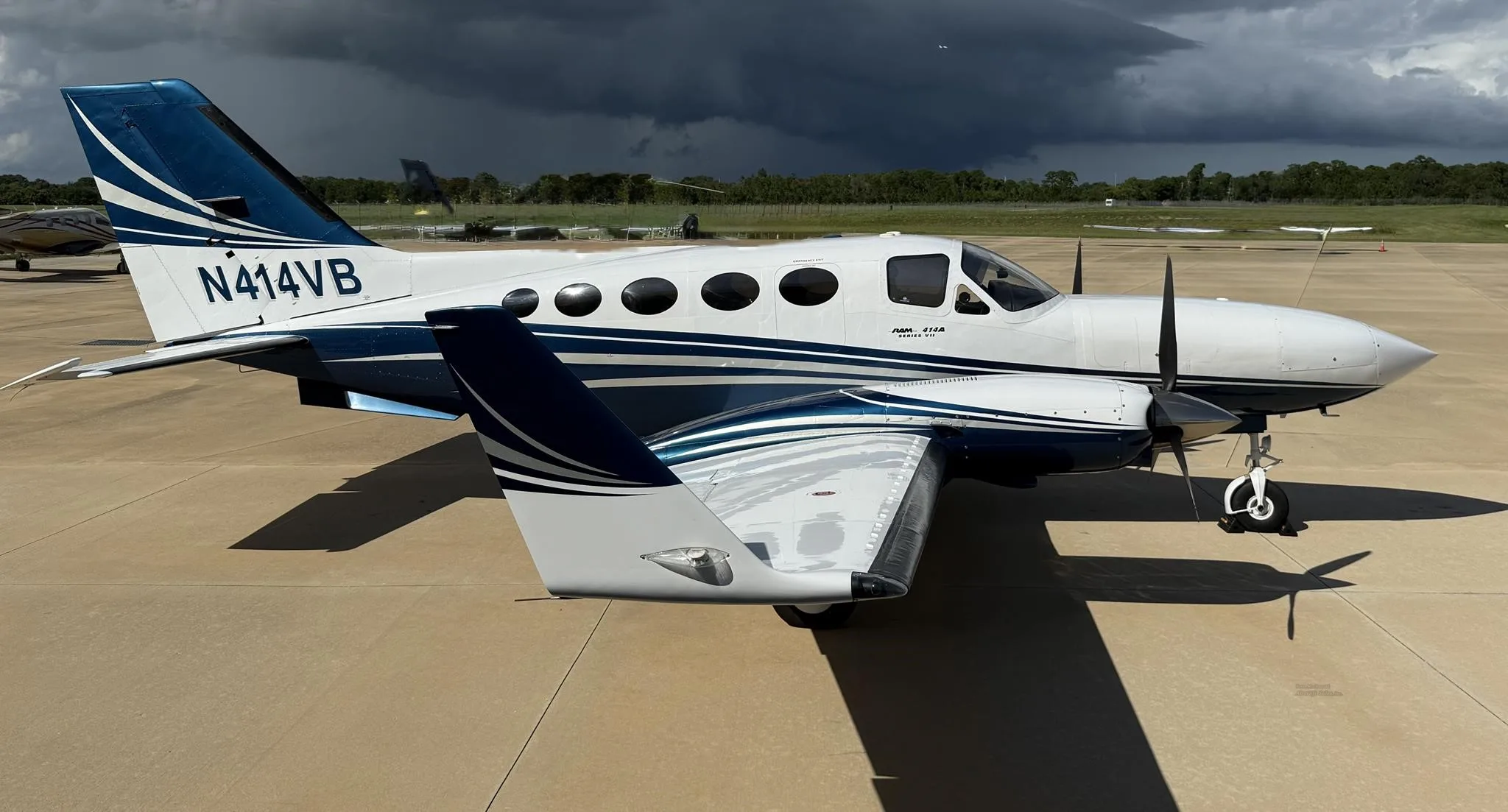
Free — save the 414A to your watchlist and track it in one place.
More CESSNA 414Amanuals & documents
See all 13 →- Rosen Sunvisor Systems PMM / IPC for Sunvisor Assembly (p/n R1181300)Systems Description
- NACELLES/PYLONS - ENGINE NACELLE FITTING REPLACEMENTService Manual
- Cessna Flyer - Cessna 414A ChancellorOther Documents
- Rosen Sunvisor Systems CMM / IPC for Sunvisor AssemblySystems Description
- Airworthiness Directives; Cessna Aircraft Company AirplanesAirworthiness Directives
- Electronics International Inc Operating and Installation InstructionsWiring Diagram
- Specifications Subject to Verification/Inspection.Specifications
- 1979 Cessna 414A ChancellorPilot's Operating Handbook
- 1979 CESSNA 414A SALES BROCHURESpecifications
- AIRCRAFT INSPECTION FOR THE GENERAL AVIATION AIRCRAFT OWNERChecklist
- Automatic Propeller SynchronizationWiring Diagram
- The Cessna 414A: A Reliable and Versatile AircraftMaintenance Manual
If you fly the CESSNA 414A, you may also be researching these.

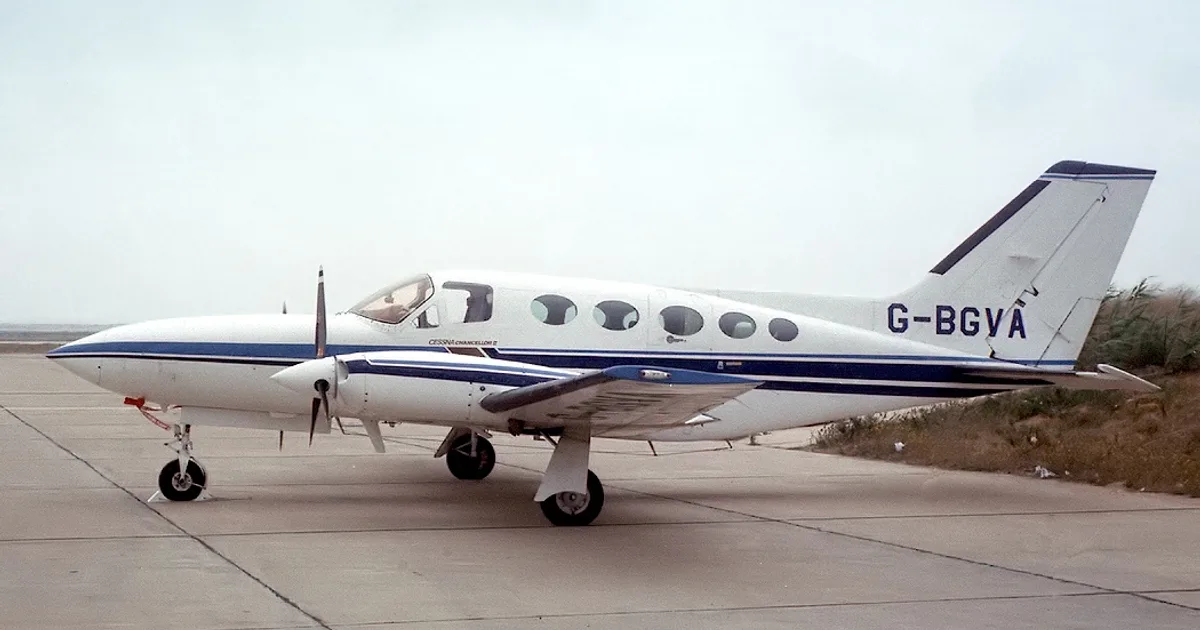


In this document
Staying Ahead of The Airplane
This article emphasizes the importance of staying ahead of the airplane, starting from ground knowledge to enhance flying skills. It discusses the challenges of type rating schools and the necessity of continuous learning and preparation for recurrent training. The author shares personal experiences and strategies for effective study habits to retain critical information.
Ice Kills Again
This section recounts a tragic incident involving an ATR 72 that crashed due to icing conditions. It highlights the importance of understanding aircraft systems and the risks associated with flying in adverse weather. The article serves as a reminder of the critical need for pilots to be aware of icing conditions and the operational limitations of their aircraft.
Owner’s Corner
This feature presents an owner's perspective on the Cessna 414A, detailing personal experiences, maintenance considerations, and the joys of ownership. It provides insights into the operational capabilities of the aircraft and the community of Cessna 414A owners.
Safety notes
- Pilots must adhere to manufacturer checklists to ensure safety, especially in adverse weather conditions.
- Understanding the aircraft's performance in icing conditions is crucial to avoid accidents.
Full document text
F O R T H E P I L O T S O F O W N E R - F L O W N , C A B I N - C L A S S A I R C R A F T DECEMBER 2024 $3.95 US VOLUME 28 NUMBER 12 Staying Ahead of the Airplane Too Old to Fly? Citation CJ2 Garmin Retrofit Patrick Dougherty’s 1983 Cessna 414A O w ner ’s Cor ner Stevens https://raisbeck.com 24 Content s DECEMBER 2024 • VOL. 28, NO. 12 Editor’s Briefing 2 Reflection and Thanks by Lance Phillips Position Report 4 From Patience to Precision, What 2024 Taught Me About Aviation by Dianne White POSTMASTER: Send address changes and inquiries to Twin & Turbine, Village Press, Inc., P.O. Box 968, Traverse City, MI 49685. Twin & Turbine (ISSN 1092-6402), USPS 24432 is pub- lished monthly by Village Press, Inc. with advertising offices located at 2779 Aero Park Drive, Traverse City, Michigan 49686. Telephone (231) 946-3712. Printed in the United States of America. All rights reserved. Copyright 2016, Village Press, Inc. Periodical Postage Paid at Traverse City, MI. SUBSCRIPTIONS: Twin & Turbine is distributed at no charge to all registered owners of cabin-class aircraft. The mailing list is updated monthly. All others may subscribe by writing to: Twin & Turbine, P.O. Box 968, Traverse City, MI 49685, or by calling 1-800-447-7367. Rates for the United States and its possessions follow: one year $15.00; two years $29.00. Canadian subscrip- tions are one year $24.00; two years $46.00, including GST tax. Overseas subscriptions are one year $52.00; two years $99.00, U.S. funds. Single copies $6.50. ADVERTISING: Advertising in Twin & Turbine does not necessarily imply endorsement. Queries, questions, and requests for media kits should be directed to the Advertising Director, Twin & Turbine, P.O. Box 968, Traverse City, Michigan 49685. Telephone 1-800-773- 7798. Website: www.twinandturbine.com. MANUSCRIPTS: Twin & Turbine assumes no responsibility for unsolicited manuscripts, photo- graphs, or art work. While unsolicited submissions are welcome, it is best to query first and ask for our Writer’s Guidelines. All unassigned submis- sions must be accompanied by return postage. Address queries and requests for Writer’s Guidelines to the editor. C O V E R P H O T O : Courtesy of Patrick Dougherty Issues of Twin & Turbine are available for free www.twinandturbine.com E D I T O R Lance Phillips lance@twinandturbine.com EDITOR IAL OFFICE 2779 Aero Park Drive Traverse City, MI 49686 Phone: (231) 946-7770 P U B L I S H E R Dave Moore P R E S I D E N T Dave Moore P R O D U C T I O N M A N A G E R Mike Revard P U B L I C A T I O N S D I R E C T O R Jake Smith G R A P H I C D E S I G N E R Marci Moon T W I N & T U R B I N E W E B S I T E www.twinandturbine.com A D V E R T I S I N G Jenna Reid 816- 699-8634 Jenna.Reid@VPDCS.com A D V E R T I S I N G C O O R D I N A T O R Betsy Beaudoin 1-800 -773-7798 betsybeaudoin@villagepress.com G E N E R A L A V I A T I O N A D V E R T I S I N G I N F O R M A T I O N Aviation.Publications@VPDCS.com S U B S C R I B E R S E R V I C E S R honda Kelly Jessica Meek Jamie Wilson P.O. Box 968 Traverse City, MI 49685 1-800 -447-7367 To change mailing address, email rhonda.kelly@vpdcs.com December 2024 / TWIN & TURBINE • 1 6 Staying Ahead of The Airplane by Mindy Lindheim 12 Ice Kills Again by Stan Dunn 28 Am I Too Old to Fly? by Thomas P. Turner On Final 32 And for everything else, there’s Mastercard... by David Miller 16 Editor’s Pics 18 Garmin CJ2 Retrofit by Rich and Tigre Pickett Owner’s Corner 24 Patrick Dougherty by Grant Boyd 12 18 6 by Lance Phillips Editor’s Briefing 2 • TWIN & TURBINE / December 2024 lance@twinandturbine.com Reflection and Thanks Every year, we get to sit back and reflect and evaluate what we’ve seen and learned over the last 12 months. I learn so much from the T &T writers every month, and this December issue is no different. Dianne White shows how patience, a quality not necessarily attributed to aviation often, pays off, especially when upgrading an airplane. Our newest author, Mindy Lindheim, demonstrates the practices she incorporates into initial simulator training and how those practices improve performance during recurrent, both in class and in the sim. Pilot extraordinaire Stan Dunn reminds us that adherence to manufacturer checklists saves lives in icing conditions. T&T reader David Dow provides a beautiful photo of an epic Epic. T&T’s resident doctor, Rich Pickett, and Rich’s son, Tigre, give us an excellent, in-depth review of Garmin’s new extensive CJ2 retrofit. I may have mentioned a time or two that I love Cessna’s 300 and 400-series twins. Years ago, I accom- plished a multi-engine rating in a 310Q. Before that, I remember f lying with my dad in various 421s and gaining experience in 414s and 441s. All fast, efficient and capable. This month, we read about Patrick Dougherty’s journey to his beloved Cessna 414A. To close this month and this year, Tom Turner (who happens to be one of the foremost disciples of safety in piston aircraft) provides a way to self-evaluate as we age. Sometimes, a second opinion provides assurance, and a qualified instructor is a great way to evaluate our performance periodically. Finally, David Miller swipes his way to visibility while approaching Denver in a vintage Sabreliner. Who doesn’t love a Sabreliner story? Thank you to all of the fantastic writers and staff at Twin & Turbine. And Merry Christmas and Happy Holidays to our readers. Let’s reflect and prepare for a safe and prosperous 2025. SMR BE 4 • TWIN & TURBINE / December 2024 Position Report by Dianne White As 2024 draws to a close, it is an excellent time to reflect on the lessons the year taught us about aviation, aircraft ownership, and the art of airmanship. Here are a few thoughts from my year: Putting your aircraft through a repainting process is an exercise in patience. Ask me how I know. There are three truths when repainting your aircraft: 1) the paint schedule is always optimistic; 2) it won’t be perfect, especially the
Show full textShow less
first time you see it; 3) a successful outcome requires good communication between you, the manager, and the technicians doing the work. After a couple of years of waiting for an opening at a reputable paint facility, we dropped our plane off for repaint earlier this fall. Lead times at the top paint shops in the country are still long, thanks to shortages of skilled labor, increased post-recovery demand, and limited paint facilities. Once the process started, our facility did a good job with progress photos and asking questions to clarify our vision for the paint scheme. Once the plane was “ready,” we showed up fully expecting not to take it home that day. Sure enough, there were several noticeable defects that the paint shop acknowledged needed fixing. Talking to the technicians directly helped tremendously in getting the plane to the quality level we expected. Overall, no regrets. There’s nothing more satisfying than opening the hangar door and seeing that shiny, new paint and racy paint scheme. Technology tools to enhance safety keep evolving. For example, ForeFlight continues to get better and better. This year alone, the company introduced several useful enhancements, including enhanced wake turbulence alerts. This feature provides visual and audio alerts using ADS-B data to calculate and display real-time risks. I saw this action on a recent flight as I followed a large business jet into my home airport. As the jet descended through my altitude ahead of me, the alert provided detailed information regarding wake positions and the intersection point. Other new ForeFlight features I’m loving this year: Graphical Weight & Balance: A visual tool allows users to easily input and adjust passenger and payload details. Support for Civil Twilight: ForeFlight now provides accurate solar data, including morning and evening civil twilight times, to help pilots log day and night hours for FAA compliance. From Patience to Precision, What 2024 Taught Me About Aviation Runway Analysis Expansion: Support for additional aircraft, including models like the King Air 360HW, Cessna Citation, and Piper M700, broadens runway performance analysis options. Profile View Enhancements: Added layers for headwind/tailwind and ground speed in Profile View provide detailed route planning insights. Two heads are better than one. This is obvious, but never more so when your autopilot fails during an approach in IMC. My airplane is certified to be flown single-pilot, and at the hands of a competent, well-trained pilot, it’s perfectly safe to do so. But given the choice, why not have another competent brain in the right seat? I was glad that was the case when the aforementioned autopilot inexplicably disengaged. I didn’t bother troubleshooting; I uneventfully hand-flew the approach December 2024 / TWIN & TURBINE • 5 Dianne White Is a 35-year aviation industry veteran, past editor-in-chief of Twin & Turbine Magazine, and the former executive director of the Malibu/M-Class Owners & Pilots Association (now PMOPA). She currently serves on the Board of Angel Flight Central. She is an active instrument & multi- engine-rated pilot and owns several aircraft. You can reach her at editor@diannewhite.com. like we’re trained to do. While it wasn’t an emergency, it was nice having my PNF partner handling the radios, eyes outside watching for the runway lights, verifying “gear down,” and backing me up on flight instruments. After flying together for 32 years, my husband and I have developed an effective CRM system with clearly delineated roles and tasks that we’ve fine-tuned during hundreds of post-flight debriefs. I won’t hesitate to take off single-pilot, but flying with my partner-pilot is twice as nice. Always be humble – we are never as good as we think we are. Every flight gives us a chance to improve our competency and our knowledge. Don’t miss the opportunity to learn something new or perfect your cockpit flow. No flight is ever perfect; only perfect practice gives us a shot at getting close. Being humble means you are open to constructive criticism from yourself and others you fly with. Commit to being better, but never stop being humble. Bad things can happen to the best of us. It’s an uncomfortable truth, but even some of the best-trained aviators in the world crash. This year, this hit close to home when a U.S. Navy EA-18 Growler (a variant of the F/A-18 Super Hornet) crashed during a routine training flight near Mt. Rainier in Washington state. My daughter is an active-duty Growler instructor pilot and knew the crew well. While the investigation is ongoing, what we know is that the pilot was an outstanding stick and a decorated aviator who flew multiple strikes into Houthi-controlled areas in Yemen. It was a sobering reminder that even with the most sophisticated aircraft and the best training in the world, things can go terribly wrong. As pilots, we must do what is within our control: keep our skills razor-sharp, train often, respect the weather and the capabilities of our aircraft, and always have an out, which sometimes means staying on the ground. The perfect aircraft doesn’t exist. But we can keep striving to make it so. If we’ve learned nothing else from SpaceX and its groundbreaking Starship and Falcon 9 missions, it is that breakthroughs are found through the relentless pursuit of well-focused goals. In an industry famous for its risk aversion and slow adoption of innovation, general aviation must continue to move forward to make flying safer, more efficient, and more accessible. Potentially unpopular opinion: let’s stop dragging our feet on the inevitable transition to unleaded avgas and embrace viable fuels, such as G100UL. Happy holidays, and fly safe in 2025. Preferred 6 • TWIN & TURBINE / December 2024 Staying Ahead Of The Airplane by Mindy Lindheim If you are a pilot, I have no doubt that you have heard these words: “Stay ahead of the airplane.” And if you are lucky, maybe these words were even shouted to you while shoved up against a sweaty-armed instruc- tor in a Cessna 172 back in private pilot training. Typically, this phrase is meant to be applied when airborne in the friendly skies to stay ahead of your tasks, but this phrase can actu- ally be applied to many facets of your aviation journey. For me, “staying ahead of the air- plane” starts on the ground. If you know your ground knowledge like the back of your hand, the flying portion becomes much easier and allows you Author Mindy Lindheim with the Citation M2 and Phenom 100 to focus on actual flying skills when entering the cockpit. Type Rating School Earning a new type rating is a chal- lenge. Most students only know of their start date just a few weeks prior and don’t get much time to pre-study, which, in my opinion, is actually ac- ceptable. The course isn’t designed for applicants to know much more than their memory items and limitations prior to showing up. Fast forward to day one of school, and you are sitting in class drinking from a fire hose. You have several days, or even weeks, of brand-new knowledge being directed at you of systems, aerodynamics, performance, and more. While immersed in type rating school, you’ll find that this in- formation sticks with you quite well. Your instructors drill into your head each day what to remember, and in just a few short weeks after a success- ful checkride, you walk out with your fresh type rating certificate. But what about after you leave type school? Unless this new mate- rial is studied more frequently, your brain will quietly dismiss all your new learnings. Systems troubles on a trip may have you struggling to reach back in your memory bank from school many months ago on how to solve your issue. December 2024 / TWIN & TURBINE • 7 Or, what may be even more like- ly is that you are staring down day one of recurrent training and can hardly remember what you learned a full year ago. How will you prove to your instructor that you are still as sharp after all this time in just a handful of short days? Your Future Self Will Thank you It all starts with initial type train- ing. And if you are already past this point, don’t worry—this still applies to you! Most schools are the same. They give you about thirty pounds of books, guides, manuals, etc., and it appears it would take a lifetime to go through it all. This can be especially daunting if you are just trying to have a quick refresher before recurrent training. The solution to easy future study- ing and waltzing through recurrent is quite simple. You need to make Mindy Lindheim completing Citation 525S Type Rating School in 2021 Exterior view of the full-motion flight simulators your own study guide. And no, I don’t mean borrowing mine – you must make your own. Study Guide How-To This is too easy; if you haven’t done this before, you are sleeping on the simplest way to succeed. Here are the steps to take while in training: 1. Read and learn the material each day as assigned 2. Highlight key items in the mate- rial as you read so you can eas- ily find it again 3. Take handwritten notes in class (must be handwritten! Studies show handwritten notes are bet- ter for memory and learning) 4. Save any quizzes or tests you take with the correct answers 5. Each evening, compile the high- lighted items from the book, hand- written notes, and correct quiz questions into a single document on your computer (yes, you can type this time). Sort the informa- tion however you’d like, but I like to sort it by chapter according to the primary training book. Then, add additional sections at the end of the document with miscellaneous and simulator notes. Why Does It Work? This works by exercising several parts of your brain – reading, listen- ing, writing, and reviewing. It’s im- portant to read the entire chapter once on hydraulics, for example, as you need to know how the system works, but your study guide doesn’t need to be that in-depth. It should be bullet points of limitations, brief explanations, any “gotchas” your in- structor informed you of that may be on the test, and even real-world flying tips & tricks you may be taught in class. Anything you want your future 8 • TWIN & TURBINE / December 2024 self to know about that chapter should have its place as a bullet point. The miscellaneous and simula- tor sections are equally important to note. My study guide’s miscella- neous notes remind me of a variety of things, such as V-speeds, single- pilot operation requirements, RVSM notes, max weights, etc. Then, my simulator section consists of every single thing I could remember from my checkride, as this will help you prepare for recurrent. Put The Hard Work In Now The bottom line is that you are al- ready working your tail off in school. You may as well put all the hard work in now as you are already committed to learning this material. This study guide will be a fantastic resource for you as you study for the initial checkride but then again as a resource each time you go to recurrent. Your thoughts and notes will be in one easy document to brush up on, and you will be off to the races. Bonus points if you add to it each recurrent of new things you may learn! For reference, my study guide on the Cessna Citation CJ3+ covers ma- terial from all 17 chapters I learned in school (plus my miscellaneous and simulator section) and is 41 pages long. Some chapters are a half-page of bullet points, and more complex chapters may take up four pages. If I am skimming through the guide in its entirety, it may take me about thirty minutes to read it front to back, but that is a lot of information in a very short time. Prove It Does it actually work? In fact, it does. My study guide was a fan fa- vorite in my initial Citation M2 type rating class when prepping for the checkride and helped me easily get through the oral portion. But this guide really proved itself later on. I took time away from flying jets as I shifted my aircraft sales career and kept busy refurbishing my vintage Cessna Skylane. However, something kept calling me back to jet life, and I decided to go to recurrent earlier this Cockpit view of the Citation CJ3+ Simulator Some schools offer additional training simulators for extra practice December 2024 / TWIN & TURBINE • 9 Mindy Lindheim with a Cessna Citation before takeoff Inside the Citation CJ3+ simulator during emergency procedure training 10 • TWIN & TURBINE / December 2024 Mindy Lindheim is an exper-ienced pilot, aircraft bro- ker, and aircraft owner. She has Textron Aviation factory experience as both a sales di- rector and demonstration pilot and has since worked her way up to earning a Citation 525S type rating and selling aircraft for Lone Moun- tain Aircraft. Mindy is very active on social media to educate, inspire, and share aviation experiences on her accounts @schmiiindy. You can contact Mindy at Mindy@Chasin- Tailwinds.com. year for the first time since I earned my 525 type rating over three years prior. Also, to be noted, I had only flown the Citation 525 a small handful of times during those three years, so the information was far from relevant. I stepped into a three-day progres- sive recurrent, and with the help of my study guide, I aced my schooling with f lying colors. My classmates were pilots actively flying the aircraft full-time and had thousands more hours than I did in the Citations, but I knew every answer they didn’t. It wasn’t because I am a super genius but because I read my study guide before class. The instructors jokingly (but not jokingly) asked if I wanted a job teaching the course. Lastly, you are way more likely to review a polished document and keep it handy than trying to decipher your old written notes on a dusty shelf. Anything that is not easily acces- sible will hardly ever be put to good use. And as promised, if you are past initial type school, start creating your study guide at your next recurrent. You will be delightfully surprised at just how easy this makes your life and dramatically shortens study time and stress. CIES Turbines December 2024 / TWIN & TURBINE • 11 Textron ADVERTORIAL Upgrade your flight experience with McCauley® propellers today. +1.800.621.7767 | mccauley.txtav.com Scan to explore more. A TIMELESS PURSUIT OF EXCELLENCE For over eight decades, McCauley® Propeller Systems has been a pioneering force in the aviation industry, known for their expertise and commitment to quality. Their legacy is built on crafting dependable products that deliver competitive performance, making them the trusted choice for pilots worldwide. Today, McCauley® innovates next-gen propellers for advanced aircraft like the Cessna® Caravan® turboprop, Cessna SkyCourier® aircraft, Beechcraft® Denali® single-engine turboprop and more. A D V E R T O R I A L THE MCCAULEY ADVANTAGE McCauley® propellers offers a wide range of aluminum and composite products designed to enhance and maintain your aircraft’s performance. From propellers to governors, spinners and de-icing systems, they have the solutions you need. Their team of engineers and customer support specialists are always ready to assist with your propeller and component needs, ensuring you spend more time in the air and less time on the ground. ELEVATE YOUR KING AIR B300 The latest innovation by McCauley® propellers is a must- have for Beechcraft® King Air® B300 series owners. They’ve engineered a sophisticated propeller system featuring a new aerodynamic scimitar blade design and a single-acting hydraulic control system. Lightweight yet extremely durable, this propeller features advanced specifications and capabilities, giving better performance, a quieter flight and the industry’s best time between overhauls (TBO) and warranty. Driven by craftsmanship and trust, McCauley® propellers are transforming aviation, with a personal touch. WHY UPGRADE YOUR KING AIR® B300 AIRCRAFT TO A MCCAULEY® PROPELLER: • Performance improvement at takeoff and climb. • Light propeller, weighing 173 pounds. • A superior TBO of 5,000 hours or 72 months. • Installment does not require changes to existing aircraft operating procedures or additional aircraft modifications. • Reduced noise in cabin and cockpit. • Backed by a warranty of 5,000 hours or 36 months. 12 • TWIN & TURBINE / December 2024 Ice Kills Again On August 9th, 2024, video of an ATR 72 in a flat spin went viral. It was a remarkable and devastating mo- ment memorializing the deaths of all 62 occupants aboard the 76-seat turboprop. With severe ice forecasted in the area, the culprit quickly became obvious. Still, the question remained: how did two professional pilots, in an aircraft equipped for flight in icing conditions, manage to lose control of an airliner? The Aircraft The accident aircraft was an ATR 72-500. It was a legacy version of the twin turboprop, utilizing an assortment of round gauges instead of the more streamlined flatscreens prevalent in the newer -600 models (Voepass operated both variants). The accident aircraft was equipped with two pneumatic air conditioning kits (PACKs), which con- ditioned pressurized air from bleeds tapped from the compressor section of the Pratt & Whitney engines. One of the PACKs had malfunctioned on a previous flight and had been deferred through a minimum equipment list (MEL). This allows airlines to continue operating aircraft with certain inoperable components until a maintenance by Stan Dunn fix can be scheduled. In the case of a single PACK MEL, the aircraft was restricted to a maximum altitude of 17,000 feet. A SIGMET forecasted FGA (severe ice) between 12,000 and 21,000 feet. Severe ice is defined as a rate of accumula- tion such that anti-icing and de-icing equipment cannot control or reduce the hazard. Operation in forecasted areas without an escape plan (i.e., the ability to climb above or descend below the ice levels) is inadvisable. The aircraft was equipped with an ice evidence probe (IEP) and an ice detector. The IEP was a small airfoil that protruded just below the captain’s side view window. Ice that accumulated on the probe provided a visual indication of accumulation on unprotected surfaces. The ice detector located on the wing was a probe that vibrates at a certain frequency. When ice accumulates the frequency changes. This generates an amber alert, ICE DETECT, along with a single chime for flight crew awareness. In addition to this, ATR had developed an aircraft performance monitoring (APM) system which calculated predicted cruise speed based on air data, power setting, and aircraft weight (which was input each flight by the crew via a rotary knob). The system provided alerts at three levels. CRUISE SPEED December 2024 / TWIN & TURBINE • 13 LOW was a blue colored annunciation that alerted the crew when actual airspeed was 10% below predicted airspeed. DEGRADED PERFORMANCE was amber and accompanied by a single chime to alert crews of a 22% to 28% degradation of airspeed. These two preemptive alerts indicated that ice accumulation might be adversely affecting performance. A final alert warned when the aircraft was approaching a stall in icing conditions. The number of icing detection/protection layers is ex- tensive. There is a reason for this. This was not the first ice-related crash in the ATR’s varied history. On Halloween in 1994, Simmons Airlines flight 4184 (doing business as American Eagle) crashed into a soybean field in Roselawn, Indiana. NTSB investigators later determined that the aircraft had encountered severe icing conditions. The pilots had been holding due to flow into Chicago O’Hare airport. They had extended flaps in the hold in response to an uncomfortable deck angle at the slow holding airspeed. Ice gradually accumulated aft of the protected surfaces, which resulted in abnormal aerodynamic forces on the ailerons. This caused the aileron to snap into full deflec- tion once the flaps were retracted when the aircraft exited the holding pattern. The resulting roll instability led to a loss of aircraft control. All 68 occupants were killed. For a short period after the crash, the FAA prohibited the ATR fleet from operations in areas of known icing. New deice boots were quickly developed and installed that protected further aft along the top of the wing. American Eagle eventually banished their fleet of ATRs to island hopping out of Puerto Rico. No More Turboprops ATR was not the only turboprop to suffer a public crash in cold weather. The last fatal airline crash in the United States occurred in 2009 when a Bombardier Q400 operated by Colgan Air crashed during approach to Buffalo Niagara Airport. Like the ATR crashes, icing conditions were present, though not severe. Both pilots had commuted to their base in New Jersey for the assignment. Neither had apparently slept in a bed the previous night (the captain was seen sleeping in the crew room, the first officer had commuted from the West Coast on a two-leg redeye). Due to icing conditions on approach into Buffalo, the stall Standard Aero https://selectairparts.com 14 • TWIN & TURBINE / December 2024 protection system was operating in advanced mode. This resulted in a higher airspeed trigger point for stick shaker and pusher activation. During an intermediate level off the captain (who was the pilot flying) failed to increase power from the descent setting. The aircraft slowed, the stick shaker rattled, the autopilot automatically disengaged, and the captain yanked the yoke aft. The Q400 entered an aerodynamic stall and crashed. The airline turboprop fleet in the U.S. had already been skating on thin ice due to competition with newly developed regional jets such as the Embraer 170. Though the turbo- props were much more efficient over short-haul distances, passenger preference was for jet engines. The Colgan crash resulted in congressional hearings (many of the dead pas- sengers were from Senate leader Chuck Schumer’s district). The visibility of those hearings did nothing for the public perception of turboprops. At the same time, turboprops in the regional airlines (originally a staple of the industry) were rapidly falling out of favor, as the short-haul structure of regional airlines had expanded into longer routes out of hub airports, an operation more efficiently flown by high-flying turbofans. The days of airline turboprops in the U.S. was rapidly waning. The difference between a turboprop and a turbofan is not nearly as significant as it may seem. Modern jet engines replace four (or six) propeller blades with twenty-four fan blades. The core section of the engine is nearly identical. For all of that, turboprops (in general) have a less desirable safety record compared to jets. There are a few different reasons for this. Turboprops are often crewed by less ex- perienced pilots (and, in many cases, by only one pilot). Cruise altitudes are often in the mid-20s, a ripe place for icing encounters. Added to this, straight-wing aircraft experience a steeper drop-off in lift at lower airspeeds. A stall in a swept-wing jet is less about the loss of lift and more about drag (at a certain angle of attack, induced drag exceeds thrust). The net result is that a stall-spin is much more likely in a straight-wing aircraft. The Pilot Makes the Difference There is a simple solution to ice. Fly fast. Ice accumu- lation decreases the angle of attack (thus increasing the airspeed) that a wing stalls at. It is difficult to find a crash caused by icing conditions where insufficient airspeed was not a factor. The difficulty with ice is that accumulation not only increases stall speed, but also drag. When drag exceeds thrust, the aircraft slows. The double whammy in propeller aircraft is contamination of the props, which greatly decreases the transfer efficiency of power into propulsion. Even with relatively high-performance turbine engines, sometimes the only option to maintain airspeed is to descend. If terrain allows it, this is a good solution. Not only does it preserve life-saving speed margins, but objectionable icing conditions rarely persist across more than a few thousand vertical feet. Descend three thousand feet, and you will likely exit the problematic icing. In the case of the Voepass crash, flight data recorder (FDR) transcripts indicated that wing deice failed early in the flight. The crew quickly turned the system off in response. This was consistent with abnormal checklist pro- cedures. However, Brazilian investigation entity CENIPA does not comment on whether the crew verbally accom- plished the full checklist (only a partial transcript from the cockpit voice recorder was released). There is evidence that the crew either failed to complete the checklist or ignored it. Under DE ICING AIRFRAME FAULT, the first item is: ICING CONDITIONS: LEAVE AND AVOID. In the event icing conditions cannot be avoided, the checklist requires pilots to maintain a minimum speed of “icing bug + 15 knots” (icing bug speeds are calculated pre- flight by the crew). Following the failure, the ice detector triggered ice ac- cumulation caution messages five times. There is no indica- tion that the crew discussed exiting the icing conditions. After the fifth alert, one of the pilots attempted to activate airframe deice again (this was contrary to the DE ICEING AIRFRAME FAULT procedure, which instructed the crew to turn the system off). Soon after this, CRUISE SPEED LOW was alerted (indicating a 10% degradation in airspeed due to ice-induced drag). The deice fault message once again alerted, and the crew turned the airframe deice off for the second time. Twenty-one seconds later, the DEGRADED PERFORMANCE alert was triggered. The checklist associated with this message recommended a minimum airspeed of icing bug + 30 knots. It also instruct- ed the crew to turn off the autopilot (autopilots can mask the aerodynamic effects of ice accumulation) and to select LOW BANK mode for turns (decreasing angle of attack during level turns). The crew did not perform any of these actions. As they got closer to the destina- tion airport, the first officer commented: “A lot of icing.” Once again, the deice sys- tem was turned on. Less than a minute later, in a turn, an INCREASE SPEED message alerted. Concur- rently, an airframe buffet could be heard in the audio, as well as triggering of the December 2024 / TWIN & TURBINE • 15 stick shaker. The ensuing stall evolved into an unrecover- able flat spin (multi-engine aircraft that enter a spin with high power settings often become flat). Mistakes and Lessons Given ATR’s well-documented history in icing conditions, the crew’s blasé response to multiple layers of ice alerts is difficult to comprehend. Continuing into icing conditions with broken deice equipment is a bad idea in any aircraft. Perhaps the crew’s confidence came from the knowledge that warmer air on approach would be certain to melt the contaminants in the descent. Regardless, the pilots deviated from manufacturer guidance when they either ignored or failed to accomplish the appropriate checklist when the airframe deice system faulted. The secondary speed alert messages occurred during a high workload period (the first officer was communicating on the radio, and the captain was making a PA to the passengers). The tried-and-true axiom “aviate, navigate, communicate” was devastatingly proven. Communications clearly distracted the crew from recognizing the degraded airspeed messages and responding to ensure proper airspeed margins (the aircraft stalled at 169 knots, six knots below the ice accre- tion limit of ICE BUG + 10 knots, and 26 knots below the SEVERE ICE limit of ICE BUG + 30 knots). There were, as always, several holes in the various layers of Swiss cheese: the failure to articulate a plan to Stan Dunn is an airline captain and check airman. He has 7,000 hours in turbine powered aircraft, with type ratings in the BE-1900, EMB-120, EMB-145, ERJ-170, and ERJ-190. Stan has been a professional pilot for 14 years, and has been flying for two decades. You can contact Stan at tdunns@hotmail.com. confront the SIGMET for severe ice (inexcusable in an aircraft limited to 17,000 feet); the PACK MEL that created the altitude restriction in the first place; the failure of the deice boot system; the crew’s failure to adhere to abnormal checklist procedures; and the decision to try the airframe deice system after it had twice failed. It is obvious that the crew had become increasingly concerned with the amount of ice they saw accumulating. Turning on a faulty deice system can be tempting, but it is a bad idea. Asymmetric ice accumulation on the wings is extremely dangerous. If the failure in the airframe deice system was caused by a single inoperative boot, cycling the system would have cleared one wing while the other remained contaminated. This greatly increases the odds of a spin in the event of a low-speed encounter. In the end, the message is clear. When it comes to malfunctions, follow manufacturer guidance to the letter. Always take ice seriously. When the airframe is contaminated, go fast. It is that simple. 16 • TWIN & TURBINE / December 2024 Editor’s Pics David Dow’s friend, Lance Berryhill, loves his Epic. David captured it here and discussed his camera gear, “I always have an RX100 MVII in my backpack, but my primary camera is a Sony a7RIV. I shot this image a couple of days ago with a Sony 24-105 F4 lens. The Epic is an impressive-looking aircraft if you are unfamiliar with it.” 18 • TWIN & TURBINE / December 2024 Synergy – the interaction of multiple elements which, when combined, provide more than just the sum of their parts. We experienced this effect first- hand with Garmin’s latest modernization STC for the Cessna Citation CJ2. Tigre and I recently had the opportunity to visit Garmin International in Olathe, Kansas, to explore this new offering and learn more about Garmin, a key partner in our aviation community. A Little Bit About Garmin We’ve been using Garmin aviation technology since the mid-1990s, starting with their original handheld GPSMAP 195. We were amazed that a handheld GPS device could store up to 20 flight plans at that time. Fast forward to today, and Garmin’s aviation offerings cover a wide range, providing navigation and automation across almost the entire spectrum of aviation. During our visit to their expansive campus, we learned about their latest avionics offerings and took a detailed tour of their extensive manufacturing operations. All of Garmin’s aviation and automotive products are built in- house at Olathe, from individual components to printed Garmin CJ2 Retrofit by Rich and Tigre Pickett circuit boards (PCB), sub-component assembly, and full environmental and certification testing. Watching the au- tomated process—from individual resistors, capacitors, and integrated circuits progressing to fully finished component boards—was fascinating. Garmin’s vertically integrated production, from manufacturing to highly automated order processing and shipping, all under one roof, explains its many prestigious aviation and manufacturing awards. With over 20,000 employees—5,500 in development and engineering alone—they have the talent and expertise to deliver, as they did with their latest offering. On to the CJ2 Having f lown the Cessna Citation CJ2 for about 10 years, mostly with the original avionics (sometimes sup- plemented by a Garmin or King GPS panel-mount unit), I was looking forward to an integrated solution. Tigre and I have had the pleasure of flying various business jet models and, in Tigre’s case, a regional jet equipped with avionics from many manufacturers. Newer avion- ics offer high levels of integration, while legacy systems (remember the proverbial six-pack?) were standalone units with little integration. December 2024 / TWIN & TURBINE • 19 Garmin’s latest STC for jets, their first to include the full range of components mentioned below, is the Garmin CJ2 Retrofit. This system offers even greater capability for the CJ2 and is designed for legacy aircraft that originally lacked such integration. Garmin’s approach isn’t about adding technology to existing components but replacing virtually every part of the avionics from nose to tail. Although Garmin’s open architecture allows integration with components from other manufacturers, the most capable setup comes from starting almost with a clean slate. The Upgrade Process The process begins by gutting the avionics and panel of the plane. Some operators opt to upgrade other parts of the aircraft, like the interior, while the plane is down for several weeks, which makes sense. With the original components removed—including autopilot servos and the old wire harness used to power and communicate with them—the result is a substantial weight reduction. A wiring harness is the aircraft’s nervous system, con- stantly relaying information between sensors, servos, line-replaceable units (LRUs), and avionics. Watching technicians build and install these harnesses is always impressive. Removing outdated wiring can optimize the system and resolve issues from years of operation or previous upgrades, as happened during an installation at Leading Edge Avionics in Chino, CA. The new Garmin avionics use an Ethernet-based com- munication protocol called the High-Speed Data Bus (HSDB), which can handle exponentially more data than older systems. The New Panel The completed panel almost looks too simple, as if it’s missing components. Yet all the necessary information— and more—is right at your fingertips. The layout typically includes one or two Garmin 600TXi 10” displays (PFDs), a Garmin 7” EIS display, two Garmin GTN 750Xi GPS/NAV/ COM units, a Garmin G600 autopilot, one or two GI 275 standby indicators (each with their own standby battery), and two Garmin USB/USB-C power outlets. Additional options include the GDL60 and Garmin’s latest weather radar, the GWX 8000. The Garmin G600TXi displays are touch-screen enabled, offering various views, including single-display or a 60/40 split. In full-display mode, the PFD provides an expansive view of the attitude indicator (AI), synthetic vision, and an HSI with inset map capabilities for weather, airport diagrams, and more. In split mode, the PFD can serve as an MFD, displaying options like weather or flight plans. Enhanced Engine Monitoring The Garmin TXi Engine Information System (EIS) does more than replace legacy engine gauges and the N1 computer; it adds new capabilities like engine start timers. The EIS also integrates fuel/trip planning and system functions and serves as the display for the GDL60. The GDL60, part of Garmin’s PlaneSync system, is a key component of aircraft management. It communicates wirelessly via 4G LTE or Wi-Fi, collecting and sending 20 • TWIN & TURBINE / December 2024 data such as engine configuration, fuel level, GPS location, and temperature. It can automatically upload flight and engine logs to the cloud and download database updates. Powered by a dedicated Concorde lead-acid battery in the nose of the CJ2, the GDL60 even allows you to check your fuel level remotely via an iOS app. One future suggestion: it’d be great if the app could pre-warm the crew seats on cold mornings! Flying the Bird Garmin graciously offered us the opportunity to fly their corporate CJ2, with the expert assistance of Jessica Koss, one of their seasoned pilots. Jessica has flown this plane for a long time and has experience with a variety of airframes. We boarded the CJ2 at Garmin’s ramp at New Century AirCenter (KIXD) in Olathe, Kansas, for our test flight. With the battery switch on, the GI275s and the EIS dis- plays powered up. The engine data displays were easy to read, with limits automatically set for each phase of the start. After a stable start and complet- ing our checklist, we powered on the remaining avionics. At this stage, the GDL60, via the EIS display, checked the database status of the other units and up- dated as necessary. After verifying our weight and tempera- ture data, I entered the V-speeds into the PFD using the easy-to-navigate touch menus. I also selected the voice callouts for the V-speeds. Yes—Garmin’s avionics can serve as a co-pilot, calling out speeds, which is a nice safety feature, especially when flying solo or even with a crew. I set the altimeter in the GI275, and the settings propagated across the panel—so easy! We quickly loaded our flight plan using Garmin Connext and the Garmin Pilot application, then taxied after receiv- ing our clearance. Garmin’s surface situational aware- ness system, combined with SurfaceWatch and high- quality displays, made taxiing in complex environments easier and safer. After takeoff clearance and aligning on the runway, I advanced the power levers to the computed N1 on the EIS. As we approached V1, the voice callout reminded me—right on cue! Then came Vr, another callout, and we were airborne. December 2024 / TWIN & TURBINE • 21 Once airborne, I flew the CJ2 manually for a while, then engaged the G600 autopilot. The G600 offers everything you’d expect from a modern autopilot, including integrated Emergency Descent Mode (EDM) and Electronic Stability and Protection (ESP), which provides under-speed protec- tion and full flight path automation—from climb to cruise, approach, and even missed approach. These features re- duce pilot workload, allowing the pilot to focus on other critical flight operations. We tested the ESP by disconnecting the autopilot and exceeding the pre-programmed bank limits of 45 degrees. The autopilot servos gently re-engaged, nudging the air- craft back under 45 degrees while issuing a voice callout informing us of the correction. Once the roll protection was no longer needed, the autopilot disengaged. During an approach to landing stall, before we reached stick shaker activation, the aural alerts stated “Airspeed, Airspeed” and the autopilot engaged automatically, lower- ing the pitch. Because auto-throttles aren’t included in this retrofit, the pilot still needs to manage power settings to take full advantage of these advanced capabilities. Weather Radar Capabilities One feature of the Garmin CJ2 Retrofit I was particularly eager to test was the Garmin GWX 8000 weather radar. This radar is a software upgrade of the GWX 75, automatic tilt and a volumetric analysis of weather threats in Auto mode by evaluating returns at multiple tilts (essentially, altitudes) and improved threat assessment. I’ve always been a fan of using horizontal and vertical tilt modes to evaluate weather threats, but this new feature significantly simplifies the process. With multiple displays, the pilot can show a variety of weather sources, including international weather through Garmin Connext, allowing simultaneous flight path as- sessment using these weather tools. Jessica and Rich in Olathe, KS. 22 • TWIN & TURBINE / December 2024 Approach and Missed Approach The Garmin avionics suite is equipped to handle the full catalog of approaches approved for this class of aircraft. The FMS, in conjunction with the G600, can perform coupled missed approaches—a feature typically available only on Garmin’s G3000/G5000 flight decks and a few avionics suites from other companies. For our test, we flew the RNAV RWY 35 approach at Ottawa, KS (KOWI) down to our decision altitude of 1,216 feet using the autopilot. When on the glide path, I set the missed approach altitude. At minimums, I pressed the TO/GA button, advanced the power to takeoff N1, and the G600 initiated the missed approach, including the climb to the pre-selected altitude displayed on the PFD. With the exception of auto-throttles, this was a fully coupled missed approach. After swapping seats, Tigre took the controls and ex- ecuted another coupled missed approach before bringing us in for a smooth landing back at KIXD. He appreciated the cleaner panel layout and the upgraded tech, though he noted one drawback: the G600’s split-screen mode. While functional, the chart visuals felt cramped, requiring constant zooming to read them clearly—something that could be improved by optimizing the available display real estate on the panel. Customer Aircraft A week after our evaluation flight, Jonathan Bailey in- vited me to pick up his newly installed CJ2 Garmin Retrofit at Advanced Avionics in Chino, CA (KCNO), perform a test flight, and deliver the aircraft to his home airport while providing transition instruction. The timing was perfect! I met Zach Nation, the lead technician on this project at Chino. He and his team had implemented this impres- sive retrofit, which is a significant undertaking. Jonathan opted for nearly all available options, including a full set of co-pilot displays, the GDL60, a refurbishment of the electroluminescent (EL) panels, and 4 USB-A/C power mod- ules – you can’t have too many charging points these days! After any major maintenance event, a thorough pre- flight inspection is critical. For an extensive retrofit like this, even more time is needed to verify and set up all components. Zach and I went through the process of checking as many elements as possible on the ground; however, some items couldn’t be tested until flight. We needed a few configuration adjustments, and Zach was helpful in not only adjusting these but also resolving some issues not related to the Garmin installation. The Garmin avionics installation worked well, and as can be expected, the test flights gave me the opportunity to adjust customization options. The avionics suite offers Clemens https://wingsofhope.ngo Heavy Inspections Avionics Install - Garmin G1000, G5000 & GoGo Avance Installation Complete Interior & Aircraft Refurbishment Jabara Airport KAAO 3628 N Jabara Rd / Wichita, KS 67226 Email: sales@clemensaviation.com Call Us: 316-636-9700 ext 107 Factory Direct December 2024 / TWIN & TURBINE • 23 With 14,000+ hours of piloting more than 100 aircraft models, Rich Pickett is still passionate about flying. Rich holds an ATP, CFII SME, SES, glider license, and type ratings in the following aircraft: L29, L39, Citation 500/510/525, Eclipse 500S, Beechcraft Premier and Dassault Falcon 10. He runs his company, Personal Wings, with his son Tigre. Personal Wings provides training, mentoring and aircraft services. You may contact Rich at rich@personalwings.com. Tigre Pickett is an ATP-rated pilot fly- ing for a regional airline, as well as a commercial single- and multi-engine pilot type-rated in Citation 525-series jets. He brings his passion for aviation to managing multiple CitationJets in Southern California alongside his father and Co-Captain, Rich Pickett. Tigre also enjoys exploring new destinations with his family in their Cessna Turbo 206. Follow Tigre’s professional aviation journey and discover more content on PersonalWings.com and their YouTube channel, where he shares insights and adventures from the skies. a significant level of customization options. I always set up an initial baseline, then show my clients the various options that they can adjust as they become more familiar with the equipment. With any avionics upgrade or maintenance, I strongly suggest flying at least the first flight in VMC conditions to reduce your workload and allow for a thorough evalua- tion and several more flights to explore all the functions. After multiple flights, the experience confirmed this is a truly effective upgrade. With many locations to enter and obtain information, such as flight plans, weather, etc. It does take some practice to find a flow that works best for each pilot. I did find that my line of sight to view the entire G600 autopilot mode controller display is blocked in the air by the control yoke, requiring me to move slightly to confirm button selection, which is done frequently in flight. It may be more advantageous to have the autopilot above the EIS, since in actual flight you use the autopilot frequently with mode, course, heading, and altitude changes. The pilot can select heading, course, altitude, and vertical speed/pitch/speed on a pedestal mounted control unit. Future-Proof Upgrades One key advantage of the Garmin STC is easy access to future software and hardware upgrades through their extensive dealer network. When OEMs control the instal- lation approval, owners often face extra steps, and in some cases, OEMs don’t support future upgrades, leav- ing owners frustrated and stuck with outdated systems. I’ve encountered this firsthand with several aircraft I’ve flown. We would like to see some future enhancements including CPLDC and perhaps RF approach approvals. What does this all cost? The pricing is quite variable, depending upon which components and capabilities an operator needs. I would definitely recommend the full set of displays both featured in Garmin’s and Jonathan’s aircraft. This allows both pilot positions to see the same information and offers great redundancy. The GDL60, and the dedicated battery, are very useful and will save pilots time in many ways. The GWX 75 radar is a great option, and can be upgraded to the GWX 8000 later if not chosen at installation. Connext weather is well worth it for inter- national weather. Of course, multiple USB modules are essential and Jonathan’s plane had four of them. Expect to spend between $300-400K on this technology upgrade. We still think Synergy would be a perfect name for this avionics upgrade! You can view our YouTube video of our CJ2 demo flight at: https://tinyurl.com/retrofit-cj2 24 • TWIN & TURBINE / December 2024 Patrick Dougherty O w ner ’s Cor ner Patrick Dougherty of El Reno, Oklahoma, has owned four aircraft to date that he f lies for business and personal use. The 1983 Cessna 414A that Doughtery currently flies is not the first aircraft that he’s owned, nor is it his first 400-series twin Cessna. “I have wanted to fly since I was a little kid but didn’t have an oppor- tunity until I was in my 20s. And it wasn’t until I was 32 that I went out and bought a [Cessna] Cardinal, because I figured if I owned a plane – then I would have to finish up the license. Right?” Dougherty recalled. The CEO of Dougherty Forest Manufacturing, a manufacturer of Patrick Dougherty in front of his 1983 Cessna 414A forestry equipment for vegetation management, quickly learned how aviation could serve his business. “The Cardinal is simple, not super- fast (about 130 knots), but it was a great airplane, and I loved it. I bought it personally, but eventually had the business acquire the airplane and used it as a tool. We would go to a lot of tradeshows and as I was driv- ing, it would gnaw at me the things I could be doing and the time I would be wasting on the road. The plane was a time machine and just what I was looking for.” Dougherty would fly the plane to tradeshows and meet customers re- gionally. He began thinking about PHOTOS COURTESY OF PATRICK DOUGHERTY what aircraft would come next and considered several options before settling on a twin. “The business was going pretty rapidly, so I bought a 414A. First, I leased some other twins, and I was like, ‘Wow, this is really a next step up, with pressurization, two engines, and all these other great things. It opened up my eyes to real business aviation,” he said. “The 414A I got was a pretty eco- nomical purchase, which is never a good thing in aviation. I ended up painting it, putting a panel in, and doing some other things. But the problem was when I bought it, it had 7,300 hours, so it was a little bit tired. December 2024 / TWIN & TURBINE • 25 History wise, it had gone all the way to Australia and back and sometimes wear and tear can’t be fixed. It was a good plane that I trusted decently, but I had some changes in business and sold the aircraft in 2015.” While Dougherty acknowledges that the new Cirrus SR22 he pur- chased was a good aircraft, it was apparent that the single-engine piston was a step back personally. He planned to get back to the speed and legs he had lost when selling the twin Cessna. “I said, ‘Well, I’m going to go back to a 414, but am going to find a lower time airplane’ and did an exhaustive search of those on the market at the time. Rather than purchasing it on looks or any of that, I went through the purchase history for every plane, and its whole history – down to the engines and other things,” he said. After regularly scouring listings on all of the aircraft sales resources, Dougherty found an aircraft that ap- peared that it could be a diamond in the rough. It sounded like a good option, but it didn’t look that way in the pictures. “My plane only had 5,100 hours on the airframe, and I knew all the shops that had worked on it before, but it didn’t really look that good in the photos. But I thought if the numbers worked, we would paint it or some- thing to make it more aesthetically pleasing,” Dougherty noted. “The guy who was managing it flew it over to my airport and it looked great! Everybody had passed by the listing because of the photos. But the airplane was what I was looking for. It had RAM sevens (335-horsepower engines), one of which was really low time, and the other was mid- time. Then I went and put a panel in. That took quite a bit of time and effort to get the airplane where I wanted it to be.” Dougherty was impressed by the pedigree of this 414A, and this aircraft demonstrates the model’s true allure. “I still use the plane for my trade- shows, which me and my business partner just did one over in Missouri. We loaded it up with TVs and a booth in the back, with other things in the nose. The 414 is really a workhorse and you can just load everything you want to and fly it wherever you want. You can really see the utility that they had when there were fleets of these aircraft flying around. It is a great aircraft.” When examining the speed and range vs. the cost of ownership equa- tion, this twin Cessna ranks favorably. Dougherty budgets about $25,000 per year in maintenance costs and $250 per hour in fuel expenditures. He notes that insurance is high, but not AOPA Patrick Dougherty flying with his daughter 26 • TWIN & TURBINE / December 2024 as much as it would be in a single engine turboprop. “For me, the cost of ownership and the performance envelope, the 414A is just a tremendous airplane. This 414A has a useful load of 2,038 pounds and [a fuel capacity of] 206 gallons, which is about five hours or 1,000 miles. Full fuel payload is 802 pounds,” Dougherty explained. “For a typical flight, I usually fly with 140 gallons of fuel, so I can load the plane up with about 1,200 pounds. Down low, I don’t run high power set- tings because the airspeed does not go up proportionally to the fuel used. Under 10,000 feet, I usually see about 185 knots on 34 gallons per hour. Over 15,000 feet, I can get up to 220 knots on 42 gallons per hour. I love that there is no fuel penalty flying low. In winter I fly east up high and west down low to avoid headwinds.” Owners of twin Cessnas are often focused on the upkeep of their air- craft, and the models are sometimes negatively associated with onerous maintenance expenses. “Knock on wood, but I have not had any bad experiences with the maintenance of this aircraft. It even still has the safety cards for the back of the seats when purchased and the tie-downs on the back shelf when I bought it. I think it lived a pretty charmed life,” he said. “My [maintenance] costs have been lower than most people, but I am very proactive with resolving issues. If there is a problem, I get it fixed imme- diately. There are some inspections and things that the FAA wants done that people always kind of grumble about. But I figured that these are things that should probably be done, like an exhaust inspection or replac- ing a heater at a certain interval. If you do those things [proactively], then you probably won’t have to worry. Trouble often appears in aviation when people try to scrimp on money.” In addition to maintenance as- pects, Dougherty has an ongoing focus on his own proficiency. He currently has roughly 670 hours behind the yoke, more than 250 of which have been in the 414. “I try to f ly the airplane once a week, for at least an hour, to keep myself current. I also do it because the airplane has systems that need to cycle once a week, and I think that’s part of the reason why I don’t have maintenance problems. A lot of times, people put these planes in a hangar and leave them until they want to go on a trip after two months [of inactivity]. It’s not healthy,” Dougherty noted. “The second thing I do to help with proficiency is I go to sim train- ing every year in Burnet, Texas at Aircraft Simulator Training. That is an insurance requirement, but I would still be doing it even if it wasn’t. Patrick flying for business The 414A on the ramp The panel that Dougherty installed in his 414A after purchase ...It’s just made so well, and everything is robustly built.” December 2024 / TWIN & TURBINE • 27 Jet Shades Grant Boyd is a private pilot with eight years of expe- rience in aviation business, including marketing, writing, customer service, and sales. Boyd holds a Bachelor’s and a Master’s of Business Admin- istration degree, both from Wichita State University, and a Doctor of Edu- cation degree from Oklahoma State University. He was chosen as a NBAA Business Aviation “Top 40 Under 40” award recipient in 2020. The team down there has a lot of knowledge about these aircraft. I also do instrument proficiency [training] about twice a year.” As Dougherty f lies the aircraft more and speaks with other owners, he becomes more enamored with this model. He feels that Cessna really hit it out of the park with its design. “These airplanes have a huge rud- der, and the engines are pretty close to centerline, which makes it feel like you’re a great pilot when flying with only one engine. Also, one of the engines is canted several degrees to help with single-engine operations. Cessna did tremendous engineering with the plane with little details that everyone’s forgotten about,” he said. “I did the research once on Cessna in the late 70s, and you could not build the plane now the same way. You can really tell that they had a lot of engineers to put to problems, and it shows how solidly built the airplane is. For example, it has two hydraulic pumps for the landing gear. If one fails, the other one can cycle the gear, and it only loses three or four seconds. It’s just made so well, and everything is robustly built.” Wings of Hope https://wingsofhope.ngo 28 • TWIN & TURBINE / December 2024 Almost a year ago, a Baron 58P owner contacted me and arranged his recurrent training for the first week of Octo- ber of this year. When I checked with him in September, he told me he still wanted to fly with me, and his insur- ance company recognizes me for his annual 58P-specific training requirement. I happily took time to conduct his Flight Review and Instrument Proficiency Check (IPC). After the usual introductions, I begin a training flight briefing by asking the pilot about his or her goals for the session. My client said he felt rusty on hand-flying and visual maneuvering. He had not flown much in the past year and the less he flies the more he uses the autopilot. He needed flight review and IPC endorsements to satisfy his insurance carrier, but he also knew he needed to earn them— especially the IPC, which, since the Airman Certification Standards (ACS) have been “incorporated by reference” into the Federal Air Regulations, means he had to demonstrate proficiency to checkride standards on a long list of “Tasks” from the Instrument Airplane ACS. Most tellingly, my student added: “What I really need is your honest evaluation of whether I still have what it Am I Too Old to Fly? by Thomas P. Turner takes to fly a 58P. Am I too old to fly?” That surprised me because (1) the pilot doesn’t look much older than me, and (2) most pilots who need to ask that question…don’t openly ask that question. We briefed the flight to occur in two parts: first, visual maneuvering and traffic patterns, in which I would see his strengths and help him improve on any weaknesses; and second, after a break for lunch and additional briefing, work toward an IPC unless the first session demanded more focus on basic flying skills. He lives less than an hour from Wichita, so we could get back together another day for his IPC if we didn’t have time to get through all the required tasks that day or if he needed additional work to perform to ACS standards. My client liked the plan. Validation “I want you to fly as if you are alone in the airplane,” I told the pilot. Especially with pilots experienced in their airplane—he has owned it for over 20 years and flown annually with many of the big names in 58P training—a large part of a Flight Review is confirming that the way the pilot flies is both safe and effective at getting desired performance. “If the way you do things is safe and gets the job done,” I told him, “we don’t need to try to change anything.” I might demonstrate a different technique if I Am I too old to fly?” That’s a question we all hope to be around to ask some day. December 2024 / TWIN & TURBINE • 29 think there’s an easier or more effective way, but he would be free to adopt it or not. “More than anything else with an experienced pilot,” I concluded, “I’m looking for safe, precise and consistent performance. We’ll work to make you even more precise, but mainly we’ll validate the way you currently fly.” I added, “safe, precise and consistent are good criteria to answer your question about being too old to fly as well.” After preflight, all before-takeoff checks and voicing a departure risk assessment and emergency plan, we took off. For the next hour and 45 minutes, we did standard rate and steep turns and high angle of attack maneuvers. We focused on engine failure from various airspeeds and attitudes, in and out of turns—emphasizing PUSH the nose to the horizon for Blue Line speed (VYSE, best single-engine rate of climb) and HOLD heading with rudder, “fly the airplane” to provide the time to complete the Engine Failure in Flight memory steps. We practiced precise pitch references for Blue Line speed in a Baron: on the horizon before propeller feathering, seven degrees up after feathering. Our first flight concluded with a series of visual takeoffs and landings, including a go-around. The pilot was a little imprecise at first. But his performance improved markedly as he regained confidence in his command of the P-Baron. After the break he was in his element, instrument pro- cedures. He flew accurately and confidently using the autopilot, hand-flying with the flight director, and partial panel. I showed him the use of the Go-Around button for its named purpose and also as a reference for takeoff and for the single-engine Blue Line attitude once a propeller is feathered. Both using the “GA” button and predictable Blue Line attitudes were things he never learned in over two decades of training in this airplane, he told me. As the propellers ticked to a stop at the end of our flight I told my client, “You are definitely not too old to fly this airplane.” Debriefing in the FBO I asked him to rate his performance and he gave it a “C+,” a little better than average. I told him I’d call it a “B” in the context that “aver- age” means the ability to fly the airplane to the minimum standards of the pilot certificate and ratings he holds—a Private Pilot, by the end of the first session he was flying closer to Commercial Pilot tolerances. He summed up his weaknesses and his strengths when asked, and we reviewed the lessons learned on this flight. I confidently endorsed his logbook, and he immediately asked to schedule for another check of his abilities next year. Second opinion What if, however, the pilot didn’t score a “C,” that is, did not fly safely, precisely or consistently? What if you schedule a Flight Review and you know you didn’t fly well, or worse yet, you think you’ve done a passible job but your flight instructor disagrees? Don’t dismiss the suggestion outright. We all need con- firmation that we’re safe to fly. The older we get the more frequently we need an objective review. Eventually every- one’s skills will wane. It might be age, your skills may have atrophied from lack of use, or you might have just had a bad day. But never say “you’re wrong, I did just fine.” Trust me, it’s not easy for a flight instructor to tell a student he or she has major deficiencies, so the CFI means it. You need more information. Get specifics. Start with your performance and the ob- jective standards. Did you land long or short? Could you not hold altitude or heading? Did you bust instrument minimums? Do you not know the immediate action items of an emergency procedure? The good news is that these types of discrepancies can usually be fixed with additional training…unless you have cognitive or motor skills decline from age or other health factors, or an attitude that may or may not be age related. Ask your instructor to quantify your specific deviations from Airman Certification Standards on that flight, and discuss ways to improve. Talk subjectively. Yes, subjective evaluation is also valid: “you were behind the airplane,” “you hesitated to go around when needed,” “your landings weren’t consistent,” “you seemed uncertain or confused.” These “soft” pilot skills may indeed point to age-related issues. They may also be the result of temporary or chronic health issues not related to age. They may simply be due to lack of recent experience or gaps in your earlier training—“rust” that can be removed. Have this conversation with the instructor. Get a second opinion. If you receive a bad report from your doctor, it’s common to seek a second opinion. The same works with flight instruction. I can argue it either way: fly with the same flight instructor all the time so he/ she can see trends in your performance over time, or fly with different instructors to reduce familiarity and support objectivity…and to be exposed to new ideas and techniques even if you have a lot of experience. If you failed to meet objective standards, schedule more training on those areas with the same instructor or another one—a second opinion on those objective items. If your instructor won’t endorse you for subjective reasons, honor that opinion for now but seek out another instructor—preferably one with whom you’ve never flown—to see if that CFI shares the first instructor’s opinion. If multiple instructors are telling you the same thing it’s time to strongly consider what they say. Data-driven proficiency From my experience the fact the pilot asked if he’s too old to fly suggests he is not. But “Am I too old to fly?” asks the wrong question. What you need to know is, “Do I safely, precisely and consistently fly the airplane?” There’s no objective age limit. Sometimes, you can improve lagging performance. Sometimes, you may no longer have it in you. It’s not just about age; it’s about your ability to command the airplane. Thomas P. Turner is the author of the FLYING LESSONS Weekly blog (www.thomaspturner.com) that inspires pilots to pursue Mastery of Flight.™ A prolific writer, speaker and flight instructor, Tom has been inducted into the National Flight Instructor Hall of Fame. 30 • TWIN & TURBINE / December 2024 Ad Index TO ADVERTISE IN TWIN & TURBINE MAGAZINE, CONTACT: ADVERTISING DIRECTOR, JENNA REID 816-699-8634 | Email: Jenna.Reid@VPDCS.com AEA Training ................................................ 30 Airtext........................................................ 15 AOPA Finance .............................................. 25 CIES Corporation ........................................... 10 Clemens Aviation .......................................... 22 Covington Aircraft Engines ............................... 13 Factory Direct Models..................................... 22 Jet Shades .................................................. 27 Ice Shield/SMR Technologies ..............................3 McCauley-Textron...........................11, Back Cover Preferred Airparts LLC ......................................5 Select Airparts ............................................. 30 Standard Aero .............................................. 21 Stevens Aerospace .....................Inside Front Cover Turbines Inc. ................................................ 10 Vac Veterans Airlift Command ........ Inside Back Cover Wings of Hope .............................................. 27 Select Airparts https://wingsofhope.ngo Jenna House Jenna http://raisbeck.com T O A D V E R T I S E I N T W I N & T U R B I N E M A G A Z I N E C O N T A C T : J E N N A R E I D , A D V E R T I S I N G D I R E C T O R J E N N A . R E I D @ V P D C S . C O M 8 1 6 - 6 9 9 - 8 6 3 4 32 • TWIN & TURBINE / December 2024 On Final by David Miller In 1990, my small Dallas manufacturing company needed transportation that could span the country with 4-6 pas- sengers to visit customers and build our business. Person- ally, I needed something to brag about to my friends. Not having the money to buy a late-model Citation or Learjet, I scoured the market, looking for the best bang for the buck. And I found it, the Sabreliner Model 40. Designed in the late 50’s as a T-39 for the military, the Sabreliner was an impressive looking airplane. It was built like a tank. It was heavy like a tank too weighing almost 20,000 pounds at maximum takeoff weight. And to lift all that metal required two Pratt and Whitney JT12 turbojet engines gulping over 7,000 pounds of fuel in about three hours. We departed Addison, Texas, under clear winter morn- ing skies bound for snowy Denver with my long-time pilot JC and newly recruited co-pilot Monte in the right seat. I rode in the back with several customers who had never flown in a small jet before. Climbing like a rocket in the unusually cold air, we quickly reached FL 450 and settled in for our magic carpet ride to the mile-high city. There is nothing more regal than riding in the back of your own private jet, sipping orange juice, and eating a croissant. It just doesn’t get any better. Unless you can’t see where you are going. I glanced forward to check on the crew and noticed JC and Monte in an animated conversation. Not wanting to upset my neophyte passengers, I casually approached the cockpit to find the two pilots wiping the inside of the windshield with both hands. At that moment, our 1950s technology airplane chose to fail both windshield heat controllers simultaneously. Frozen moisture was forming on the inside of the windshield, and we were quickly turn- ing into the inside of an ice cube! Monte and JC grabbed handkerchiefs, Kleenex, Jepp charts and everything else they could find and began a symphony of dancing digits like you have never seen before. But the ice was forming faster than the two could remove it. And we were descending into severe icing and whiteout conditions in Denver. Without a clear windshield, we were in trouble. And then it dawned on all three of us at the same mo- ment. Grabbing our wallets, we produced three credit cards and began scraping furiously left to right, up and down. Me with an American Express, Monte with a Visa and JC with his Mastercard. We had enough shaved ice to have our own happy hour. The passengers, with horrified expressions, needing reassuring. I confidently told them this was part of the “deicing” process and asked them if THEY had any credit cards. In the blink of an eye, they came up with three more: Discover, Sears, and JC Penny. Now, with cards in each hand, the deicing process was in full stride. The three of us looked like an octopus at a NASCAR event waiving all those credit cards. I don’t know if it was JC’s dexterity or the fact that as captain, he had the most to lose, but he had the most suc- cess on his side of the cockpit. All of us kept scraping until we broke out of the muck at minimums. In near-whiteout conditions, we had just enough forward visibility to keep our ice-covered popsicle on the runway. Mastercard comes in handy for buying fuel, but this particular morning, it was much more valuable… for everything else. Fly safe. David Miller has owned and flown a variety of aircraft from light twins to midsize jets for more than 50 years. With 6,000 plus hours in his logbook, speaks nationally and writes on a variety of aviation safety topics. You can contact David at davidmiller1@sbcglobal.net. And for everything else, there’s Mastercard... From Best Of On Final, originally published in March 2010 VAC VETS Textron
What's in the CESSNA 414A TCDS
A Type Certificate Data Sheet (TCDS) is the FAA's record of what an aircraft type was approved as. It is the source of truth for weights, seating, fuel and the rules the design was certified against. Expand any line to see what it means.
1,387 CESSNA 414A parts for sale
See all →


Parts listed for sale by vetted eBay sellers — confirmed on eBay at checkout.