The Mooney Flyer Volume 12 Number 8 August 2023
Mooney M20S Eagle · Other Documents
Overview
This document is the August 2023 issue of 'The Mooney Flyer', a newsletter dedicated to the Mooney aviation community. It features articles aimed at enhancing the skills and knowledge of Mooney pilots, including tips on flying techniques, safety practices, and insights into aircraft maintenance. The newsletter also includes an Airworthiness Directive (AD) specific to the Mooney M20S Eagle, along with various community updates and product reviews. The content is designed for both seasoned pilots and those new to the Mooney aircraft family, providing valuable information to improve flying proficiency and safety.
- Vx for the Mooney M20S Eagle is 85 knots; Vy is 100 knots; Vcc is calculated as 115 knots.
- The Defined Minimum Maneuvering Speed (DMMS) is 1.404 times the clean stall speed, which decreases as weight decreases.
- Proper engine idle speed is crucial for safe landings; excessive idle can lead to landing difficulties.
- In the event of engine failure, prioritize a controlled glide and use the aircraft's structure to enhance survivability during a forced landing.
- Regularly check and maintain compliance with Airworthiness Directives to ensure aircraft safety.
Document
Source
Originally published by themooneyflyer.com. Sprinkle hosts a reference copy with an added summary, specifications and searchable full text.
Document details
- Type
- Other Documents
- Year
- 2023
- Pages
- 49
- File size
- 4.6 MB
- Publisher
- themooneyflyer.com
Most owners only have the POH. Here's the essential set for the Mooney M20S Eagle.
- Pilot's Operating Handbook / AFM
- Checklist
- Maintenance Manual
- Parts Catalog (IPC)
- Systems & Wiring
- Service Bulletins
- Type Certificate (TCDS)
Mooney M20S Eagle for sale now
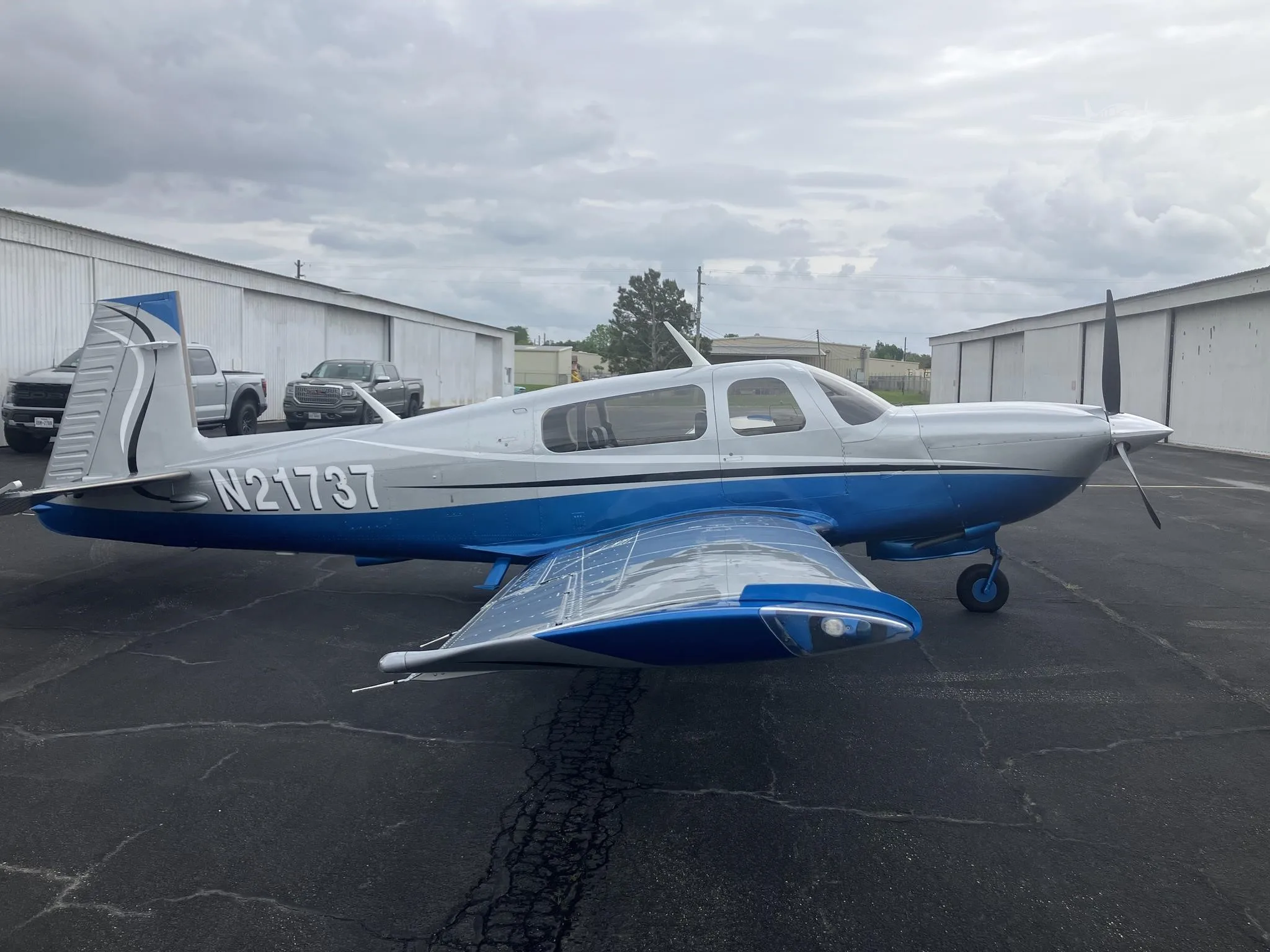
Free — save the M.20S Eagle to your watchlist and track it in one place.
More Mooney M20S Eaglemanuals & documents
See all 14 →- AIRCRAFT MAINTENANCE ENGINEER LICENSING CAR 66 - ISSUE 07Airworthiness Directives
- Emergency Procedures for the Mooney M20S EagleEmergency Procedures
- Performance Data for the Mooney M20S EaglePerformance Data
- Federal Aviation Administration (FAA) Approved Model List (AML) SA02402SE for Installation of Electronics International Inc. Glass Panel Engine Monitor (with In-Flight Data) CGR-30CChecklist
- FEDERAL AVIATION ADMINISTRATION (FAA) APPROVED MODEL LIST (AML) SA02283SE FOR INSTALLATION OF ELECTRONICS INTERNATIONAL INC. GLASS PANEL ENGINE MONITOR (WITH IN-FLIGHT DATA) CGR-30PFlight Manual
- From Corona to Bisbee with DeliaSystems Description
- SERVICE BULLETIN M20-310AFlight Manual
- SERVICE BULLETIN M20--294Flight Manual
- SERVICE INSTRUCTION M20-107Maintenance Manual
- Mooney M20S Eagle Systems DescriptionSystems Description
- Supplemental Type Certificate for the Mooney M20S EagleSupplemental Type Certificate
- Propeller Performance ConversionsSpecifications
If you fly the Mooney M20S Eagle, you may also be researching these.


In this document
Airworthiness Directive (AD) 2023-09-09
This section details the latest Airworthiness Directive affecting the Mooney M20S Eagle, outlining necessary compliance actions for owners and operators to ensure safety and regulatory adherence.
How to be an Excellent Mooney Pilot
This article provides practical tips for Mooney pilots, emphasizing the importance of understanding Vx, Vy, and Vcc (cruise climb speed). The author shares personal insights on achieving smoother takeoffs and effective climb techniques.
Mooney Landing 'Gotchas'
The newsletter discusses common mistakes during landing in Mooney aircraft, including the risks of excessive speed during the flare and the importance of proper engine idle speeds to ensure a safe landing.
Engine Failure – Approach Airport Technique
This section outlines techniques for handling engine failure during flight, including the use of HIGH key, LOW key, and BASE key for a controlled landing approach.
In Praise of Used Parts
An article discussing the benefits of using used aircraft parts for maintenance, highlighting cost savings and the importance of sourcing quality components.
Safety notes
- Always adhere to the latest Airworthiness Directives for your aircraft model to maintain safety and compliance.
- In case of an engine failure, execute the 'Safety Push' immediately to maintain control.
Full document text
The Mooney Flyer The Official Online Magazine for the Mooney Community www.TheMooneyFlyer.com August 2023 The Mooney Flyer Volume 12 Number 8 August 2023 Page 2 Editors Phil Corman | Jim Price Contributors Jerry Proctor | Tom Rouch | Richard Brown | Parvez Dara | Departments Features From the Editor – Nobody Asked; just our Humble Opinion How to be an Excellent Mooney Pilot by Phil Corman Airlines that were Short Lived by Jim Price In Praise of Used Parts by Kevin Knight ELTs and the VOR MON Program by Fred Gibbs Baby, it’s Dark Outside! By Jerry Proctor To Turbo or Not to Turbo, That is the Question by Terry Carraway Airworthiness Directive (AD) 2023-09-09 by Jim Price Mooney Mail – Feedback from our Flyer readers. Ask the Top Gun –Tom Rouch answers your questions Product Review – PlaneSync from Garmin Upcoming Fly-Ins – Fly somewhere and have fun! Have You Heard? – This month’s Relevant GA news & links Mooney CFIs – The most comprehensive listing in the USA If you love The Mooney Flyer and want to keep it healthy, just click on the “Donate” button. Subscribe and we will email you we publish a new issue. Find all the back issues (starting in 2012) or use our powerful search engine to find a past article. The views expressed in each author’s article are their own. The Mooney Flyer’s goal is to educate, inform, and entertain Mooniacs. The Mooney Flyer Volume 12 Number 8 August 2023 Page 3 Cruise Climb As a Mooney pilot, I am obsessed with speed and also economy, which are the reasons I have owned Mooneys my whole aviation life. Let’s face it, no other GA airplane comes close to our speed and our economy. We are all very aware of Vx and Vy and, if you are a long-time reader of The Mooney Flyer, you are aware of the Carson speed, which is the best speed/economy airspeed for cruise. But do you internalize Vcc or cruise climb. It’s a very handy speed for us Mooney pilots. There are several advantages to Vcc. First, it will keep your engine cooler than Vx or Vy. The second advantage is that it will get you to your destination faster than other airspeeds. Additionally, you will get better forward visibility using cruise climb, which is always an advantage in our faster Mooneys. I couldn’t find Vcc in my POH, so here is a method to compute it for your Mooney. Take the difference between Vx and Vy. Then add that difference to Vy and “Voila” you have Vcc. In my Eagle Vx is 85kts and Vy is 100kts. So, my Vcc is 115kts. So, if you want to get there faster with minimal loss in vertical speed in the climb, select Vcc. Lightspeed Delta Zulu Headset I’m the proud owner of the new Lightspeed Delta Zulu headset. I do love it. When you get it, the accompanied App walks you through an “equalizer” setup for your ears. The improvement is amazing. It also comes with the ability to record all transmissions and receptions with the app. I am embarrassed to say why I purchased it. I am sharing the story in hopes that I help other Mooniacs to avert this brain cramp. We flew to New Cuyama (L88) for lunch at Buckhorn. New Cuyama is fun. It is a high desert airport with a fresh runway. On this day, it was sunny and about 75oF. Without thinking, I placed the controller for my old Zulu headset on top of the glareshield. When I returned to the plane, the controller literally burned my hand. The headset would not work, and the controller was badly warped. With my new Delta Zulu, I place the control unit on the floor out of the direct sun. Another expensive lesson learned the hard way. FTE The Mooney Flyer Volume 12 Number 8 August 2023 Page 4 Next month’s poll: “The Best Part of AirVenture is” CLICK HERE to vote The Mooney Flyer Volume 12 Number 8 August 2023 Page 5 You can also go to https://themooneyflyer.com/ and click on CFIS – (located in the top menu). You can also click on the CFIs icon, found in the website’s right column menu. To list your name and contact information on our website, or to modify your current listing, send an email to TheMooneyFlyer@gmail.com Be sure to include your home base and state. Need a Mooney CFI? to find one The Mooney Flyer Volume 12 Number 8 August 2023 Page 6 I would like to subscribe to The Mooney Flyer. I really liked the previewed past reading and I’m sure that I can get enough of the right info to help in my decision to make the right choice to which M20 type I’ll eventually acquire. Thank you in advance for the opportunity to be a part of such a group of pilots. Best Regards, Derrick M Congratulations to our writer/contributor Richard Brown who won this award at AirVenture this year! We are both proud to know Richard and honored that he authors such amazing articles each month. mail Destination Bowling Green, KY (KBWG) Bowling Green, KY is the home of the Chevrolet factory that produces Corvettes and also home to the National Corvette Museum ( https://www.corvettemuseum.org/ ). If you are into cars, even if you are not a huge Corvette fan, it is a nice place to visit. The grill at the museum is quite good. The waitress recommended the Jalapeno Crunch burger, (don't worry, it was pretty mild), and she was spot on. And leave room for the Bourbon Bread Pudding. The FBO is Co Mar and strangely, full service from them is cheaper than the city run self- serve. Nice FBO, except keep an eye on them when fueling. I requested 20 per side and got 40 on one side. Online info says they offer a ride to the Museum, but when we asked, they said that Uber was easier. by Terry C The Mooney Flyer Volume 12 Number 8 August 2023 Page 7 Become a Safer Mooney Pilot Attend the Mooney pilot proficiency Program in Westfield, MA (KBAF) on Sep 8 – 10, 2023. (Plan to arrive Thursday, Sep 7). Visit MooneySafety.com to learn more about this and other Mooney pilot programs. You can register for this and other Pilot Proficiency events at https://www.mooneysafety.com/ppp-registration/ You can contact Lela Hughes by email: lelahughes49@gmail.com or call her at 830-315-8008 Her at 830-315-8008 (413) 485-0078
Show full textShow less
Reserve your room at the Hampton Inn, Westfield. Call (413) 564-6900 with Code “MAP” for the discounted rate of $169. Note: Cutoff date is August 8th. The Mooney Flyer Volume 12 Number 8 August 2023 Page 8 How To Be an Excellent Mooney Pilot At MooneyMax, Richard Simile and Bob Kromer gave excellent presentations, regarding how to be a better Mooney pilot. I am sharing some of those ideas in this article, plus a few additional ideas that I have researched. The “Mooney Pull” On takeoff roll, our Mooneys will often jump or hop into the air when we reach takeoff airspeed. But there is a smoother way to depart the runway. Bill Wheat called it the “Mooney Pull”. Our Mooneys are most often near or at forward CG, but takeoff trim is usually set for a mid CG. As you are rolling, try a slight aft pull on the yoke of approximately three lbs. This will give you a smoother run and a gentle departure. Give it a try. You and your passengers will appreciate it. A “Conditioned Response” and the “Safety Push” This suggestion pertains mostly to an engine loss on departure. There are a few things you need to think about beforehand, so you can, without thinking about it, execute the correct procedures when and if this happens to you. The first I call a “Conditioned Response”. Usually when our brains are confronted with an emergency situation, it takes almost three seconds to respond. It’s because our brains are approximately an Intel 286 processor. You need to ingrain in your brain that if on departure, your engine fails, or partially fails, that you immediately need to make the “Safety Push”. It could be the difference between life and death. It could mean the difference between a stall/spin or a controlled glide. The safety push should be made quickly and without thinking. The safety push should be assertive and strong, giving you a light in your seat feeling. Engine Failure – Approach Airport Technique When making a “dead stick” approach to landing, use the HIGH key, LOW key and BASE Key technique. (See illustration on the next page). The Mooney Flyer Volume 12 Number 8 August 2023 Page 9 A “Forced Landing” and Defined Minimum Maneuvering Speed We all know that a forced landing in a Mooney, compared to other General Aviation aircraft, is more survivable. This is because of our tubular steel cabin frame and our one-piece wing spar. But equally important, we need to land as slowly as possible. The other major consideration is to use the airframe to increase your chances of survival. Use the wings to slow your deceleration. Do not try to save the plane. The objective is to walk away from the incident. Use your Mooney to increase your odds of walking away. Glide between trees and let those trees slow you down. In the event you have an engine failure, you will probably be doing some low altitude maneuvering. It is a situation that is prone to accidents. If you doubt this, check the NTSB findings. Richard Simile talked about “Defined Minimum Maneuvering Speed” (DMMS). This is the speed you should strive to achieve, rather than best glide at low altitudes during maneuvering. The DMMS is 1.404 times the clean airplane stall speed. Remember, all stall speeds listed in your POH are for your Mooney at maximum gross weight. Stall speed decreases as the weight decreases. I use 2-3kts slower for every 300 lbs. under maximum gross weight. The Mooney Flyer Volume 12 Number 8 August 2023 Page 10 CLICK HERE to watch this valuable video on Engine Failure Recovery and Learn about Defined Minimum Maneuvering Speed (DMMS) Let It Slide At a touchdown speed of 70 kts, you will experience the following during different slides: ➢ 9G deceleration in 30 ft ➢ 3G deceleration in in 90 ft In a field, avoid a head-on with a rock. In a forest pick a meadow or lighter colored leaves which indicate younger trees, and more give. Mooney Landing “Gotchas” The most common landing mistake is to flare at too high of an airspeed. I tell new Mooney pilots that if you are 2-3 knots fast in the flare, you might land in the next county. If you are fast and force it onto the runway, this will almost always cause you to porpoise. Don’t bounce three times. If you are new to Mooneys, initiate a go-around. If you are experienced, you can add a little power keeping the nose attitude and let your Mooney settle back to the runway. Under no circumstances should you ever push the yoke forward unless you are executing a go-around. Another landing gotcha is less common, but will ruin a landing and that is excessive engine idle speeds. Your Mooney will simply not land in any normal fashion if your engine idle speed is too high. Check the following table for correct engine idle speeds. Summary Use these techniques as you see fit or adapt them to your personal style. On the 3rd bounce in a porpoise, you will almost always have a propeller strike. If you porpoise, go- around before the 3rd bounce! The Mooney Flyer Volume 12 Number 8 August 2023 Page 11 Airlines with Short Lives They say that if you want to make a million dollars in aviation, you’ll need to start with two million. As Mooney owners have learned, flying is not cheap. Here’s a fun look at airlines that learned lessons the hard way. Pride Air, 1985 Under the leadership of Paul Eckel, the Continental management pilot who had tried to prevent Frank Lorenzo's takeover with an employee stock ownership plan (ESOP), a group of striking Continental pilots started their own airline, Pride Air, to compete on selected routes with Continental. They chose New Orleans (MSY) as a hub because at the time, a dominant airline was not operating from the airport. Pride air began operations as a full-service airline on August 1, 1985. However, only three months after it began flying, Pride Air suspended operations on November 15, 1985, due to increased competition from Continental Airlines in New Orleans and low initial passenger loads. The Mooney Flyer Volume 12 Number 8 August 2023 Page 12 Smokers Express In 1990, William Walts and former Walt Disney executive, George “Mickey” Richardson, two entrepreneurs from Florida, were not happy about the FAA’s ban on smoking on an airliner. In 1993 they tried to establish an airline that was based on a private club. It required a $25 membership fee and was only open to people over 21. That meant the airline would be free of noisy children. The airline would be based at the Space Coast Regional airport in Titusville, Florida. They planned to offer steaks, burgers, and pizzas, free headphones, in-flight movies, free destination maps, and complimentary Lotto tickets for each passenger. And, living up to its name, Smokers Express would offer free cigarettes and full-sized ashtrays. Almost a year after the announcement, however, they had no license or plane. Although they claimed to have over 5,000 memberships, regulators denied Smokers Express a license. Everything disappeared in a puff of smoke. In 2006, German entrepreneur Alexander Schoppmann decided to start Smoker's International Airways, or SmintAir for short. He wanted to launch a daily service between Tokyo and his hometown of Dusseldorf. However, SmintAir failed to raise the capital required to start operations and never took to the air. The Mooney Flyer Volume 12 Number 8 August 2023 Page 13 Pet Airways, 09 – 12 Founded in 2009 in Delray Beach, Florida, Pet Airways was an airline exclusively dedicated to “pawsengers.” Pets, like dogs and cats, flew, without their owners, in the main cabin of a specially adapted aircraft. The seats had been replaced with carriers. Each aircraft could carry about 50 pets, with "Pet Attendants" checking on them every 15 minutes. Before taking off, the animals were given a pre-flight walk and a bathroom break in specially designed airport lounges. The idea was that concerned pet owners would rather go to the length of flying their pets through a dedicated airline rather than having them on board their own flight in the dark and cold cargo hold. The airline operated for about two years, serving a dozen US cities including New York, LA, Denver, Chicago and Atlanta. Fares started at $150 and could go as high as $1,200 depending on the size of the animal. In 2012, the airline had financial troubles and started canceling flights, before ceasing operations completely the following year, after having ferried about 9,000 pets. The Mooney Flyer Volume 12 Number 8 August 2023 Page 14 Hooters Air, 02 – 06 In 2002, Robert Brooks, chairman of the restaurant chain Hooters, acquired Pace Airlines, a charter carrier with a fleet of eight aircraft, mostly Boeing 737s. The next year he turned it into Hooters Air, an airline designed after the restaurant chain. So-called "Hooters girls" were on board, mingling with passengers and hosting trivia games with gadget prizes - - wearing the same tank-top-and-orange-shorts "uniform" popularized by the restaurants. In addition, there were three FAA certified flight attendants. The airline was based in Myrtle Beach, South Carolina which had lost direct airline traffic in the general restructuring of commercial aviation following 9/11. The Mooney Flyer Volume 12 Number 8 August 2023 Page 15 Due to its budget pricing and direct connections to cities such as Atlanta, Newark and Baltimore, Hooters Air attracted golfers and tourists, and families. However, it was never successful enough to make money, and ceased operations in early 2006, due to the rise in fuel prices following hurricanes Katrina and Rita. The Lord's Airline, 85 – 87 The Lord's Airline was founded by New Jersey businessman Ari Marshall in 1985, when he purchased an old DC-8 that was meant to be the airline's lone aircraft. They would not serve alcohol and instead of inflight magazines, there would be Bibles and Torahs They would only have religious movies, and a quarter of the fares were devoted to finance missionary work. The plan was to have three weekly flights from Miami to Tel Aviv’s Ben Gurion Airport and offering a direct route to Jerusalem, about 30 miles away. At the time, religious pilgrims looking to reach the Holy Land had to catch a connecting flight to New York. Marshall said, "The Russians have their airline. The British have one. So does Playboy. So why shouldn't the Lord have an airline all his own?" By 1987, however, the airline had failed to qualify for an FAA license because of unfinished modifications and maintenance works on the aircraft. Investors became nervous and removed Marshall, installing a new board of directors to move things along. The new chairman, Theodore Lyszczasz, did not see eye to eye with Marshall and the two started bickering in the press. Eventually, Lyszczasz and his brother showed up at Marshall's house demanding corporate records, which resulted in a scuffle and Marshall suing them for trespassing. They were acquitted, but the Lord's Airline eventually perished, and the DC-8 was scrapped. The Mooney Flyer Volume 12 Number 8 August 2023 Page 16 MGM Grand Air, 87 – 95 Inaugurated in 1987, MGM Grand Air was a first-class only, superluxury airline that initially flew LAX to JFK. It had Boeing 727 and Douglas DC-8 aircraft in lavish configurations. Although the planes could carry 100, no flight could have more than 33 passengers. The airline promised no queues, no check-ins and no waiting for luggage. Porters brought bags onto the plane and returned them at the destination. MGM also offered an optional door-to-door limousine service. Special lounges at both airports offered luxury amenities and a concierge service. On board, there were five flight attendants and a stand-up bar, as well as private compartments for meetings. A full meal service with fine wine and champagne was always available and the restroom had golden faucets and monogrammed soap. The ticket cost was similar to a first-class ticket on other airlines. Initially popular with celebrities and the very wealthy, MGM Grand Air eventually opened more routes, but was struggling to fill the 33 seats. Operations slowed down in the 1990s, as private jets became more widespread, and in 1995 the airline was sold and changed its name to Champion Air, offering chartered flights to sports teams and government agencies. It eventually shut down completely in 2008. The Mooney Flyer Volume 12 Number 8 August 2023 Page 17 Baby, it’s Dark Outside! By Jerry Proctor Well, you know that song that we hear about a million times building up to Christmas. Substitute dark for cold and it is now going to be singing in your head the rest of the day. So be it. Just smile. Yes, dark and flying is what this article is all about. Now for background. I used to fly bunches at night. Once again, a reference to the OV-1 Mohawk. The only time it flew missions was in the middle of the night. I loved flying at night. It was quiet, smoother, a bit more challenging, and the world looked a whole lot different. Cities, such as Seoul, are spectacular. Alas, those were the good old days. Since buying a Mooney 13 years ago, I seldom flew at night. Even I did fly at night, it was to get my three night take offs and landings and that was about it. Did I always keep night currency? Hardly. However, that all changed about a month ago. Earlier in the year I signed up to do some Civil Air Patrol support for an exercise in El Paso, Texas. Two of the notable requirements were to be IFR and night current IFR. Batting .500, while great in baseball, wasn’t going to cut it here. I contacted the other CAP flight instructor, and a deal was set for a night flight. On the evening of the flight, I got a call, and it sounded like my CFII friend was about to go the way of a very lame horse. I decided to make myself current. My plan was to take off a little after dusk and eeeease my way into darkness. It was a good plan, but it was poorly executed. I did get a little distracted and started a bit later than I planned. Then, it took me longer to run up and find the switches because I couldn’t see as well. Yup, I figure you already know where this is going. By the time I applied full power, it was DARK outside, Baby! The good news is the old bones came back to me and I did three fairly good stop and go landings. Now that I was highly current at night, another CAP pilot came to the airplane, and we switched seats so I could get him current. End of story? Nope, not even close! Within the week, a bunch of other CAP pilots and I were in El Paso. There were constant night flight operations. So, you get handed your take off times for three-hour missions. Some of us lucky dogs got two flights per crew rest period. My first take-off was 2130, on station at 2200. The Mooney Flyer Volume 12 Number 8 August 2023 Page 18 The second take-off was 0130 after a fast refuel and defuel. I believe they deviously planned this exercise when there was no moon; nadda, fuhgeddaboutit. North of ELP is, well – Baby it’s Dark Outside. So, for the next approximately six flight hours, lots of ups, downs, lefts, and rights; flying completely on instruments. There was no reason to look out at all, as there was zip to see. I landed after the second mission about 0500, and got a ride to the hotel, just as the sun was lighting the eastern sky. The next night was Groundhog Day. We did this for five evenings and I logged about 30 hours of night flying. You know what? It was a blast! It was challenging, interesting, and just plain fun. I’d do it again in a heartbeat and probably will again next year. My circadian rhythm may still be messed up, but it brought back the memory – that it is really fun and challenging to fly at night! Given that about half the nation is sweltering in rather unusual HEAT, why not get your flying kicks at night. Don’t try to beat the heat by flying early, thinking that it won’t be so hot when you land. Take an afternoon nap and take off at 2100 hours or so. Fly at night. It be cool, fun and you will refresh those bones you may have forgotten. Goodnight all, Jerry The Mooney Flyer Volume 12 Number 8 August 2023 Page 19 In Praise of Used Partsby Kevin Knight I hate airplane downtime, particularly during summer and fall when the flying weather is perfect in the Pacific Northwest. Unfortunately, my Lycoming recently needed a “new” starter ring ASAP to get airborne. Lycoming wanted $1,755 for the part. Air Power, $1,004. Thankfully, BAS Part Sales in Greeley, Colorado, had a used one in excellent condition for $525. Sold! I had bought some control rods from BAS a few annuals ago and was impressed with their customer service, product quality, website, delivery time and return policy. More than anything, I appreciated the huge cost savings they provided versus a new part. For the record, BAS seat belts and BAS Part Sales are completely unrelated. In early July, BAS acquired all the salvage parts from Loewen’s Mooney Salvage, a division of Lasars. Here’s the press release. https://baspartsales.com/blog/bas-part-sales-llc-emerges-as-north-americas- largest-mooney-airplane-parts-dealer-with-recent-acquisition/ Since it’s questionable if the Mooney factory will keep making parts after its latest bankruptcy and engine parts under our cowls and instruments in our panels cost big $$$, I had a long chat with BAS owner Jared Boles to learn more about the used parts business. The Mooney Flyer Volume 12 Number 8 August 2023 Page 20 His company competes with Wentworth Aircraft, Arizona Air Salvage, Dawson Aircraft, Texas Air Salvage, Air Salvage of Dallas, and Dodson International, among others. However, I’ve found BAS to be particularly well organized, with a stellar website and phone app that’s saved me lots of time when comparison shopping. (Calling an aviation salvage yard during its business hours and being stuck on hold while they hunt for a part, isn’t fun.) Jared’s aviation career began roughly 25 years ago when he was a business student at the University of Northern Colorado in Greeley. He wanted to become a pilot and thought that would happen faster if he worked at Beegles Aircraft Services, a well-regarded repair station. His job was hauling aviation wrecks, so they could be repaired or parted out. In 2012, Beegles split out the parts business to become a separate entity. It is now housed in a 48,000 square foot hangar that is very clean and orderly. Jared, who at age 36, acquired Beegles and BAS in 2017, realized early on that eBay would be an ideal outlet for posting parts for sell. Although it still uses eBay, the company’s own website feels faster and is easier to navigate. See for yourself at https://baspartsales.com/ One bit of advice before reading the Q/A I had with Jared: Consider buying some spare parts for your Mooney if you have components that are looking worn. I’d rather have them gathering dust on my shelf than worrying if they can be found later. New parts are great if you can afford them, but used parts are even better. And, if anyone asks, tell them you’re helping save the planet by using recycled parts. They don’t need to know you also saved a lot of money. The Mooney Flyer Volume 12 Number 8 August 2023 Page 21 Also, if a shop or A&P is working on your plane and tells you that some parts are needed, encourage them to buy used parts, or tell them you’ll provide the parts if they provide the product numbers. That’s what I did on this latest project, and it made a huge difference in my budget. If a shop insists that they must use new parts, ask them why. I can understand if it’s a starter with a two-year warranty. Otherwise, they need to make a strong case why new is better than factory original. Never forget, it’s your plane and money! Q: How is business? A: Great! BAS has 41 employees and roughly 50,000 used parts on our website. Last year, we shipped products to 62 countries. Beegles is an FAA certified repair station with 25 employees in Greeley. Q: How do you get parts? A: It’s not a simple thing. It’s a whole ecosystem of acquisition. We’ve acquired a lot of inventory from companies like LASAR. We bid on wrecks through insurance companies, and we are continually on the internet looking for individuals or small shops that are selling parts which meet our criteria for quality and value. When we get an aircraft, we surgically disassemble it down to the rivets. We don’t cut anything and want to maximize the number of parts we can harvest. We have a very detailed process for cleaning, inspecting, tagging and photographing the components, then getting them on our website and shelves as soon as possible. When you order from us, around 97 percent of the parts ship the same day. In many cases, shipping is free. The Mooney Flyer Volume 12 Number 8 August 2023 Page 22 Q: How do you come up with prices? A: We’re an aircraft salvages business that’s really an Ecommerce company. How we price is based on technology to see what the market is, and where we can be competitive. We offer same day shipping and 90 day returns, but employ the latest technology so our pricing is always competitive. We don’t want to just be the biggest in this industry. We want to be the best for customers, and value is a big part of that. Q: Discuss your warranty. A: We’re the industry leader by providing a 90-day, money back guarantee. We understand there’s a risk in buying used parts, so we stand behind what we sell. We test a lot of components, but we can’t test all of them. We stand behind every unit that ships from here, including engines. If it’s making metal and we didn’t catch that, send it back! Q: What role do insurance companies play in this industry? A: Roughly two-thirds of our parts come from wrecks we acquire through insurance claims. The companies put them out for bid. Whoever has the highest sealed bid gets to pick up the plane and take it apart. Q: What about logs or documentation on those wrecks? A: I typically won’t bid on a plane unless it has a lot of logbook history. Roughly 90 to 95 percent of the planes we have here have logs. If they don’t, we work hard to track them down. Q: What are the most popular products you sell? A: Nothing we buy sits very long, but avionics, particularly anything for ADS-B, are always popular. Steam gauges are turning into paperweights for a lot of pilots. But I’m often surprised by how many really old products are purchased. Q: What are the biggest challenges you face? A: There are lots of Mom-and-Pop shops unloading parts to get them out of their garage. No warranty, no refund, but they’re cheap. We have an employee who scours the internet for those deals. And we have online forms that let people tell us what they’re selling. We’ve bought lots of parts that way. Q: Is yellow tagging to confirm a part is airworthy confined to avionics? A: No! It pertains to control surfaces, landing gear and many other components. We have third party, FAA certified experts who yellow tag roughly five percent of our parts. Part 135 operators require that for parts and components. The Mooney Flyer Volume 12 Number 8 August 2023 Page 23 To Turbo or Not to Turbo, That is the Question by Terry Carraway There are always debates about whether you want or need a turbo charged airplane. And to be succinct, there is no right answer for everyone. The main downside of a turbo is more maintenance. The turbo needs to be overhauled every so often. There are other things that can go wrong. Recently, an AD was issued on the clamp from the turbo to the tailpipe on M20Ks and earlier models with a turbo STC. So, maintenance wise, a non-turbo is simpler and cheaper. Engine management can be more difficult with a turbo. In the Mooney world, the M20K 231 is probably the poster child for this. Without an automatic waste gate, every change in engine controls results in needing to tweak the other controls as things interact. It is not difficult, but it results in a bit more workload. Also, in some ways, engine management can be easier. In my 252, all three controls are fully in for takeoff. There is no leaning for density altitude. Climb power is also all three fully in with no leaning in the climb. Very few will argue that a turbo is not a big help at high density altitudes. The engine makes full rated power at any altitude up to the critical altitude, which is WELL above any airport altitude. So, take off and climb performance is much better. Take off rolls are still slightly longer, as you need a higher ground speed for the same indicated airspeed. If you live or travel or plan on traveling in the west, a turbo is a very good thing. To use the turbo efficiently, you need to climb to altitudes where supplemental oxygen is required. If you are going to do this a lot, you probably want a built-in system with as large of a tank as you can fit to reduce the number of times you have to refill it. Refills are typically priced per refill, not how much oxygen is put in. And you need to wear a cannula or mask. They do not bother me, but some people find them annoying. I recently installed a boom cannula on my headset. This works like the mic boom but delivers oxygen. It does not have loops over the ears. I find it to be very comfortable and I forget it is there. Several companies make them. One tip to use less oxygen: the Mountain High O2D2 pulse demand system lowers the consumption of oxygen to ¼ to 1/3 the amount used without it. There are some other more intangible things. I tend to fly in in the 12,000 to 17,000 range. I am flying on BasicMed, so I am limited to a maximum of 18,000. There is almost no traffic in that altitude range. Most general aviation is 12,500 or below due to oxygen requirements. The pressurized and turbine traffic is higher in the mid-20s and up. Even on a five-to-six-hour flight, while at cruise altitude, I may have traffic called out to me once per flight. Another great benefit is that you can file and GET direct. After Mooney Max, I visited a friend in the Denver area. Out of KBJC, I filed Direct to my home field, 0W3, which is 1,333 nm away. My clearance was PLAINS 1 Departure, Akron Transition, DIRECT. Yeap, got out of the Denver Class B and then went direct from there. Same thing on the way to Mooney Max. I got a heading, then to a fix, then direct – for the next 5 hours. Along with this, you are typically talking to centers, not approach controls. The Mooney Flyer Volume 12 Number 8 August 2023 Page 24 So, there are fewer frequency changes and less radio traffic to sort through. I have had flights where I wondered if I had a radio failure because there was nothing heard for long periods of time. The next is a good news/bad news issue. The good news is, if you are going the right way, you can get some amazing tail winds. On my KBJC – 0W3 trip, I saw tail wind components of over 50 knots. I even managed to get a tailwind going out and coming back. But the bad news is, you can get amazingly bad head winds. I have seen winds over 80 knots, luckily mostly crosswinds, but still about a 25-knot headwind component. Another benefit to flying higher with a turbo is you are typically above the heat, haze, turbulence, and many times, above the clouds. Not only is this more comfortable for you and your passengers, but you can see and avoid buildups. Without much traffic, the typical response from the controller is, “left and right deviations approved, report when direct to destination.” Remember, if you are IFR when you do this, there are no cloud clearance requirements, so you can skim the clouds and play a little bit. The downside is, it is really annoying to descend and land when you are cruising high, so long range tanks are very nice. One last point. As you go higher, your TAS for a given IAS goes up. If you can fly at 130 KIAS, that is about 135 KTAS at 2000 feet, 150 KTAS at 8000 feet, 166 KTAS at 14,000, 177 KTAS at 18000 feet, and 192 at FL240. Therefore, flying in the 14,000 – 17,000 range, I am getting 20 – 30 knots “free” speed versus the typical normally aspired 8,000-foot cruise altitude. Is a turbo right for you? Maybe. Food for thought. In my case, you will have to pry my turbo from my cold dead fingers. AD 2023-09-09 Turbo Band Clamp This AD applies to K Models and earlier Models with a turbo STC installed. It applies to the clamp that attaches the exhaust pipe to the turbo outlet. This clamp has spot welds attaching the various pieces. M and TN Models have a different clamp with different issues. The effective date for this AD is July 17, 2023. So, let's try to parse this. I am only going to go through the applicability, not the actual inspection procedure. Paragraph (i)(1)(i) states, if your clamp has less than 500 hours, you must replace it before 500 hours or 50 hours after the AD does into effect, whichever is later. If you just replaced it or have log entries that it has less than 450 hours, you can go up to 500 hours before replacing it. If it has more than 451, up to 499 hours, you have 50 hours to replace it. Paragraph (i)(1)(ii) states, if yours has more than 500 hours or you cannot determine how many hours, you have 50 hours to replace it. Paragraph (i)(2) states, instead of replacing it as required in the preceding paragraphs, you can do the inspection outlined in the AD at the time when you would have removed it, and then every 6 months or 100 hours, whichever comes first, after that. And you can do this for up to 2 years after the AD goes into effect (until July 17, 2025). So, you could have as much as 2 years to replace the clamp if it passes inspection each time. The Mooney Flyer Volume 12 Number 8 August 2023 Page 25 This also says, after 2 years from the AD effective date, you must replace it, even if it passes inspection. This is assuming you have reached at least 500 hours on the clamp. And then it will need to be replaced every 500 hours. It states that replacing the clamp does not terminate the need for the 6-month/100-hour inspection, but the next paragraph requires inspection at every annual. So, I called the FAA for clarification and was told that once you replace the clamp with a new one, you have to do the inspection required in Paragraph J, which is done at each annual. 4) Paragraph (j) sets a requirement to inspect at every annual, even after you replace it. The 6 month/100-hour inspection is for a clamp that is over 500 hours or not determined, starting no more than 50 hours after the AD effective date. If less than 500 hours (including after you replace it), it needs to be inspected during every annual. But, at 500 hours, you can inspect it and repeat every 6 months / 100 hours, for up to 2 years from the effective date. The BIG problem is these clamps don’t seem to be available. They are backordered everywhere. The M and TN Models use a riveted clamp. This sounds great, except that in the limitation section, these clamps may only be torqued twice and installing the new clamp counts as one torque. Remove and reinstall it ONE TIME, and the next time you take it off, you need to replace it with a new one. Synopsis If a Clamp has 0 – 450 hours – Replace or inspect before 500 hours. If a Clamp has 450 or more hours – Replace or inspect within 50 hours. If a Clamp has unknown hours – Replace or inspect within 50 hours. Continue to inspect every 100 hours or 6 months, whichever comes first until July 17, 2025, then you MUST replace clamp. After replacing the clamp, inspect at every annual and replace before 500 hours. And, of course, if the clamp fails any of the inspections, it needs to be replaced before further flight. The Mooney Flyer Volume 12 Number 8 August 2023 Page 26 ELTs and the VOR MON Program By Fred Gibbs AVOIDING ELT FALSE ALERTS Did you know that Emergency locator transmitters (ELTs) cause over 8,000 false alerts each year in the United States? Yup, that’s what they say. Most of these false alerts occur during testing and maintenance, and they account for 98% of all beacon activations. A false alert is a non-distress activation of an emergency beacon and can be caused by accidental activation during testing, mishandling, improper installation, or unfamiliarity with beacon operation. False alerts create a problem for Search and Rescue (SAR) personnel since they respond to every activation of an emergency beacon. SAR response will stop only when the activation has been proven a false alert. Therefore, every false alert has the potential to put rescuers in harm’s way and waste valuable resources. You should make every effort to prevent or identify false alerts, which will help save time and resources for SAR personnel and allow for a better response to actual emergencies. It is important for pilots to register their ELTs, because the simplest and quickest way for SAR personnel to confirm a false alert is to place a phone call to the person to whom the ELT is registered. They do this using the information provided by the beacon owner in the National Oceanic and Atmospheric Administration (NOAA) Search and Rescue Satellite Aided Tracking (SARSAT) Beacon Registration Database system. Your ELT can be, and should be, registered through the NOAA via the SARSAT portal. After registration, your contact information should be kept up to date. The Mooney Flyer Volume 12 Number 8 August 2023 Page 27 You should conduct ELT self-tests and annual tests according to the manufacturer’s instructions. If the ELT is accidentally activated, immediately cancel the false alert by calling the U.S. Air Force Rescue Coordination Center at 800-851-3051, the U.S. Coast Guard at 1-855-406-USCG (8724), or the nearest Federal Aviation Administration Air Traffic facility and providing the beacon’s hex ID. VOR DISCONTINUANCE CANDIDATE LIST The FAA remains committed to the plan to retain an optimized network of VOR NAVAIDs. The Minimum Operational Network (MON) will enable pilots to revert from Performance Based Navigation (PBN) to conventional navigation for approach, terminal and en route operations in the event of a GPS outage and supports the NAS transition from VOR-based routes to a more efficient PBN structure consistent with NextGen goals and the NAS Efficient Streamlined Services Initiative. The FAA continues to plan the NAS transition from defining ATS routes and instrument procedures using VORs and other conventional NAVAIDs, to a point-to-point system based on RNAV and Required Navigation Performance (RNP). RNAV will generally be available throughout the NAS, and RNP will be provided when beneficial. The Mooney Flyer Volume 12 Number 8 August 2023 Page 28 The FAA's network of DME NAVAIDs will provide a PBN-capable backup to GPS; however, for aircraft without scanning DME receivers (DD) or DD with Inertial Reference Unit aiding (DDI) equipment, the FAA will provide a conventional navigation backup service based on the proposed VOR MON. The VOR MON is designed to enable aircraft, having lost Global Navigation Satellite System (GNSS) service, to revert to conventional navigation procedures. The FAA has increased the power levels of the remaining low altitude VOR to guarantee 70-mile reception at or above 5,000 feet. The VOR MON is further designed to allow aircraft to proceed to a MON airport where an ILS or VOR approach procedure can be flown without the necessity of GPS, DME, ADF, or Surveillance. Of course, any airport with a suitable instrument approach may be used for landing, but the VOR MON assures that at least one airport will be within 100 NM. The below link will take you to a list of current VOR Discontinuance Candidates, as the FAA works toward the establishment of a VOR MON. It is tentative and may be adjusted based on economic or other factors: VOR Candidate Discontinuance List 2023-05-09.xlsx (23.01 KB) Last updated: Wednesday, May 10, 2023 You cannot propel yourself forward by patting yourself on the back. The Mooney Flyer Volume 12 Number 8 August 2023 Page 29 Airworthiness Directive (AD) 2023-09-09 (Applies to M20 aircraft with a turbocharged engine). Spot-welded V-band Couplings Cause Accidents; FAA Final Rule issued Notice Number: NOTC3081 On June 12, 2023, the FAA published an Airworthiness Directive (AD) 2023-09-09 for turbocharged, reciprocating engine-powered airplanes and helicopters and turbocharged, reciprocating engines with a spot-welded, multi-segment v-band coupling installed at the tailpipe to the turbocharger exhaust housing flange. This AD only applies to spot-welded, multi-segment v-band couplings installed at the tailpipe to the turbocharger exhaust housing flange (it does not apply to riveted couplings). This AD establishes a 500-hour life limit of the v-band coupling and requires repetitive inspections. The AD contains an optional inspection in paragraph (i)(2) for only the first 2 years after AD publication so owners/operators can re-use their v-band couplings if they pass the AD required inspections, even if the v-band couplings have reached 500 flight hours. Photo of the affected clamp: Photo can be downloaded at: https://www.faasafety.gov/files/notices/2023/Jul/Exhaust_Clamp.pdf You may view the Final Rule at: https://www.regulations.gov/document/FAA-2022-0891-0041. For questions about the AD you may contact: Thomas Teplik, Aviation Safety Engineer Central Certification Branch, FAA 1801 S Airport Road, Wichita, KS 67209 Phone: (316) 946–4196; email: thomas.teplik@faa.gov The Mooney Flyer Volume 12 Number 8 August 2023 Page 30 The Mooney Flyer Volume 12 Number 8 August 2023 Page 31 Thunderbird Aircraft Sales Specializing in pre-owned Mooney Sales and Brokerage Hello Mooney Flyer Gang, My name is Richard Simile, I am the President of Thunderbird Aircraft Sales. We Specialize in the Sale and Brokerage of late Model Mooney Aircraft. If you are considering the purchase of a newer Mooney, or thinking about selling your current Mooney, we hope you will consider using Thunderbird Aircraft Sales. Our objective is to always provide a very pleasant transactional experience for both the Seller, and the Buyer. We have two offices. One in Auburn, AL and one in Chandler AZ. Please give us a call or email. We look forward to the possibility of serving you. Thank you. 602-884-2111 richard@thunderbirdaircraft.com www.thunderbirdaircraft.com Mooney Chromoly Steel Roll Bar Cage Protection Aircraft Dormancy has been an issue recently with some aircraft that I've taken on to sell after the owners have had either medical problems or are too old to be able to acquire insurance. They don't want to give up on flying and giving the airplane up is like GIVING IN!! I get it but given the LONG list of squawks I have seen, I would highly recommend that these owners either have someone fly them in the airplane frequently so that the airplane can stay moving and the engine can evaporate the moisture in it. In general, airplanes are made to be exercised regularly. Doing so will prevent the significant squawks that occur when an aircraft sits up for a significant amount of time. Dealing with this as an aircraft salesman is a pain in the neck and so is giving the owners continuous bad news with yet another thing going wrong! The list keeps growing on airplanes like this until it is a very expensive proposition in the end. DON'T LET THEM JUST SIT THERE!!! Airplanes are built to be flown and you can reduce your maintenance cost tremendously by flying them regularly until you decide to sell them. If you can't fly them regularly or can't find someone to fly them regularly, I highly advise that you sell the aircraft while it's still within its exercise window before certain squawks take place that can be very costly. If you'd like to discuss this further, please call me and I will give you some further input personally. 602 884-2111 The Mooney Flyer Volume 12 Number 8 August 2023 Page 32 DM The Mooney Flyer Volume 12 Number 8 August 2023 Page 33 Mooney Maintenance CLICK HERE for Airworthiness Directives for all Mooneys. The Mooney Flyer Volume 12 Number 8 August 2023 Page 34 Send your questions for Tom to TheMooneyFlyer@gmail.com Dear Tom, How do I install the new fuel senders that improve the accuracy of the fuel levels? Are they worth the price? You asked a good question and I really have two answers, and a lot depends on your aircraft and how much you value accuracy. The biggest part of the job is running the wiring to the new transmitters. We must remove almost all the interior and I estimate it takes probably 10 plus hours, maybe double, depending on how much you damage just doing the job. That being said, I don’t think it is worth it if you are keeping the old gages, matching digital to analog just doesn’t work. Now if you are installing one of the new digital systems that replace the old gages then it is a good upgrade. For me, if I put fifty gallons in my plane it is simple to figure out how long I can fly, but then I am old school. Part of the install problem is you have to run power wires from the instrument panel to the transmitters so you can see where a lot of man-hours are involved. From a shop point of view, the man-hours involved are a plus. Please remember that many of the parts to maintain the old Mooneys are not available, so there may be limited choices. In that case, I suggest that you invest in an entire upgrade. TG The Mooney Flyer Volume 12 Number 8 August 2023 Page 35 The Mooney Flyer Volume 12 Number 8 August 2023 Page 36 The Mooney Flyer Volume 12 Number 8 August 2023 Page 37 FAA Issues Advisory Circular Update on Non-Towered Airport Operations The FAA has issued an updated Advisory Circular (AC 90-66C) providing fresh guidance on operations at non-towered airports. While much of the 28-page document reaffirms existing information on preflight planning, charts, weather information and other fundamentals, the AC is very specific on traffic pattern entry, traffic pattern flow, and communications and phraseology. For example, section 8.2.1 of the AC reads: “The FAA does not regulate traffic pattern entry, only traffic pattern flow. This means that when entering the traffic pattern at an airport without an operating control tower, inbound pilots are expected to observe other aircraft already in the pattern and to conform to the traffic pattern in use.” The AC also advises that “an aircraft on an instrument approach flying on the final approach course to land would follow the requirements dictated by the approach procedure. Further, to mitigate the risk of a midair collision at a non-towered airport in other than instrument conditions, the FAA does not recommend that the pilot execute a straight-in approach for landing when there are other aircraft in the traffic pattern. The straight-in approach may cause a conflict with aircraft in the traffic pattern and on base to final and increase the risk of a midair collision.” On communications best practices, the AC provides detailed guidance on the “self-announce” procedure: “‘Self-announce’ is a procedure whereby pilots broadcast their aircraft call sign, position, altitude, and intended flight activity or ground operation on the designated CTAF. … Self-announcing should include aircraft type to aid in identification and detection but should not use paint schemes or color descriptions to replace the use of the aircraft call sign.” The AC further admonishes: “When referring to a specific runway, pilots should use the runway number and not use the phrase ‘Active HYH The Mooney Flyer Volume 12 Number 8 August 2023 Page 38 Runway,’” adding, “To help identify one airport from another when sharing the same frequency, the airport name should be spoken at the beginning and end of each self-announce transmission.” The AC also reminds pilots: “The use of the phrase ‘ANY TRAFFIC IN THE AREA, PLEASE ADVISE’ is not a recognized self-announce position and/or intention phrase and should not be used under any condition.” Reference: https://www.avweb.com/aviation-news/faa-issues-advisory-circular-update-on-non- towered-airport-operations/?MailingID=1413 5G Concerns Fizzle It would appear concerns over 5G interference with radio altimeters have faded away. The deadline for telecom providers to crank up the power on 5G antennas near airports came and went on July 1 and the widespread disruptions and cancellations forecast by some did not appear to materialize. Only Delta responded to lightreading.com when asked for comment on the deadline. “We expect minimal operational impact,” the airline said in an email response. At the request of the FAA, telecoms agreed to reduce power from 5G transmitters near airports until July 1 to allow time for 5G retrofits or replacements. The non-event passed just a couple of weeks after Secretary of Transportation Pete Buttigieg fretted that 5G presented “a real risk of delays or cancellations.” Most airlines have completed 5G-resistant retrofits on their fleets although Delta still has about 20 percent of its planes to upgrade. That the deadline passed in summer is helping to minimize the impact since it’s only a problem in low-visibility landings. Delta said it would schedule its noncompliant planes for fair-weather destinations when possible to avoid delays and cancellations. Reference: https://www.avweb.com/aviation-news/5g- concerns-fizzle-with-uneventful-july-1-power-boost/?MailingID=1415 BAS Part Sales, LLC Emerges as North America's Largest Mooney Airplane Parts Dealer with Recent Acquisition GREELEY, COLORADO, UNITED STATES, July 7, 2023/EINPresswire.com/ -- BAS Part Sales, LLC, a leading provider of General Aviation, Turboprop, and Business Jet aircraft parts, proudly announces its recent acquisition of a significant Mooney airplane parts inventory, Loewen’s Mooney Salvage, a division of Lasars. The inventory was obtained as the original owners of Lasars, Paul & Sherry Loewen, retired their business in California - renowned for their 50-year collection of Mooney salvage. The Mooney Flyer Volume 12 Number 8 August 2023 Page 39 With this strategic acquisition and the addition of several Mooney aircraft purchased in the past year, BAS Part Sales now stands as the largest Mooney salvage business in North America. For more information, CLICK HERE FAA Approves SureFly Dual Electronic Ignitions for Certified Aircraft On opening day of EAA AirVenture Oshkosh 2023, SureFly Partners reported it has received an FAA Supplemental Type Certificate (STC) that permits the replacement of both mechanical magnetos on certified four- and six-cylinder Lycoming- and Continental-powered aircraft with dual SureFly Electronic Ignitions. The new approval permits the replacement of both magnetos, eliminating ignition maintenance, as well as eliminating 500-hour magneto inspections, while improving starting and providing available variable timing that can save an average of one gallon per hour for many aircraft owners. “Installation is as easy as replacing a magneto with the simple addition of a power wire,” company officials said in a press release. “Owners of dual electrical bus aircraft can install two SIMs with no other additions. Owners of single electrical bus aircraft must provide a secondary source of power independent of the primary aircraft battery for the second SIM.” SureFly SIMs are available for purchase at SureFly.aero. Prices range from $1,755 to $2,085. For more information, click HERE. Slide In the new Honeywell KX200 NavComm The King KX155 and KX165 now have an easy upgrade. Honeywell announced at AirVenture2023 a new slide-in replacement called the KX200. Shipping in the 4th Quarter of 2023. Intro price will be around $5,100. Watch the introductory video at https://www.youtube.com/watch?v=qnRpMPIJ5kY BAS Part Sales, LLC Emerges as North America's Largest Mooney Airplane Parts Dealer with Recent Acquisition GREELEY, COLORADO, UNITED STATES, July 7, 2023/EINPresswire.com/ -- BAS Part Sales, LLC, a leading provider of General Aviation, Turboprop, and Business Jet aircraft parts, proudly announces its recent acquisition of a significant Mooney airplane parts inventory, Loewen’s Mooney Salvage, a division of Lasars. The inventory was obtained as the original owners of Lasars, Paul & Sherry Loewen, retired their business in California - renowned for their 50-year collection of Mooney salvage. With this strategic acquisition and the addition of several Mooney aircraft purchased in the past year, BAS Part Sales now stands as the largest Mooney salvage business in North America. For more information, CLICK HERE The Mooney Flyer Volume 12 Number 8 August 2023 Page 40 Contact Dave at daveanruth@aol.com or (352) 343-3196, before coming to the restaurant, to have an accurate count. Events begin at 11:30 August 12: Fort Pierce (FPR) September 9: Winter Haven (GIF) September 8-9: Westfield, MA (KBAF) CLICK HERE for details October 13-14: Tupelo, MS (KTUP) Sign Up at https://www.mooneysafety.com/ppp-registration/ Learn more at https://www.mooneysummit.com/ Learn more at https://www.empoa.eu/index.php/en/ Other Mooney Events August 11-13: Wings to Walla Walla is back for 2023. We were hampered by the weather gods last year, so we’re trying for summer. Hotel rooms at the Whitman are already available at 866-826-9422 or 855-516-1083 under Wings to Walla Walla. CLICK HERE to sign up! This year the main organizer is Cascade Flying Club, so we’ll be sharing the ramp with others. August 26: Mountain West Aviation will be hosting a luncheon at Carson City Airport (KCXP) on Saturday from 11:00-13:00. We’ll be grilling up burgers & hot dogs, have beverages and all the fixings for a pleasant lunch on the ramp at the FBO. For planning purposes, call 775-883-1500 and let us know if you’ll be joining us. Michael Golden The Mooney Flyer Volume 12 Number 8 August 2023 Page 41 Mooney Safety Foundation Comes to Westfield, MA 8-10 September By Jerry Proctor September is an absolutely great time to be in Massachusetts! The summer has cooled, kids are in school and Mooneys are anxious to fly to Westfield, MA to see their Mooney pals. Come one, come all to Westfield. Westfield is a beautiful part of Massachusetts. One can take a two-hour flight and see four, I say again four states – Massachusetts, Vermont, New Hampshire, and Connecticut. How cool is that! A number of you have received your Mooney Safety Foundation training there and I am sure the experiences were rewarding. First, a little background. For the European settlers, this part of the country dates to the mid-1600s. Westfield was at first a rich agriculture location and then it transitioned into precise manufacturing. Who would have thought Westfield was the hub of the buggy whip! It has transitioned into a vibrant hub for education and culture. Close by is Springfield, where the game of Basketball was invented. It is also the home of the Basketball Hall of Fame. For inside activity, Springfield’s MGM Casino is very close by. Start your planning now for the events in early September. The programs of instruction have been updated with the same high energy level. Make your reservations at the Hampton Inn, Westfield, (413) 564- 6900. For the $169 discounted rate, the code is MAP. Don’t delay as the special rate will not be available after 8 Aug. The airport is the Westfield- Barnes Regional (KBAF). The FBO is Atlantic, and their phone number is (413) 485-0078. For those who have not been to a Pilot Proficiency Program (PPP), plan to arrive on Thursday. We will start classroom instruction early Friday morning and Friday lunch is included. Some might be able to have an evening flight. You will experience some interesting and well laid out classroom instruction including, Aero-med, systems, night flight, owner maintenance, accident prevention, instrument flight, filing, and a whole lot more. The Mooney Flyer Volume 12 Number 8 August 2023 Page 42 Much of Saturday is spent flying. Each highly experienced Mooney instructor gets only two students, and you will receive approximately four hours of great Mooney training. Most can expect to accomplish a Flight Review and an Instrument Proficiency Check. Additionally, the PPP is approved for FAA Wings credits. There is an evening banquet on Saturday night. There, we gather for comradery as we swap airplane stories. The banquet is not included, but it is always well attended. Spouses and companions are encouraged to come, so they too can enjoy the sights and sounds of this special event. If you need a Medical for your certificate, Aeromedical Examiner Dr. Joe Keenan has an office in Westfield terminal. To schedule an appointment, Email: jokeenanmd@gmail.com. Phone: 413-531-5200. Come one, come all to the next Mooney SF PPP. Get with Ms. Lela Hughes and make your reservation soonest. Her number is (210) 289 6939, or lelahughes49@gmail.com, or go to mooneysafety.com. The Mooney Flyer Volume 12 Number 8 August 2023 Page 43 PlaneSync We were introduced to this Garmin product at the MooneyMax 2023 Conference and we are pretty excited about it. You can: ➢ SeamlesslyConnect with your Mooney ➢ Automate Data Base Updates ➢ Remotely Check the Status of Your Mooney ➢ Access Flight and Engine Data The GDL 60 device makes all of this happen. The system wakes up by itself, checks over an LTE connection to check if there is a database update for your panel. If there is an update, it downloads the databases automatically and then loads your databases before your next flight. You will also be able to upload all sorts of engine data using related apps such as Garmin Pilot. This essentially eliminates the need to download databases to an SD card or to Garmin Pilot, and then load your data with a FlightStream 510. CLLICK HERE for more information from Garmin The Mooney Flyer Volume 12 Number 8 August 2023 Page 44 Parts for Sale 1965 Mooney M20C Mark 21 ($74,999) 180 horsepower Lycoming 0-360-A1D Johnson bar manual landing gear IFR capable (VOR/DME/Glideslope) Mooney cruise airspeed 145 Kts @ 9 GPH @ 5000ft Or 7.8 GPH @ 8500 ft Economy mode 87 Kts @ 3.8GPH (low manifold pressure and prop pulled back) Video: https://youtu.be/RNurNwEwMmg Photos: https://drive.google.com/drive/folders/112tIqrgBXgbaaG8fMdP8xXn2E1gYytR8 Panel video: https://youtu.be/r1rq_ke0eek More info on the Mooney: https://mooneyspace.com/topic/45533-1965-m20c/ Extensive 6 week annual just completed on the Mooney as of April 2023. All compressions in mid/high 70s. Mooney logs: https://drive.google.com/drive/folders/1c7fMmP43vVq5_u7zhyxafC41ot_hKpJD?usp=sharing Complete logs since new, no damage history, no corrosion Item for Sale Call Tom 303-332-9822 New Hartzell Propeller Hub HC-C2Y (K, R)-1 Serial CH41782B This hub will comply with AD2006-18-15 and superseded by AD2009-22-03 This AD affects many IO-360 aircraft. Current Hartzell price is $4,275. Price $3,500 REDUCED The Mooney Flyer Volume 12 Number 8 August 2023 Page 45 This Cowling was removed from a M20E and replaced with a M20J (201) cowling. The cowling is located at Fullerton Airport (KFUL) and is in excellent condition. Offers accepted. Contact: Bernard Lee – leebern@msn.com (562-865-2547) P/N 310309-501 P/N 310309-502 These fairings are new and priced @ $280.00 each or $525.00 for both. Priced elsewhere @ $362.69 each. Contact: Bernard Lee – leebern@msn.com (562-865-2547) Bushing P/N 914007-003 - 2- Bushings in the original package @ $35.00 each. Priced elsewhere @ $45.00 each. Bushing P/N 914007-005 1-Bushing in the original package @ $59.00 1-Bushing loose @ $50.00 Priced elsewhere @ $69.00 each Contact: Bernard Lee – leebern@msn.com (562-865-2547) Access Covers P/N 3000-901 (2-available) - 1-without nuts attached. Make offer. Contact: Bernard Lee – leebern@msn.com (562- 865-2547) The Mooney Flyer Volume 12 Number 8 August 2023 Page 46 FOR SALE 1999 Mooney Eagle M20S Location: PWK (NE T’s) Contact: David Carroll @ 847-204-4894 / dcarroll@udevices.com $210,000 Total Time: 1755.3 Engine Time: 1177.8 SFN Prop Time: 719.5 Detailed Description: 1999 Mooney M20S Eagle, 1755TT, Continental Platinum IO-550 G7, 720 SFRM, Pristine Aircraft, Always Hangered, All Logbooks & AD Current, Garmin Avionics, Last Annual October 2022 Avionics/Equipment: PMA 7000 Audio Panel Garmin GTN650W Garmin 430W Garmin GI106B Nav Indicator Garmin GTX345 XPNDR, ADS -B In/Out Sandel SN3500 HSI BF Goodrich WX-1000 Stormscope with Traffic Advisory System S-Tec System 30 A/P Insight Engine Monitor Shadin Fuel Flow Gauge Precise Flight Speed Brakes P-2 Gear Alert System E-04 ACK 406 ELT Engines/Mods/Prop: Engine Upgraded - Continental Platinum IO550-G7 Polished Spinner Interior / Exterior: Interior 9 / Exterior 9 Dual USB Power Ports Tug Available Ask about purchasing the aircraft in its current LLC. The Mooney Flyer Volume 12 Number 8 August 2023 Page 47 The Mooney Flyer Volume 12 Number 8 August 2023 Page 48 The Mooney Flyer Volume 12 Number 8 August 2023 Page 49